Lesson 1 · Module 2
Community and group dynamics
Understand how groups form, evolve and self-organise, and how a facilitator can help a group become a healthy, diverse community.
“Whatever the problem, community is the answer. Whatever the need, community is the answer. Because that’s where we can rediscover how good we are, how good we can be when we’re together.” — Margaret J. Wheatley
About this module
Welcome to the second module of the online Participatory Community Facilitator Course, part of the IN.PACT project.
Module 2, Sensing, is one of the five modules on your journey to gain the knowledge, skills and capabilities of a participatory community facilitator. Each module contains four topics of learning content. In a few words, Module 2 is about understanding community systems and co-creating participatory designs. It is therefore a core part of setting up groups and communities and making sure they function and work well. The four topics of Module 2 (Sensing: mapping and co-design) are:
Community and group dynamics
Group dynamics are the psychological, social and behavioural patterns that influence how individuals interact, communicate and collaborate within a group. For facilitators, understanding and working with these dynamics is essential to guide groups effectively towards their goals. This includes:
- Building psychological safety so participants feel comfortable sharing ideas.
- Managing group stages (for example Tuckman’s model: forming, storming, norming, performing) to navigate conflict and build cohesion.
- Using intentional strategies like group agreements, active listening, and equitable participation techniques.
- Addressing challenges such as social loafing, groupthink, or dominance by a few individuals.
Ultimately, effective facilitation uses group dynamics to foster trust, innovation, and collective decision-making that feels fair and democratic.
Participatory design and co-creation
Facilitation processes in participatory design and co-creation are structured approaches that guide diverse participants, with various backgrounds and expectations, from your community through collaborative activities to co-create solutions and desired outcomes for the challenges you face. These processes emphasise equal participation, mutual learning and shared decision-making, ensuring that all voices are heard and valued. The facilitator acts as a neutral guide, trust builder, enabler and users’ advocate. Their responsibilities include preparing inclusive environments, managing group dynamics, and ensuring participants’ needs are represented, using an array of practical tools to achieve this (for example brainstorming, prototyping, experience mapping, visioning, backcasting, scenario analysis and canvases). This should lead to emergent co-creation, democratise design, and lead to more innovative, inclusive, community-centred and sustainable outcomes.
Systems mapping and sensemaking (including Theory U and design thinking)
Systems mapping serves as a foundational tool in facilitation, enabling groups to visualise complex systems by identifying key actors, relationships, feedback loops and dynamics.
Sensemaking, particularly through frameworks like Weick’s theory and Brenda Dervin’s Sensemaking Theory, emphasises that individuals and groups actively interpret ambiguous situations to create meaning.
Theory U, developed by Otto Scharmer, integrates sensemaking with presencing: deep listening and future-oriented inquiry. It guides facilitators in helping groups access emerging futures by suspending judgement, observing deeply, and co-creating solutions.
Design thinking enhances facilitation by embedding creative problem-solving into the sensemaking journey. It emphasises empathy, prototyping and iteration, using tools like journey mapping, concept mapping and visual modelling to externalise thinking.
Together, these approaches give facilitators a robust toolkit: systems mapping structures complexity, sensemaking gives it meaning, Theory U deepens presence and future orientation, and design thinking drives actionable innovation. This makes them essential for navigating ambiguity in strategic, cross-functional or transformational projects.
Conflict transformation and mediation
Facilitators play a crucial role in conflict transformation and mediation by guiding parties towards mutual understanding and sustainable resolutions. They need neutrality, strong communication skills, and the ability to manage group dynamics to ensure all voices are heard. Key competencies (some covered in this topic, some in other parts of the course, and some elsewhere) include active listening, reframing, summarising, and asking open-ended questions to clarify interests and uncover underlying needs (compassionate communication!). Facilitators must also learn to be adept at setting ground rules, managing emotions, and using techniques like caucuses and problem-solving methods to de-escalate tensions and build trust. In mediation, facilitators help parties explore options and negotiate agreements without imposing solutions. In conflict transformation, they focus on empowering individuals, fostering recognition of others’ perspectives, and understanding underlying traumas, shadows and unresolved (sometimes intergenerational, personal or collective) issues. Their role is to support self-driven resolution, ensuring the process remains collaborative, respectful and outcome-oriented.
Overall, this second module is about starting to understand how groups of people and communities work (or how they tick), and how you can use this understanding to design inclusive, co-creative and collaborative processes. These processes support the proper and ongoing functioning of a group or community. More than that, they help a group work effectively towards its goals and outcomes, even in challenging circumstances, and give the facilitator tools to support a group or community to achieve its purpose and overcome barriers and hurdles along the way.
The power of building community: from control to co-creation
“Never doubt that a small group of committed citizens can change the world; indeed it is the only thing that ever has.” — Margaret Mead
Building community can make all the difference. There is a “group mind” that is far wiser than any individual; there is a group potential far vaster than any solo effort.
We all live in community, since we all participate in the human and ecosystem communities of the places in which we live and work. So the choice is not whether to live in community or not, but rather to what extent we consciously acknowledge it and take responsibility for creating a well-knit, healthy community that supports all participants (human and the wider community of life) to thrive and express their individual gifts for the benefit of all.
Respecting life means consciously caring for community on all levels. Although we concentrate here on building community within the human world, the qualities required are the same for our relationship with the rest of nature. Connective thinking and acting are needed in every realm, and the first step is to develop an ever greater capacity for sensitive observation and communication.
We can perceive afresh when we shift our mindset from “I already know it all, so I can judge others” to “I’m curious how things look from others’ point of view.” This will draw out the true individuality of each person’s gifts, which makes cooperating and sharing possible. But it isn’t easy. Building a new global-local culture capable of regeneration, resilience and transformation will be the product of much individual and collective work.
We are all part of many interlinking groups
Most significant human acts emerge from being part of a group. Family, classmates and workmates, friends, neighbours and community organisations are some of the groups we are part of, allowing us to meet our basic needs.
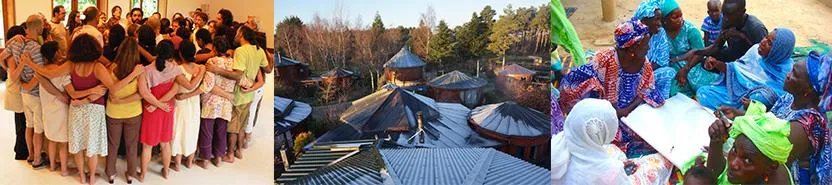
These groups are not just collections of individuals; they have common goals and objectives, membership rules, and a collective identity that, to some extent, determine the behaviour of the individuals. They share risk and they share benefits. Whether or not these aspects of group culture are made explicit, they influence us and affect our lives in countless ways.
It takes time for a group to build, consciously or unconsciously, all these elements. From its inception, a group evolves, experiences different stages of growth, works through the inevitable challenge of conflict, attains maturity, and achieves its full potential.
In its adulthood, a group discovers itself as a living organism, with each member fulfilling an important and necessary role. The organism is a complex and diverse network of relationships embodying trust, truth and love, as a pure expression of life made visible through its actions. In short, a mature group is a rich and diverse community of life. The mature community group values difference and diversity, appreciates the contribution of all its members, accepts tension and conflict as part of its own being, and acknowledges and celebrates the underlying unity from which all life emanates.
Building community is the process by which a group becomes aware of its own identity as a living collective unity and of the life spirit that sustains it. To build community is:
- to invoke the group spirit through a shared and clear vision;
- to take care of the group spirit through compassionate communication, empathy and assertiveness, generating trust and a pleasant work atmosphere;
- to sustain the group spirit through appropriate liberating structures, such as good decision-making methods and conflict engagement procedures;
- and to strengthen the group spirit through personal work to release fears and feelings of powerlessness, moving from reaction to creative participation with life.
Group dynamics
Humans have a natural tendency to join with others in groups. We seek out groups because they allow us to:
- Meet important needs such as inclusion (being part of and accepted by a group); intimacy or affection (experiencing warm, positive relations with others); and power (the ability to influence others).
- Attain certain goals and unfold shared dreams and visions, especially when they are ambitious, difficult or complex. Being part of a supportive group can enhance creativity and the capacity to express our deepest longings.
The processes that unfold within these groups (called group dynamics) leave an imprint both on their members and on society. Groups blur the boundary between the self and others, incorporating into the personal self characteristics borrowed from the collective. Groups transform the “me” into “we.” Or, to express it differently, they are the social spaces in which we are challenged to integrate a healthy expression of the individual “me” into a healthy collective “we.” The term “group dynamics” also describes the discipline devoted to the scientific analysis of these dynamics.
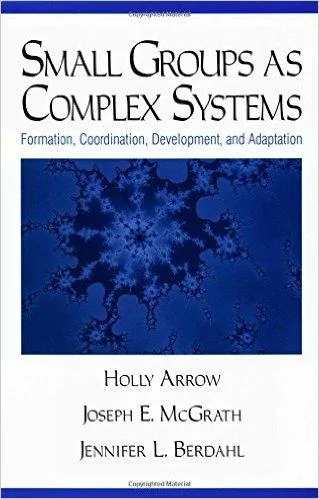
Groups vary in size from dyads (two people) and triads (three people) to very large groups, such as mobs and audiences, but all share some common characteristics. Existing research and theory about groups supports the following set of characteristics (Arrow, McGrath and Berdahl, 2000).
Groups serve more than one purpose or function. A group is far more than just a collection of its individual members. Groups:
- influence members’ attitudes, values and behaviours;
- pattern member interactions;
- can aid individual learning and self-fulfilment;
- process information, manage conflict and attain a consensus;
- motivate, regulate and coordinate member activities;
- have intentions and goals;
- carry out activities to attain these goals;
- mediate the connection between individuals and society.
Unlike networks, groups are systems with boundaries, but these boundaries are permeable, never completely isolated or closed. Spanning these boundaries, groups engage in continual two-way interchanges with their own members, with organisations, with communities, and with the physical and cultural environment.
Groups develop and change over time. They learn from previous experience and modify their activities. They also change as they adapt to changing conditions in the various contexts in which they work.
Because groups have many aspects which are non-linear, recursive and systemic (all hallmarks of complex systems), it seems appropriate to see groups as complex, dynamic and adaptive systems.
Stages in group evolution
Every group is a dynamic, a living entity in constant evolution. From its inception to its dissolution, every group forges its own path, partly predictable, partly unexpected.
Bruce Tuckman reviewed about fifty studies of group development in the mid-1960s and synthesised their commonalities in one of the most frequently cited models of group development (Tuckman, 1965). Tuckman’s model describes four linear stages (forming, storming, norming and performing) that a group will go through in its sequence of decision-making. A fifth stage (adjourning) was added in 1977 when a new set of studies was reviewed (Tuckman and Jensen, 1977).
1. Forming (formation, pseudocommunity)
Difficulties caused by the lack of experience generate different states of expectation, anxiety and some tension. These are easily overcome thanks to a general feeling of excitement and a strong wish to get along.
Group members learn about each other and the task at hand. Indicators of this stage might include unclear objectives, lack of involvement, uncommitted members, confusion, low morale, hidden feelings, and poor listening. One way to support groups that are forming is to act as a coordinator by facilitating the clarification of group goals and creating a shared vision (Manges et al., 2016).
2. Storming (conflict)
Once the initial excitement begins to fade, differences appear and conflict arises: misunderstandings, unmet needs, power struggles, and lack of clarity in goals or procedures. Conflict is necessary for the development process of a group. It forces us to know each other better and helps us to grow, individually and collectively. It is a great opportunity to learn about mutual respect and acknowledgement, about democracy and interdependence, and about what is most important to ourselves and others.
These characteristics mark the storming phase: lack of cohesion, subjectivity, hidden agendas, conflicts, confrontation, volatility, resentment, anger, inconsistency and failure. To contribute meaningfully to groups that are storming, one can build trust among group members and support them to explore and learn from conflict and tension (Manges et al., 2016).
3. Norming (organisation)
The group decides to learn to move creatively through conflicts, to make coherent decisions everyone can support, and to work cooperatively. Everybody is seen and valued as they are. Individual needs and group needs are accommodated better. Members are more aware of having a collective identity.
Group members establish implicit or explicit rules about how they will achieve their goal. They address the types of communication that will or will not help with the task. Indicators of this stage include questioning performance, reviewing and clarifying objectives, changing or confirming roles, opening risky issues, assertiveness, listening, testing new ground, and identifying strengths and weaknesses. A supportive strategy with groups that are norming and performing is to empower and help the team successfully implement and sustain projects (that is, allow for the transfer of leadership, seek feedback from staff, and set time aside for planning and engaging the team) (Manges et al., 2016).
4. Performing (community)
There is cohesion, interconnectedness, and relative harmony. Interpersonal relationships have a vibrant emotional quality. Productivity is high. The group works well in achieving its goals. Leadership is distributed among all members.
This process is by no means rigid or static. How the group experiences the process depends on the particularities of the group. External circumstances, such as the arrival of new members, a change in the social reality where the group lives, or political or economic uncertainties, can cause the group to regress from a stage of maturity to a previous stage of development, with renewed tensions and conflict.
Indicators of this stage include creativity, initiative, flexibility, open relationships, pride, concern for people, learning, confidence, high morale, and success (Manges et al., 2016).
5. Adjourning
As the group project ends, the group enters the adjournment phase and disbands. During the adjourning stage, sometimes those in leadership positions transition into a supporting role in order to expand the initiative, for example by creating future leadership opportunities for group members (Manges et al., 2016).
Groups as complex systems
Any system with three or more interacting variables is a complex dynamic system. In each human being, innumerable biological, psychological and physical variables interact constantly, so each of us is a complex system. Any group of human being-systems is also a complex dynamic system.
From this perspective, groups are complex, adaptive, dynamic systems made up of individual members. The members of the group are linked through relationships. Like all living systems, groups can be self-creating and self-organising systems (autopoietic systems). Groups may develop spontaneously as individuals begin to act in coordinated, synchronised ways. Just as all living systems receive input from the environment, process this information and resources internally, and then output their products, groups gather information, review that information, and generate products. Groups are also responsive to information about the context around them and their impact on that context, and will adapt in response to feedback.
As complex, adaptive and dynamic systems, groups:
- are nested open systems. Groups interact with the smaller systems (the members) embedded within them and the larger systems (for example organisations and communities) within which they are embedded.
- have fuzzy boundaries that both distinguish them from and connect them to their members and their different contexts.
- change their structure and behaviour over time. Change is driven in part by experience and history, and in part by the group’s response to events.
- contain feedback loops that create non-linear effects. Both negative (damping) and positive (amplifying) feedback are always found in groups and other complex systems. A small change in a variable that triggers a positive feedback loop can ultimately result in a big change at the global level.
- are shaped by unobservable, but influential, emergent properties. The group has capacities that individual members do not have on their own. Interactions between members are based on coordination: members in a group must adjust to one another interpersonally to coordinate goals, understanding and action. As a result of many cycles of interaction, patterns emerge that give rise to group-level properties and structures that define the dynamic of the group. Typical global variables in a group are written and unwritten norms that dictate behaviour, expectations about members’ roles, and networks of connections among the members (such as status, attraction and communication networks).
Peter Senge, in his book The Necessary Revolution (2008), points out: “Institutions matter. Today’s world is shaped not by individuals alone, but by the networks of businesses and governmental and non-governmental institutions that influence the products we make, the food we eat, the energy we use, and our responses to problems that arise from these systems.”
Some people believe that organisations can only function well, especially in times of crisis and chaos, by using command-and-control leadership and hierarchical structures. For Senge, however, “a sustainable world will only be possible by thinking differently, by learning how to see the larger systems of which individuals and organisations are part and to foster collaboration across every imaginable boundary. These core capabilities – seeing systems, collaborating across boundaries, and creating versus problem-solving – form the underpinnings, and ultimately the tools and methods, for this shift in thinking.” (Senge, 2008)
In Facilitating Organization Change: Lessons from Complexity Science (2001), Edwin Olson and Glenda Eoyang present a set of basic ideas for seeing communities and organisations as complex, adaptive systems. The most fundamental feature of a complex and adaptive system is self-organisation, the process by which an open system generates new structures and patterns based on its own internal dynamics. In self-organising systems, order doesn’t come from above or outside; it emerges from the interactions of the agents in the system. All living systems are capable of self-organisation, and our communities and organisations should also be self-organising.
Olson and Eoyang explain how, rather than focusing on the macro, strategic level of the organisation system, complexity theory suggests that the most powerful change processes occur at the micro level, where relationships, interaction and simple rules shape emerging patterns.
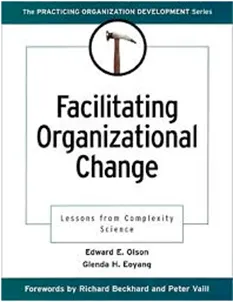
Three factors influence the patterns that emerge in a complex dynamic system, determining the sustainability of the system (Olson and Eoyang, 2001: 11–15):
- Container or boundary sets the bounds for the system. It holds the parts of the system together. Within the container, new relationships and structures form over time. The container may be physical, organisational or conceptual.
- Significant differences determine the primary patterns that emerge during self-organising processes. A difference between two agents may be reflected and reinforced by other agents in the system, generating a pattern.
- Transforming exchanges connect agents and create changes in the patterns around which the system organises itself. Information, money, energy or other resources flow from agent to agent, transforming each one and leading to the adaptability of the system.
“Organizations are not simply bodies, but dreaming bodies, physical entities moved by dreams as well as organizational structures, by emotions as well as spirits and money. The organization, together with its dreams and undercurrents, constitutes a field that is manifest in physical structures, human feelings, a particular atmosphere, and specific jobs and roles.” — Arnold Mindell
Understanding the I and the We with the Dynamic Spiral
What is the Dynamic Spiral?
The Dynamic Spiral is a conceptual model describing human and group development not as a linear ladder, but as a living, spiralling journey through distinct “levels of existence” or worldviews. Originating from the work of Clare Graves and expanded by Don Beck (Spiral Dynamics), it suggests that as individuals and groups face new challenges, they do not simply “add” new skills; they fundamentally shift their underlying values, fears, and ways of perceiving reality. Each “turn” of the spiral represents a more complex, inclusive and adaptive stage of consciousness, where the old way of being is preserved but integrated into a broader perspective.
In the context of a group, this spiral explains why a team might move from a chaotic, survival-based dynamic to a structured, rule-based one, and finally to a collaborative, value-driven system. It is a dynamic spiral because the group and its members constantly loop back to previous stages when under stress, while evolving towards higher levels of complexity when conditions allow.
The “I” as the seed of the “We”: understanding individual evolution to decode group balance
To grasp the balance of a group acting as a complex system, we must first understand the evolution of the individuals within it. According to the Spiral Dynamics model, human consciousness evolves through distinct “levels of existence”, each characterised by a specific set of values, fears, and ways of seeing the world. A group is not merely a collection of identical parts; it is an emergent system where the “We” is the sum of these diverse “I” evolutions.
If we ignore the individual developmental stage (whether driven by survival, security, achievement or community), we cannot understand why a group reacts to a crisis with panic, rigid control, or collaborative innovation. The balance of the “We” is therefore a mirror of the collective “I” evolution; a group can only function harmoniously if its organisational structure resonates with the current level of consciousness of its members.
Adaptive structures: why different groups need different organisations
Spiral Dynamics teaches us that there is no “one-size-fits-all” organisation. Just as an individual evolves through different stages (for example from a reactive “egocentric” stage to a proactive “sociocentric” stage), a group must adapt its organisation to match its current systemic complexity.
A group operating at a “Blue” (order and authority) level, for example, requires clear hierarchies and rules to feel safe, whereas a group at a “Green” (community and harmony) level thrives on consensus and flat structures. Attempting to impose a “Green” consensus model on a group still struggling with “Orange” (individual achievement) values will create friction and chaos, and vice versa.
In the context of youth participation, this means that a spontaneous youth action (often “Green” or “Yellow”) cannot be managed with the same rigid protocols as a formal youth council (often “Blue” or “Orange”). The dynamic spiral requires us to diagnose the group’s current stage and design an organisational form that supports its next step of evolution, rather than forcing it into a static mould.
The spiral internalised: every step as both an “I” and a group experience
Crucially, the dynamic spiral is not just an external process; every stage of evolution is internalised by both the individual and the group. The “I” carries the history of previous group stages within its own identity, while the group carries the collective memory of its past evolutions.
When a group transitions from a stage of conflict (storming) to one of cohesion (norming), the individuals don’t just change their behaviour; they internalise a new way of being in relation to others, which in turn reshapes the group’s DNA. Conversely, when the group evolves (for example by adopting a more inclusive decision-making process), it forces the individuals to expand their own “I” to accommodate this new reality.
This reciprocal loop means that the “I” and the “We” are inextricably linked: we cannot understand the group without the individual, and we cannot understand the individual without the group context. The spiral is the continuous, living process where both the “I” and the “We” co-create their future, constantly reshaping each other as they navigate the complexities of cooperation.
The levels of the Dynamic Spiral
The infographic “The Dynamic Spiral” summarises each level: when it appeared, a keyword, its core values, its worldview, how the individual exists within it, how decisions are made, a motto, and its estimated share of today’s world population. From the first level upwards:
- Survival (beige): appeared about 100,000 years ago. Keyword: survival clans. Values: survival instinct. Worldview: a place of instinctive survival. The individual: satisfaction of physiological and safety needs. Decisions: doing whatever it takes to stay alive, above all else. Motto: “Eat when you’re hungry.” About 0.1% of the world population.
- Fusion (purple): appeared about 50,000 years ago. Keyword: tribal orders. Values: security, matrix, indifferentiation, animism, tradition. Worldview: the security and collective warmth of the tribe or family, surrounded by a hostile environment. The individual: self-sacrifice for the survival of the group. Decisions: the knowledge of the ancients, traditions, customs. Motto: “Protect yourself, appease the spirits.” About 10% of the world population.
- Power (red): appeared about 10,000 years ago. Keyword: empires. Values: strength, conquest, exploration, power, self-assertion, courage. Worldview: the strongest wins and survives, no matter what. The individual: expresses their impulses without guilt (“I do what I want, when I want”). Decisions: the strongest imposes their decisions on others. Motto: “Privileges for the victorious.” About 20% of the world population.
- Normative (blue): appeared about 5,000 years ago. Keyword: pyramid. Values: rules, obedience, absolutes, order, hierarchy. Worldview: an absolute vision (good and evil) where everything has a predefined place and must stay there. The individual: “I sacrifice myself today to gain satisfaction later.” Decisions: the highest status decides for the entire system. Motto: “The righteous will be rewarded.” About 40% of the world population.
- Rational individualist (orange): appeared about 300 years ago. Keyword: opportunity. Values: competence, efficiency, strategy, competition, science. Worldview: a vast playground filled with individual opportunities. The individual: self-expression with strategy, to satisfy individual needs. Decisions: contract, partnership, mutual interest, universal suffrage. Motto: “Each individual acts for their own prosperity.” About 30% of the world population.
- Empathic pluralist (green): appeared about 100 years ago. Keyword: equality. Values: empathy, cooperation, harmony, inner life. Worldview: a place where everyone must be respected for who they are and what they feel. The individual: sacrifice of self now, so that later I may achieve harmony with myself and others. Decisions: everyone must be able to live what they feel within caring environments; consensus. Motto: “Everyone is right.” About 10% of the world population.
- Integrative (yellow): appeared about 50 years ago. Keyword: interaction. Values: systemic approach, integration of paradoxes, relational and organisational flexibility, fluidity. Worldview: a complex dynamic system. The individual: expression of self, but not at the expense of others, so that life may be natural and functional. Decisions: choice of life principles and permanent readjustment; decision by consent. Motto: “Acting consciously according to the situation.” About 1% of the world population.
- Holistic (turquoise): appeared perhaps 10 years ago. Keyword: network. Values: confidence, abundance, intuition, nuance, uncertainty, experimentation, dynamism, the quantum, spirituality, communion. Worldview: a network of interdependent components forming one large organism. The individual: “I am one with the Earth, the universe, and all that exists.” Decisions: connected unanimity; management by tension. Motto: “Sacrificing, if necessary, self and others for the good of all life, present and future.” Share of the world population unknown.
The infographic ends with a question mark: a possible next level, “Coral?”, is still to come.
Summary of the infographic “The Dynamic Spiral” by Tatoudi (version 2.0, May 2021, licensed CC BY-NC-SA), the English version of “La spirale dynamique” by Matthieu Van Niel (version 1.0, May 2017, licensed CC BY-SA). Dates and population shares are the infographic’s own estimates.
Spiral Dynamics explained: a video introduction to the model behind the Dynamic Spiral.
Building community and embracing diversity
All of life (humans, animals and other living beings) has an intrinsic, equal value. Having intrinsic value means they are worthy of being here and have a role to play simply for being who they are, an expression of life. We have come to look at most of life, and even many human beings, simply in terms of “instrumental value” (how they serve us to meet a need or a goal). This mistaken attitude is one of the roots of an unsustainable world and the multiple converging crises humanity is facing.
Communities focus on the idea of “unity in diversity”, which combines the growth of strong individuals with the ability to synergise everyone’s unique gifts, so that dreams may be realised together. In order to arrive at synergy (where the resulting whole is more than the sum of its parts), we need to bring out the best in one another. We need to be as curious about the needs, visions and talents of others as we are about our own. We need to practise the art of rejoicing in the beauty of others. In a community, every being has its unique place and task. As in nature, every part of a living organism is interconnected and communicating with all the other parts.
Although diversity is a source of inspiration and enrichment for every group, it is not always easy to embrace. When diversity is perceived as a threat, our tendency is to suppress it. Racism, sexism, homophobia, ideological or religious fundamentalism, economic exploitation, child abuse, and neglect of elders and people with disabilities are enactments of privilege that all too easily appear; disguising our fears, we blame someone else. A strong and diverse community needs awareness to confront oppression and exclusion, and an active attitude that encourages and nurtures all voices.
Today, as monoculture increasingly narrows the diversity of species, we need to appreciate our differences as treasures of experience and wisdom to draw upon. Sharing in circles, we symbolise the manifold rays of expression and viewpoints that can be held while focusing on the same goal. Everyone potentially holds a part of the greater truth. If we learn to access collective intelligence and unlock the collaborative advantage of sharing and solidarity, we can re-inhabit a world of abundance (Wahl, 2016).
Throughout history, we have used our ethnic, religious and cultural identities to separate ourselves from others. We have created cultural narratives of separation that in turn have alienated us from the wider community of life. This alienation has driven us to create cultures of control and manipulation (“power over”), as we came to see the world as a place of scarcity and therefore of competition for limited resources.
There is, however, another way: the path of community that recognises our fundamental interconnectedness and interdependence. With the new and ancient story that is (re)emerging as multiple versions of the underlying narrative of interbeing, we are learning to embrace diversity as life’s treasure of abundance, vitality and resilience, rather than seeing it as a source of conflict or as a reason for top-down control.
This is the foundation of social justice issues, which need to be at the centre of community development of any kind, but especially where there is a tradition of injustice and segregation. In urban areas with high-density populations it is common to find groups separated by their social identity, core beliefs or ethnic origins. In cities around the world, people live in neighbourhoods with a specific identity and a specific group mind. These pose serious challenges to urban development and cohesion, and can make it difficult for residents to participate in local government and governance beyond the neighbourhood community.
But it is exactly at this level that policies and public funds are worked out and decided on, and this affects what happens in public spaces such as streets, pavements, vacant lots, schools, parks and a number of common areas that need good administration, wisdom and flexibility.
By taking an activist approach to these issues, ecovillagers, transition town groups or conscious citizens who aim to contribute intentionally to their community’s thriving can act to interrupt oppression, challenge racist or sexist attitudes, and generally defend target groups and individuals, even when they cannot defend themselves. With empowered individuals, we can then build bridges of wellbeing and experience the transformative power of collective constructive action and solidarity.
We will examine power, privilege and oppression in greater depth in Module 3.
Community and group dynamics
Your progress is saved in this browser. Register to save it on every device.
Text © IN.PACT partnership, shared under CC BY-SA 4.0. Images, videos and quoted works belong to their authors and are not covered by this licence unless stated.