Lesson 4 · Module 1
Reflective and mindfulness practices
Reconnect self and world through deep ecology, the Cosmic Walk, council and the Work that Reconnects, and build simple daily habits of mindfulness and gratitude.
Reflective and mindfulness practices are essential for facilitators to enhance self-awareness, empathy and emotional regulation. These skills enable facilitators to remain neutral, present and attuned to group dynamics, fostering an environment where participants feel safe to express vulnerabilities and differing perspectives. Incorporating guided meditations or reflection moments at the start or end of sessions helps participants centre themselves, deepens group connection, and improves focus and retention. More importantly, facilitators who practise mindfulness and reflection themselves are better equipped to guide others through meaningful, transformative processes.
Introduction: nature as a guide and teacher
“If you do not rest upon the good foundations of nature, you will labour with little honour and less profit. Those who take for their standard anyone but nature – the mistress of all masters – weary themselves in vain.” — Leonardo da Vinci (1452–1519)
The dominant Western, rational, scientific worldview, with its mechanistic metaphors and focus on quantitative analysis, has had some far-reaching consequences. The most influential side-effect has been the so-called Cartesian split: the separation of self and world, humanity and nature, mind and body, consciousness and matter into sets of dualistic and mutually exclusive categories.
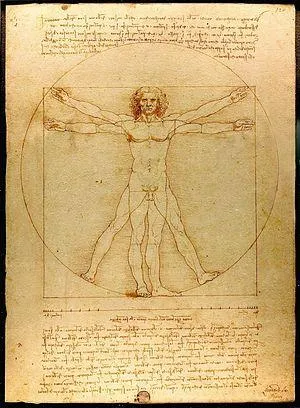
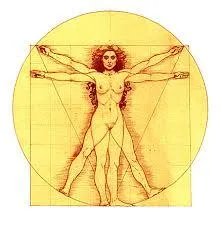
The Vitruvian Man is a drawing created by Leonardo da Vinci around 1487. It represents a cornerstone of Leonardo’s attempts to relate man (humanity) to nature. The Vitruvian Woman is an artistic new version of it.
Every perspective, no matter how useful and detailed in evidence, is only a partial perspective and creates its own blind spots and side-effects, caused by what the particular worldview focuses on and what it ignores. The blind spot of the currently dominant Western worldview is that it ignored for far too long the deep participatory connection between nature and humanity, and our dependence on Nature’s life support system. Many aspects of the current crisis of unsustainability have been caused by a lack of acknowledgement of our deep interdependence with the wider community of life. We would have done well to take Leonardo da Vinci’s advice and become humble apprentices of Nature, rather than try to predict, manipulate and control natural processes for our short-term benefit and to the long-term detriment of future generations and life on Earth.
Learning to listen to and learn from the natural world, and reconnecting humanity with the wider community of life that our future depends on, lies at the very heart of the transition to a more sustainable human presence on Earth. This will require at the same time a technical, social, economic and spiritual reworking of almost everything we do. The journey is a ‘coming home’, based not on a return to some golden past that never existed, but on the synthesis of traditional Indigenous wisdom with the best of modern science and the modern worldview. In Coming Home: The Birth and Transformation of the Planetary Era, Sean M. Kelly suggests:
“A truly planetary wisdom must recognize the nobility as well as the shadow of the Old Paradigm, or to borrow Wilber’s helpful distinction, it must honour its ‘dignity’ along with its ‘disaster’. If we think in terms of the three phases of the larger arc – the premodern (mythic, and in this case biblical), the modern (secular-scientific), and the planetary – it is clear that any proposal for planetary wisdom must honour and integrate the hard-won accomplishments of modernity.” — Sean M. Kelly (2010, p. 132)
You may ask what this has to do with community facilitation. It is not obvious on the surface, but our connection to and with nature, and acting as nature, has profound implications for how we relate to and work with other people. Exploring and reflecting more deeply, and using practices of nature connection, can provide powerful and empowering approaches, tools and practices for creating truly participatory and co-creative spaces for change and transformation, with nature as a guide and teacher.
In this topic, we will first look at how the insights of modern science can help us reconnect with nature in a new way, by acknowledging the interconnected nature and interdependence of self and world. We will then explore a small selection of useful practices (and there are many more) that can help us to listen more deeply to nature and to what we can learn from her for our work and community, in order to design with nature and co-create a more sustainable human presence in the world. It is a way of forging a group together by looking at ‘reality’ from different perspectives and taking different approaches to deeper, connective ways of being and being together.
Self and world
“It is true that anything I can see is not the real Seer – because everything I see is the Seer. As I go within to find my real self, I find only the world … the real self within is actually the real world without. The subject and the object, the inside and the outside are and always have been one. There is no primary boundary. The world is my body, and what I am looking out of is what I am looking at. The real self resides neither within nor without because subject and object are actually not-two.” — Ken Wilber (1979)
How exactly we understand and explain the relationship between ‘self’ and ‘world’ lies at the heart of any worldview. The whole, whether you call it the Kosmos, the universe or pure consciousness, has no direct means of perceiving itself from outside (since it is the whole, the all, and there is nothing outside it). We therefore need the first distinction, the first differentiation of the whole, in order to create a perspective from which that totality can be experienced. This separation creates the possibility for the self to emerge. It brings into being a conscious participant-observer who can experience the whole in all its magnificence.
The blind spot of the modern worldview has been to assume that, because of this distinction, the self has to be an ‘other’, something separate from that whole, rather than a co-creative participant in the creative unfolding of that whole. The distinction can be based on inclusion just as well as on exclusion. This may all sound very philosophical and theoretical.
In exploring the relationship between self and world, we are also exploring the relationship between humanity and nature, between mind and body, and between consciousness and matter. As we saw in the first lesson of this module, modern science and ancient wisdom are beginning to converge on a new kind of understanding that regards these dualistic categories not as mutually exclusive but as fundamentally interconnected and interdependent.
“The major problems in the world are the result of the difference between how nature works and the way people think.” — Gregory Bateson
Gregory Bateson viewed the three systems of the individual, society and ecosystem as together part of one supreme cybernetic system, the Mind, that controls everything, instead of just interacting systems.
The biologist, anthropologist and co-founder of cybernetics Gregory Bateson was one of the first to begin the scientific dialogue about the relationship between ‘self and world’ and ‘mind and body’. In the mid-1950s Bateson wrote: “The individual nexus of pathways which I call ‘me’ is no longer so precious because that nexus is only part of a larger mind.” Bateson warned (for more, see his book Steps to an Ecology of Mind or the film An Ecology of Mind by his daughter Nora Bateson):
“This false reification of the self is basic to the planetary ecological crisis in which we find ourselves. We have imagined that we are a unit of survival and have to see to our own survival, and we imagined that the unit of survival is the separate species, where as in reality through the history of evolution, it is the individual plus the environment, the species plus the environment, for they are essentially symbiotic.” — Gregory Bateson (in Macy, 1994)
To overcome the planetary crisis of perception, which lies at the core of the environmental, economic and social crises of today, we have to overcome, individually and collectively, the pervasive illusion of our ‘self’ being separate from the entirety of existence. It is now possible to integrate some of the central insights of modern Earth system science, physics, ecology and neuroscience to tell a scientifically informed story about who we are as participants in an expanding and transforming universe and a living, self-regulating planet Earth. Such a reintegration is deeply necessary at the beginning of the planetary era. It will help us to create a more sustainable human presence on Earth, to honour the value of scientific and spiritual perspectives alike, and to create a new sense of place and sense of belonging for humanity. John Seed, one of the co-founders of the deep ecology movement and of the Rainforest Information Centre, has said it beautifully:
“Through thousands of years of anthropocentric conditioning, absorbed by osmosis since the day we were born, we have inherited shallow, fictitious selves, and have created an incredibly pervasive illusion of separation from nature. … As long as the environment is ‘out there,’ we may leave it to some special interest group like environmentalists to protect while we look after our ‘selves.’ The matter changes when we deeply realize that the nature ‘out there’ and the nature ‘in here’ are one and the same, that the sense of separation no matter how pervasive is nonetheless totally illusory. I would call the need for such realisation the central psychological or spiritual challenge of our age.” — John Seed (1993)
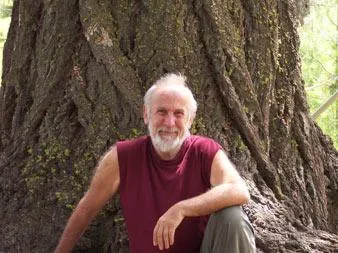
The Rainforest Information Centre (RIC) was born out of the successful struggle to save the subtropical rainforests of New South Wales, Australia, in 1981. Since then it has been involved in campaigns and projects which protect rainforests and at the same time recognise the legitimate development aspirations of rainforest peoples.
Deep ecology
The philosopher Arne Næss suggests: “We may be in, of, and for nature from our very beginning.” He argues: “Society and human relations are important, but our self is richer in its constituent relations. These relations are not only relations we have with humans and the human community, but with the larger community of all living beings” (Naess, 1988, p. 20). Along with John Seed, Joanna Macy and Pat Fleming, Arne Næss is regarded as the originator of the deep ecology movement. The conceptual and perceptual expansion of the self beyond the skin boundary, to experience and understand ourselves as a relational self or ‘ecological self’, is a central theme in deep ecology.
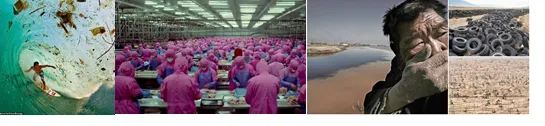
As early as the 1970s, Arne Næss saw two different forms of environmentalism that were not necessarily incompatible with each other, but very distinct in the solutions they proposed. One he called the ‘long-range deep ecology movement’ and the other the ‘shallow ecology movement’. The word ‘deep’ referred in part to the level of questioning of our purposes and values with regard to environmental issues. The deep ecology movement engages in deep questioning, right down to fundamental root causes, whereas the more shallow and short-term approaches to the environmental crisis stop before effecting fundamental change, often promoting technological fixes that are based on the same consumption-oriented values and methods as the industrial economy. The deep ecology approach calls for a redesign of all human-made systems based on values and methods that truly preserve the ecological and cultural diversity of natural systems. Together with George Sessions, Arne Næss proposed a set of basic assumptions or attitudes shared by people in the deep ecology movement, and called this list the Deep Ecology Platform. More than just a platform for a movement, it is also a call to ethically congruent action.
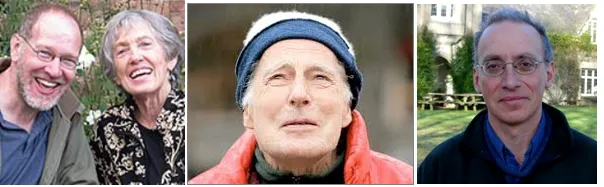
Arne Næss was a Norwegian philosopher who inspired the deep ecology movement. Other key people who have promoted deep ecology work around the world include Joanna Macy and Chris Johnstone, and Stephan Harding.
The Deep Ecology Platform
Source: Foundation for Deep Ecology.
- The well-being and flourishing of human and non-human life on Earth have value in themselves (synonyms: inherent worth; intrinsic value; inherent value). These values are independent of the usefulness of the non-human world for human purposes.
- Richness and diversity of life forms contribute to the realisation of these values and are also values in themselves.
- Humans have no right to reduce this richness and diversity except to satisfy vital needs.
- Present human interference with the non-human world is excessive, and the situation is rapidly worsening.
- The flourishing of human life and cultures is compatible with a substantial decrease of the human population. The flourishing of non-human life requires such a decrease.
- Policies must therefore be changed. The changes in policies affect basic economic, technological and ideological structures. The resulting state of affairs will be deeply different from the present.
- The ideological change is mainly that of appreciating life quality (dwelling in situations of inherent worth) rather than adhering to an increasingly higher standard of living. There will be a profound awareness of the difference between big and great.
- Those who subscribe to the foregoing points have an obligation directly or indirectly to participate in the attempt to implement the necessary changes.
The Cosmic Walk
“At all times and cultures, human beings have used rituals to help us remember who we are. Through ritual, we re-enact our place in the cosmos. It is the human vehicle for encounters with the numinous. It offers a tried and tested containment for that meeting, a means to lose ourselves and yet return safely to the everyday world afterward.” — Alex Wildwood
According to the best current estimates, the universe is approximately fourteen thousand million (14,000,000,000) years old. It is impossible for human beings to experience or even adequately imagine such vast stretches of time. To tell the story of the universe only in words would not even begin to create an impression of the immense periods of time involved in the formation of galaxies, the life and death of stars, or the evolutionary history of life on planet Earth.
The Cosmic Walk is a ritual initially created by Sister Miriam MacGillis at Genesis Farm in the United States. It has subsequently been modified and facilitated by many people around the world. The walk stretches over a distance of 1,400 metres. Done in a mindful way, it takes about one and a half hours to complete. Since the universe is believed to be 14 billion years old, each metre of the Cosmic Walk equals 10 million years of the history of our universe. Taking half-metre steps, each step you take during this ritual of walking our cosmic history will represent 5 million years. The Cosmic Walk is a way of bringing the awareness of the unfolding Universe from our heads into our bodies and into our hearts. Every atom that makes up your body was there at the beginning of time, and has taken part in 14 billion years of cosmic creativity, only to express that creativity, today and now, as the unique being that you are. We are stardust!
“The cosmic time walk has the potential to become a beautiful ritual for everyone on the planet, not only binding all humanity and all life on Earth, but the whole universe into a glorious celebration. Reminding us of our common roots and affirming us in the present. Energizing us, liberating us, and offering new life. It is a powerful context for identifying and addressing fundamental issues of the future, whether social, personal, governmental or spiritual.” — Erna and Michael Colebrook (2003)
There are a number of exciting versions of the universe walk, the Cosmic Walk or the walk through time available in book format or on the internet. Erna and Michael Colebrook, from the GreenSpirit movement in the UK, have written a wonderful e-book available for free download, entitled Walking the Sacred Story: A Ritual for Celebrating the Universe, which gives a 31-stage account of the universe story from the big bang to now.
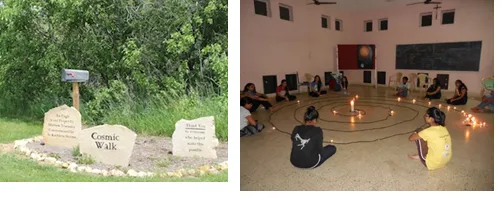
There is another version in a book by Elisabet Sahtouris called A Walk Through Time: From Stardust to Us – The Evolution of Life on Earth, and there are a number of shorter versions available on the web. Each one of them has the potential to facilitate a profound and revelatory experience when engaged with as a ritual of cosmic connection for the third millennium.
Erna and Michael Colebrook argue that “when we ground our higher awareness in an ecological and cosmological context a number of things happen to us”:
- We rediscover a sense of awe and wonder for the time and space dimensions of the universe.
- We rediscover a sense of oneness with all creation through the process of evolutionary remembering. Rediscovering our ecological selfhood redirects our consciousness and liberates our psychic energies. The strength and wisdom of the living Earth in all its manifestations flows through us again. This enables us to make choices to help liberate nature and restore the equilibrium of our home, planet Earth. By liberating nature we liberate ourselves and recover our sense of belonging.
- We realise that we are the means by which the universe has become conscious of itself.
The Deep Time Walk
Building on the process of the Cosmic Walk, Stephan Harding and others have developed a guided and scripted 4.6-kilometre walk to explore and experience the 4.6 billion years of the evolution of our planet Earth and the evolution of life from its beginning. It is a journey back in time, via a transformative walking experience, that leads participants into a profound connection with the more-than-human world.
Deep Time Walks can be done independently using the Deep Time Walk app, or as a guided walk led by a Deep Time Walk facilitator, using deep time scripts, deep time cards, timelines and other tools to bring the geological and biological evolution of Gaia to life as a lived experience. There are Deep Time Walk facilitators in many countries. More information can be found on the Deep Time Walk website and in the Deep Time Walk Community.
Deep listening
“What we most need to do is to hear within us the sound of the Earth crying.” — Thich Nhat Hanh
If we want to create a culture of fairness, inclusion and sustainability, one of the first things we have to learn is to listen more deeply:
- Listen more deeply to our own intuition and that inner voice of wisdom and guidance that will speak to us if we quieten our mind in meditation, or seek solitude in nature with a clear question in our hearts.
- Listen more deeply to the wisdom of many minds: the stories and gifts that our community and our friends have to share with us when we sit in council and offer the gift of attention and heart-full listening to others.
- Listen more deeply to the wisdom that Nature offers us when we pay attention to the diverse and surprising ways in which she can speak to us, if we are open to receiving. Deep listening lies at the heart of creating a culture of sustainability.
In this section, we will explore a number of ways in which we can learn to listen more deeply: to ourselves, to our collective wisdom and intelligence, and to Nature as the teacher within us and around us. The multiple converging crises we observe in the world are a sign that, as a species, we have lost the path that nurtures all of life. We need to listen deeply in order to find it again.
Lost
Stand still. The trees ahead and bushes beside you
Are not lost. Wherever you are is called Here,
And you must treat it as a powerful stranger,
Must ask permission to know it and be known.
The forest breathes. Listen. It answers,
I have made this place around you,
If you leave it you may come back again, saying Here.
No two trees are the same to Raven.
No two branches are the same to Wren.
If what a tree or a bush does is lost on you,
You are surely lost. Stand still. The forest knows
Where you are. You must let it find you.— David Wagoner
The Way of Council
“Ultimately, it is difficult to write about what happens in Council. As is true for other timeless ceremonial forms that are still actively evolving, Council works its magic in mysterious ways. For example, we remember the experience of being with ‘the ancestors’ and the ‘yet unborn,’ during the same Council. Current time dissolved and we had the distinct feeling of being nourished with the wisdom of an ancient circle of elders gathered to make an important tribal decision. Then, a little later we saw clearly that, by our further evolving the practice of listening and speaking from the heart, the future of Council was being seeded for those not yet born who would follow us. The feeling of interdependence of the circle was visceral and carried with it a sense of our inseparable connection with both past and future. The Council seemed to have an evolutionary life of its own – a life whose presence we felt palpably at the time, even though describing it now eludes our powers of articulation.” — Gigi Coyle and Jack Zimmerman
Council is an ancient way and a modern practice, deeply rooted in the natural world and spanning many cultures and religions. Here we listen to the whole: the people and the place, earth, water, fire, air, the life spirit in all. This practice elicits an experience of true community, recognising that each voice needs to be heard and that every person has a gift, a story to share, a piece of the whole. Council offers a way of communicating that encourages attentive listening, as well as honest and compassionate expression. It makes room for new insights and understandings, wisdom in decision-making, and the healing of differences. More than a communication tool, council allows us to access collective intelligence and group wisdom, offering a way, both new and ancient, of guiding collaborative processes.
The Way of Council offers a synthesis of our contemporary understanding of group dynamics with ancient forms of communication that have been practised in Western, Eastern, Hawaiian and Native American cultures for many millennia. For as long as we can call ourselves ‘human’, our ancestors have spent time sitting in a circle around a fireplace sharing stories, wisdom and revelations. Council is a non-hierarchical form of deep communication where each person is empowered to speak. Its primary intentions, listening and speaking from the heart, encourage genuine self-disclosure and attentive, empathic listening.
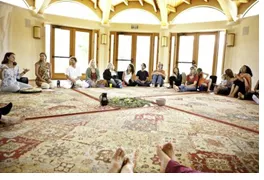
In its most basic form, the practice of council is simple. People sit in a circle. This creates a sense of equality. The council guides, or facilitators, are also participants in the council. A ‘talking piece’ is passed from person to person around the circle and, one at a time, people speak from the heart while everybody else gives them the gift of their undivided attention, listening deeply from the heart.
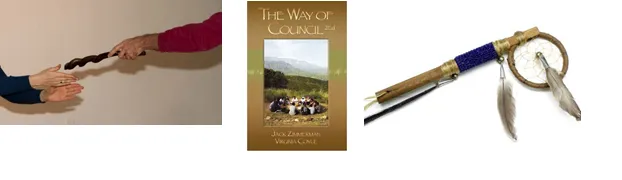
The quality of deep listening extended by everyone in the circle to the person holding the talking stick contributes to creating a container of deep trust and openness. This enables people to share deeply from the heart, and often they find themselves expressing a quality of insight and wisdom that they did not know they had. In these magical moments, people speak from a place that is deeply nourished by the collective intelligence and wisdom of the whole group. Council encourages participants to speak from their own experience, making ‘I’ statements rather than speaking in generalities for others. As the practice deepens, participants achieve greater tolerance for different perspectives and a greater understanding of the feelings of others. Council can help us develop our ability to mediate conflict nonviolently. It offers a simple but powerful contribution to the creation of a culture of peace and understanding.
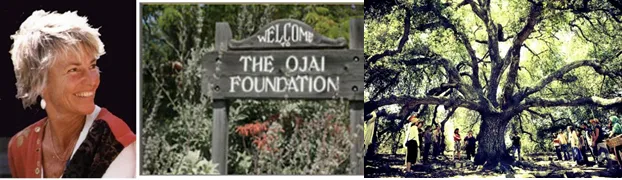
The mission of the Ojai Foundation (now Topa Institute) is fostering practices that awaken connection with self, others and the natural world. Gigi Coyle is a global activist spreading the Ways of Council. She co-created the Ojai Foundation with Joan Halifax.
One of the places that have contributed significantly to promoting and sharing the practice of council, both in their own region and internationally, is the Ojai Foundation (now Topa Institute) in California. In the past the Ojai Foundation brought council to schools, hospitals, prisons and the boardrooms of major companies. It has served many community leaders by sharing the practice of council with them and offering training programmes to deepen this practice. Jack Zimmerman and Virginia (Gigi) Coyle have provided an excellent resource for exploring the many different forms and applications of council in their book The Way of Council. In recent years some of the elders of the Ojai Foundation have helped to train a series of council trainers in Europe and Israel, leading to the creation of the European Council Network.
“The Quality of our Work flows from the Quality of our Relationships.
The Quality of our Relationships flows from the Quality of our Communication,
The Quality of our Communication flows from the Integration of our Mind, Heart, Body, Spirit.” — Marlow Hotchkiss
See more at Ways of Council and The Circle Way.
The Work that Reconnects
“It is my experience that the world itself has a role to play in our liberation. Its very pressures, pains, and risks can wake us up – release us from the bonds of ego and guide us home to our vast, true nature.” — Joanna Macy, in World as Lover, World as Self (2007, p. 23)
Forty years as an activist in the peace, justice and environmental movements, combined with a background in Buddhism, systems theory and deep ecology, made Joanna Macy a powerful force for positive change. She has touched the hearts and minds of thousands. The methodology she developed through the Work That Reconnects is one of the most powerful tools for personal transformation, empowerment, and the creation of active change agents in what Joanna has called the Great Turning: the transition from the current industrial growth society to a life-sustaining society.
The Work That Reconnects began in the 1970s and was developed out of Joanna’s ‘Despair and Empowerment’ workshops, offered as a way to acknowledge the feelings related to the real possibility of a nuclear war between the power blocs. The Work That Reconnects reminds us of our intimate connection with the web of life and our authority to take action on its behalf. Over forty years, Joanna and many of the people she helped to train as facilitators have offered this work to many thousands of people around the globe, helping them to find insight, solidarity and courage to act, despite rapidly worsening conditions.
Joanna based the work on her deep understanding of Buddhist dharma teachings and her background in systems theory. Together with Arne Næss and John Seed, Joanna helped to start the deep ecology movement. The Work That Reconnects shares the Deep Ecology Platform we explored earlier. In the book Coming Back to Life: Practices to Reconnect Our Lives, Our World, Joanna and Molly Young Brown share a treasure trove of exercises and practices that make up the Work That Reconnects.
Based on systems theory, spiritual teachings and deep ecology, the methods of the Work That Reconnects are described in Coming Back to Life, the book Joanna Macy wrote with Molly Young Brown.
“Gratitude for the gift of life is the primary wellspring of all religions… the source of all true art. Yet we so easily take this gift for granted. That is why so many spiritual traditions begin with thanksgiving, to remind us that for all our woes and worries, our existence itself is an unearned benefaction, which we could never of ourselves create.” — Joanna Macy
Joanna Macy and David Korten (author of The Great Turning: From Empire to Earth Community) have written in depth about the Great Turning, “a name for the essential adventure of our time: the shift from the industrial growth society to a life-sustaining civilization” (Joanna Macy).
According to Joanna: “The central purpose of the Work that Reconnects is to help people uncover and experience their innate connections with each other and with the systemic, self-healing powers in the web of life, so that they may be enlivened and motivated to play their part in creating a sustainable civilization. In order to do this, we pursue these contributing goals:
- to provide people the opportunity to experience and share with others their innermost responses to the present condition of our world;
- to reframe their pain for the world as evidence of their interconnectedness in the web of life, and hence of their power to take part in its healing;
- to provide people with concepts – from systems science, deep ecology, or spiritual traditions – that illumine this power, along with exercises that reveal its play in their own lives;
- to provide methods by which people can experience their interdependence with, their responsibility for life;
- to connect people with the inspiration they can draw from past and future generations, and other life-forms;
- to enable people to embrace the Great Turning as a challenge which they are fully capable of meeting in a variety of ways, and as a privilege in which they can take joy;
- to bring people into mutual support and collaboration in working for the world.”
Joanna Macy based the Work That Reconnects on two fundamental assumptions:
- “This world, in which we are born and take our being, is alive. It is not our supply house and sewer; it is our larger body. The intelligence that evolved us from stardust and interconnects us with all beings is sufficient for the healing of our Earth community if we align with that purpose.
- Our true nature is far more ancient and encompassing than the separate self defined by habit and society. We are as intrinsic to our living world as the rivers and trees, woven of the same intricate flows of matter/energy and mind. Having evolved us into self-reflexive consciousness, the world can now know itself through us, behold its own majesty, tell its own stories – and also respond to its own suffering.”
The four phases of the spiral of the Work That Reconnects (start with gratitude!):
- Coming from gratitude
- Honouring our pain for the world
- Seeing with new eyes
- Going forth
This work can be accessed through workshops and seminars (some of them online) of different types and durations in many countries around the world, through an extensive facilitator network that can be found on the Work That Reconnects website, where many resources on this work are also available (sometimes running under different names, but related to deep ecology). The basics are summarised in the following short video.
Joanna Macy on the spiral of the Work That Reconnects.
Mindfulness and gratitude
This section is taken or adapted from the Erasmus+ BurnOut project and from trainings developed by Mundus.
What is mindfulness?
Mindfulness is a mental training. Its main goal is to create attention and metacognition: to think about what I think. This helps us to take more objective decisions and moderate our reactions (Sevilla, 2025).
It is a practice of maintaining a non-judgemental, moment-to-moment awareness of one’s thoughts, emotions, bodily sensations and surrounding environment.
Rooted in ancient meditation traditions, mindfulness involves focusing attention intentionally while accepting and acknowledging feelings, thoughts and bodily states without becoming overwhelmed or reactive.
Key elements of mindfulness
- Present-moment awareness: fully engaging with the current experience without distractions from past or future concerns.
- Non-judgemental observation: accepting thoughts and emotions as they are without labelling them as good or bad.
- Intentional focus: directing attention purposefully, often through practices such as breathing exercises, body scans or meditation.
- Compassion and self-acceptance: cultivating kindness towards oneself and others as part of the practice.
Benefits of mindfulness
- Emotional regulation: reduces stress, anxiety and emotional reactivity.
- Improved focus: enhances concentration and decision-making.
- Physical health: lowers blood pressure, improves sleep, and reduces symptoms of chronic conditions.
- Social benefits: encourages empathy, compassion and healthier relationships.
Examples of mindfulness techniques
- Body scan meditation (know more)
- Focused breathing exercises
- Practising gratitude to shift focus to positive aspects
A neuroscientist explains how breathing affects the brain.
A five-minute body scan meditation.
Other activities: start your day with a mindful morning routine and begin your day with presence, not pressure.
For more, try the guided audio meditations and mindfulness videos from the UMass Memorial Health Center for Mindfulness.
The role of gratitude in well-being
Gratitude is the practice of recognising and appreciating the good in life. It:
- improves mental and physical health;
- enhances relationships and social connections;
- increases overall life satisfaction.
Reflective and mindfulness practices
Your progress is saved in this browser. Register to save it on every device.
Text © IN.PACT partnership, shared under CC BY-SA 4.0. Images, videos and quoted works belong to their authors and are not covered by this licence unless stated.