Lesson 3 · Module 2
Systems mapping and sensemaking
Map the living systems of your place through a bioregional lens, and explore Theory U, World Café, design thinking and other methods that help groups make sense of change.
Systems mapping serves as a foundational tool in facilitation. Here our focus is on mapping systems through a place-based, bioregional lens, enabling groups to visualise complex systems by identifying key actors, relationships, feedback loops and dynamics.
Sensemaking, particularly through frameworks like Weick’s theory and Brenda Dervin’s Sensemaking Theory, emphasises that individuals and groups actively interpret ambiguous contexts to create meaning.
Theory U, developed by Otto Scharmer, integrates sensemaking with presencing: deep listening and future-oriented inquiry. It guides facilitators in helping groups access emerging futures by suspending judgement, observing deeply, and co-creating solutions. The U-process (sensing, presencing, crystallising, prototyping and implementing) is a structured approach to facilitation that supports systemic change, and is part of a wider toolbox for co-creative and collaborative facilitation.
Design thinking enhances facilitation by embedding creative problem-solving into the sensemaking journey. It emphasises empathy, prototyping and iteration, using tools like journey mapping, concept mapping and visual modelling to externalise thinking.
Together, these approaches give facilitators a robust toolkit: systems mapping structures complexity, sensemaking gives it meaning, Theory U deepens presence and future orientation, and design thinking drives actionable innovation. This makes them essential for navigating ambiguity in strategic, cross-functional or transformational projects.
Ways to co-create our future
“Another world is not only possible, she is on her way. On a quiet day, I can hear her breathing.” — Arundhati Roy
“The future belongs to those who believe in the beauty of their dreams.” — Eleanor Roosevelt
Once we understand that we live in a world where everything is connected to everything else, where small actions can have far-reaching consequences, where every day we cannot but affect the future of all life on Earth by the way we live our lives today; once we have understood this powerful reality of interconnectedness and interdependence as a fundamental property of an expanding, transforming and evolving universe, we become conscious of our own power and responsibility to co-design and co-create a healthier, more just and more sustainable future for all.
It is in fact impossible to live your life and not affect the future of all there is in some way or another. This is the nature of interconnectedness, whether we are conscious or unaware of our co-creative agency as participants in, and part of, the natural process. This awareness of our co-creative agency in this world is based on a shift in worldview: from the mechanistic, reductionist paradigm of the “objective” observer to the organismic, holistic paradigm of the subjective participant. While the former can make us feel like a helpless “cog in a big machine”, unable to affect anything in the big “system” out there, the latter returns to us the co-creative power and responsibility that is our birthright as participants in and expressions of a living, conscious and creative universe.
“Carefully watch your thoughts, for they become your words. Manage and watch your words, for they will become your actions. Consider and judge your actions, for they become your habits. Acknowledge and watch your habits, for they shall become your values. Understand and embrace your values, for they become your destiny.” — Mahatma Gandhi
Systems mapping through a place-based bioregional lens
A bioregion is the natural geography where one lives. It identifies a locale for carrying out activities that are appropriate for maintaining those natural characteristics. Bioregions have distinct features such as climate, soils, landforms, watersheds, and native plants and animals. They have also been sites of adaptive, long-term habitation by earth-based and indigenous peoples, many of whom, despite colonisation and genocide, still inhabit those areas and have managed to retain some of their wisdom and knowledge of how to live well in that place.
Kirkpatrick Sale describes bioregional organisation in terms of scale, economy, polity and society in Dwellers in the Land: The Bioregional Vision.
- Scale: people can understand issues and their connections to them at a scale where the forces of government and society are still recognisable and comprehensible, where relations with others are still intimate, and where the effects of individual actions are visible.
- Economy: a bioregional economy seeks first to maintain the natural world, to adapt to the environment rather than try to exploit or manipulate it, and to conserve not only the resources but also the relationships and systems of the natural world. This economy also seeks to establish a stable means of production and exchange, rather than one always in flux and dependent on continual growth and constant consumption.
- Polity: a bioregional polity would seek the diffusion of power and the decentralisation of institutions, with nothing done at a higher level than necessary, and all authority flowing upward incrementally from the smallest political unit to the largest.
- Society: symbiosis is as apt a model as any for a successful human society. It envisions a place where families operate within neighbourhoods, neighbourhoods within communities, communities within cities, and cities within regions, all on the basis of collaboration and exchange, and cooperation and mutual benefit.
What is bioregionalism?
Bioregionalism, also known as bioregioning in practice, is a comprehensive way of defining and understanding the place where we live, with the aim of living in that place sustainably and respectfully. It reconnects us with the living biosphere and acknowledges that we not only live in cities, towns, villages or the countryside; we also live in watersheds, ecosystems and ecoregions.
The intellectual roots of bioregional thinking lie with Patrick Geddes, who in the early 20th century called for designing cities within the bio-geographical context of their region. Lewis Mumford spread Geddes’ ideas in the USA, and through Ian McHarg the bioregional approach inspired a civic movement on the US West Coast led by Raymond Dasmann, Peter Berg, Kirkpatrick Sale and the poet Gary Snyder. Reinhabiting a Separate Country: A Bioregional Anthology of Northern California, edited by Peter Berg in 1978, is one of the first books on bioregionalism.
“[…] if the life-destructive path of technological society is to be diverted into life-sustaining directions, the land must be reinhabited. Reinhabitation means developing bioregional identity. It means learning to live-in-place in an area that has been disrupted and injured through past exploitation. It involves becoming native to a place through becoming aware of the particular ecological relationships that operate within it. Simply stated, it involves becoming fully alive in and with such a place. It involves applying for membership of a biotic community and ceasing to be its exploiter.” — Peter Berg and Raymond Dasmann
While the term “bioregionalism” is a new way of representing and identifying with a place and its history and culture, and of living within the laws of nature, the concept is new only to people with a modern, Westernised, settler-coloniser heritage. The essence of bioregionalism has been a reality and common sense for earth-based and indigenous peoples for thousands of years, and remains so for most human beings today.
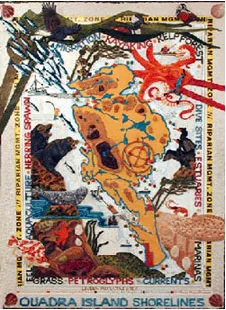
An effective way to begin acquiring a sense of your own bioregion is by making a map that shows some of its basic natural characteristics.
A strong and vibrant connection to the bioregion informs individual and planetary health. When we become co-designers of a regenerative culture, we are ultimately designing for systemic health: a pattern of health connecting individuals to families, communities, bioregions and ecosystems; a pattern of health connecting bioregions in an interrelated network to support a healthy biosphere and planet. Regenerative design is part of increasing the health of both humans and the planet (see also salutogenic design).
With mass migration forced by climate disruption, social issues, war and political instability, some concepts of bioregionalism bear revisiting, including how to embrace emerging cultures such as those created when climate refugees mix with residents of their host country. An expanded or permeable orientation to bioregionalism can guide us to become co-designers of climate resilience; we can be prepared for climate migration and build on the increased diversity and complexity it brings, rather than being taken by surprise.
In fact, the experience of immigrants can enrich the bioregional “map” in many ways. Historically, immigrants have had to learn about a new bioregion, assimilate to a dominant culture, and find ways to retain their own cultural elements and lifeways. A bioregional awareness that includes both immigrants and indigenous people, honouring our differences and valuing what we all bring to the table, can be a powerful way of welcoming people to a new bioregion and thus enriching society for everyone.
Although the relationship to the land that indigenous people have is impossible for those of us who have been displaced, immigrants are also part of the land, and we can learn together. Bill Plotkin, in his book Wild Mind: A Field Guide to the Human Psyche, speaks of the interdependence, belonging and kinship that all of us can experience on Earth, as wild creatures do. In a sense, from this perspective, all humans, like all grasses and all birds, are indigenous to the Earth.
Yet many people in modern Westernised societies come from a background without a strong earth-based culture or connection to the land, or one that has been fragmented, lost or systematically erased. Those whose ancestors left Europe centuries ago (whether fleeing oppression or seeking riches) and who now live as settlers on indigenous peoples’ lands, in the Americas, in Africa or elsewhere, are co-learning or re-learning as much as more recent immigrants from around the world. Immigrants from earth-based cultures relocating to Westernised societies, as well as people belonging to local indigenous cultures, may bring helpful perspectives on how to listen to the land.
For all these reasons, in mapping our bioregion, we need to map much more than the landscape, the ecosystems and their elements. We need to map the social aspect of increasingly complex communities and their needs at all levels: spiritual, relational, food ways, living arrangements, livelihoods, relationship to the land, and so on.
Implementing the systems-based bioregional approach
Living with a bioregional awareness does not require that we begin by mapping our entire bioregion. We can start small, with our own home and immediate surroundings. Here are some ideas for getting started.
- Make a seasonal wheel: a circle bisected by twelve angles (one for each month of the year). Record the cycles of plants, animals, weather and cultural events within and around the circle. Note the date or week when a bird began building a nest near your house, when the chicks hatched and when they fledged. Note the date that your favourite flowers emerged, blossomed and went to seed.
- Begin a nature journal to record daily experiences and the history of your neighbourhood or sub-watershed. Note the specific location, time of day, weather conditions, sounds, and what the animals were doing or eating. Draw and colour illustrations to bring the journal to life.
- Map your backyard. Map places that feel special to you and write down why each place feels special. Map places where you have seen animals, their burrows and habits, native plants, geological formations, and historical information about your house or neighbourhood.
- Map your local water cycle. Where does your water come from and where is the wastewater discharged? You can include the location of any reservoirs, treatment systems and discharge points. You might decide to show the locations of the major components on Google Earth maps.
- Tell the story of your area. Ask around and find your local elders, indigenous people and recent immigrants. Learn the natural and human history of your bioregion and turn it into a story that will interest both adults and children.
- Plant seeds. Plant three native culinary herbs for your kitchen.
- Cook local food. Cook a meal for your family or friends using only fresh food that you know originated within 20 miles of your home or that you have grown in your garden.
- Look for an aspect of the bioregion that needs your help. Unfortunately there are lots of options. Help clean up a polluted waterway or a deteriorating neighbourhood, school, park or wild place. Create a team of people who share your concern and meet regularly to have work parties.
If you want to go beyond this, if you are networking with regional groups to bring greater resilience and strengthen relationships in the place where you live, or if you are designing a land-based community, you may enjoy bioregional mapping. A recent guide, Bioregional Mapping and Planning, is a good place to start.
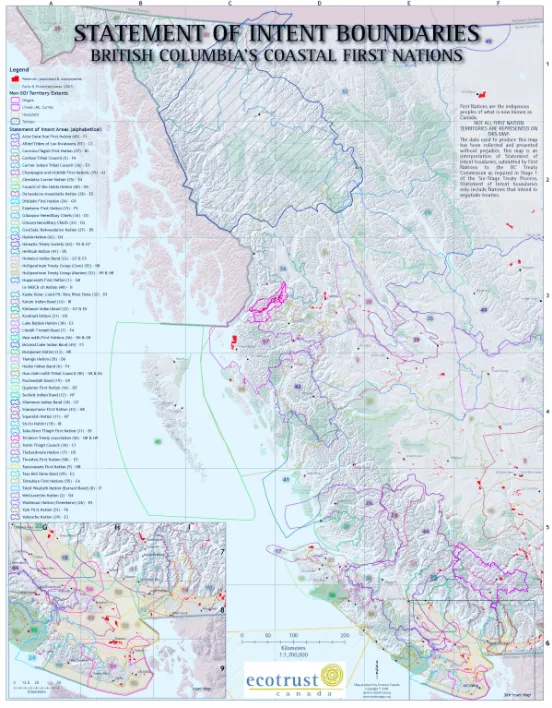
Mapping the bioregion’s opportunities and challenges is done in layers that focus on hydrology, geography, vegetation, bioproductivity, climatology, the histories of places, biodiversity, social systems, infrastructure and the local economy. All these layers of information about a region can inform the process of helping the community and region to meet basic needs as much as possible within the regional boundaries.
Of course, no one person can hold all of this knowledge. To draw a map of even the smallest bioregion asks us to find people around us who know the land, the water, the creatures and the human cultural elements of our place. In other words, it requires that we build a social network.
For a very useful, bigger-picture presentation of bioregionalism, watch the talks by Joe Brewer and Penny Heiple at the r3.0 conference 2025, or find out more at Bioregional Earth.
Joe Brewer and Penny Heiple on bioregionalism at the r3.0 conference 2025. Their talk runs from 12:45 to 51:30, followed by other presentations.
Sensemaking through facilitating change and transformative processes
There are a great number of effective and tested ways to facilitate social change processes in communities, organisations and cultures, which help us as groups and communities to make sense of the work we do and to become effective change makers. Some of these methods and tools need training to be used effectively. They become more effective when they are based on experience built up by applying them in more and more challenging contexts, being willing to learn from mistakes, and being open to constructive feedback from the people we work with. Other methods can be explored in a day-long or weekend workshop and then used straight away to build up experience as we go along.
There is a lot of good literature and online material on facilitation methods and social change processes. This section introduces a few examples, and it is up to you to explore the ones that draw your attention. Some people dedicate their entire lives to the path of becoming effective and compassionate facilitators of social change. The learning never stops, as each new situation and context offers new challenges and opportunities to grow and learn.
Worldwork, Deep Democracy and Process Oriented Psychology
“Process Work is an innovative approach to individual and collective change that brings psychology, group dynamics, spirituality, and creative expression together in a single paradigm. An offshoot of Jungian psychology, Process Work was developed by Jungian analyst Arnold Mindell in the 1970s” (Process Work Institute, 2012). Arny Mindell and his wife Amy Mindell have since taken process work a step further into what they call worldwork and deep democracy.
Theory U
The U-process and Theory U form a method for change management that understands leadership as a process of inner knowing and social innovation. It was initially developed in the late 1960s by Friedrich Glasl and Dirk Lemson, but has reached widespread application since the 2009 publication of Otto Scharmer’s book Theory U: Leading from the Future as It Emerges, and through the earlier work of Otto Scharmer, Joseph Jaworski, Peter Senge and Betty Sue Flowers, described in Presence: Exploring Profound Change in People, Organizations and Society.
“Theory U explores a whole new territory of scientific research and personal leadership. By moving through the ‘U’ we learn to connect to our originating Self. We travel down the left side of the ‘U’ to find ourselves in the realm of presencing, where we learn to sense the future that is seeking to emerge. At that level of operating, we experience the opening of our minds, our hearts, and our wills. Yes, this is an intellectual journey, but it’s one that is grounded in real-life experience and shared practices. On this journey of sensing, presencing, and realizing, we learn new ways of being—ways crucial for each of us at this chaotic time.” — Presencing Institute, 2012
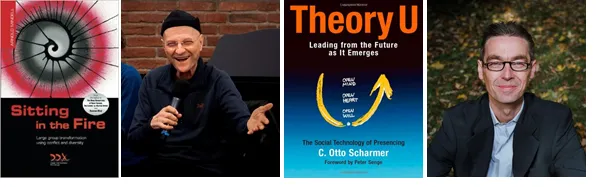
An introduction to Theory U by Otto Scharmer.
Theory U takes participants through a series of steps designed to shed old assumptions, beliefs and attachments and to view a system collectively and objectively. In doing so they develop the capacity to see the full potential of the system and can begin to explore opportunities to realise transformational change.
The journey through the U-process develops seven essential leadership capacities.
| Capacity | What it involves |
|---|---|
| Holding the space of listening | The foundational capacity of the U is listening. Listening to others. Listening to oneself. And listening to what emerges from the collective. Effective listening requires the creation of open space in which others can contribute to the whole. |
| Observing | The capacity to suspend the “voice of judgement” is key to moving from projection to focused and peripheral observation. |
| Sensing | Seeing the system from the edges. The preparation for the experience at the bottom of the U requires the tuning of three inner instruments: the open mind, the open heart, and the open will. This opening process is an active “sensing” together as a group. While an open heart allows us to see a situation from the current whole, the open will enables us to begin to sense from the whole that is wanting to emerge. |
| Presencing | The capacity to connect to the deepest sources of self: to go to the inner place of stillness where knowing comes to the surface. |
| Crystallising | When a small group of change makers commit to a shared purpose, the power of their intention creates an energy field that attracts people, opportunities and resources that make things happen. This core group and its container function as a vehicle for the whole to manifest. |
| Prototyping | Moving down the left side of the U requires the group to open up and deal with the resistance of thought, emotion and will; moving up the right side requires the integration of thinking, feeling and will in the context of practical applications and learning by doing. |
| Co-evolving | A prominent violinist once said that he couldn’t simply play his violin in Chartres cathedral; he had to “play” the entire space, what he called the “macro violin”, in order to do justice to both the space and the music. Likewise, organisations need to perform at this macro level: they need to convene the right sets of players in order to help them to co-sense and co-create at the scale of the whole. |
Source: Presencing Institute.
The Presencing Institute and the u-school are very active and successful in reaching many people and organisations around the world with their innovative programmes supporting transformative change. Nowadays many groups and organisations use Theory U, or at least processes inspired by Theory U, in their work, projects and initiatives, in order to go beyond conventional ways of operating.
World Café
Techniques to facilitate healthy and productive dialogues are plentiful and available online to try. One that is widely practised is the World Café model.
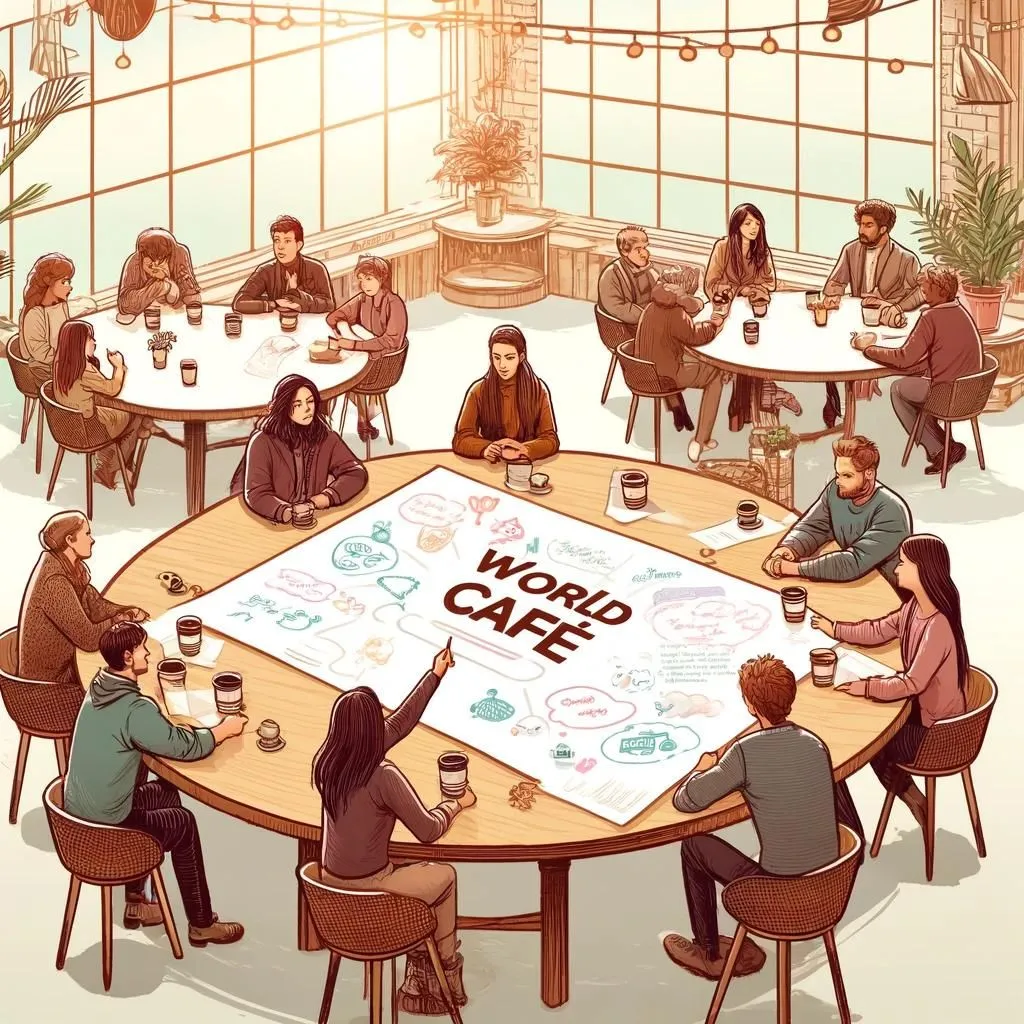
The World Café approach to community thought-generation is based on seven design principles:
| Principle | What it means | |
|---|---|---|
| 1 | Set the context | Pay attention to the reason you are bringing people together, and what you want to achieve. |
| 2 | Create hospitable space | Café hosts around the world emphasise the power and importance of creating a hospitable space. |
| 3 | Explore questions that matter | Knowledge emerges in response to compelling questions. Find questions that are relevant to the real-life concerns of the group. |
| 4 | Encourage everyone’s contribution | As leaders we are increasingly aware of the importance of participation, but most people don’t only want to participate, they want to actively contribute to making a difference. |
| 5 | Connect diverse perspectives | The opportunity to move between tables, meet new people, actively contribute your thinking, and link the essence of your discoveries to ever-widening circles of thought is one of the distinguishing characteristics of the Café. |
| 6 | Listen together for patterns and insights | Through practising shared listening and paying attention to themes, patterns and insights, we begin to sense a connection to the larger whole. |
| 7 | Share collective discoveries | Conversations held at one table reflect a pattern of wholeness that connects with the conversations at the other tables. The last phase of the Café, often called the “harvest”, involves making this pattern of wholeness visible to everyone in a large group conversation. |
Source: The World Café, design principles.
The World Café process, with perspectives from practitioners on how to make it successful.
The Oasis Game and Warriors Without Weapons
The Oasis Game and the Warriors Without Weapons training programme for social entrepreneurs were both developed at Instituto Elos in Brazil, an NGO founded in 2000 by a group of urban architects.
“The Oasis Game is a two-day event that invites a community to project and build in a cooperative way a challenging project chosen by the members of the community to suit their needs. Projects can range from a square, a park, a kindergarten to a cultural center. The game considers a broad definition of the community and involves representatives from different sectors of the society – NGO’s, Government as well as community members from other parts of the city.” — Instituto Elos, 2012
“‘Warriors without Weapons’ is a biennial learning program where youth social entrepreneurs from all over the world are immersed for 30 days. The objective of the program is to get participants to return to their communities inspired, armed with efficient techniques to work in groups. In a strengthened cooperative spirit, they will be able to act in their own communities.” — Instituto Elos, 2012
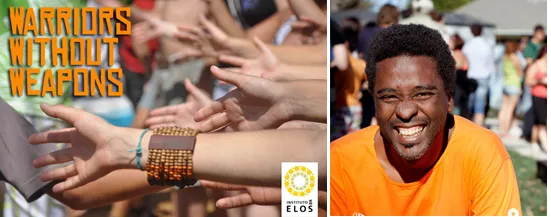
Warriors Without Weapons is an experiential international training in leadership and social entrepreneurship, offered to young people who are trained in technologies to transform realities anywhere in the world. See also this video documentary about the programme.
Dragon Dreaming
The Dragon Dreaming process was developed by John Croft and Gaia Foundation Australia. It is an effective way to support communities in turning vision into reality, based on a 12-step project management process.
“How do you make your own, or other people’s dreams come true? Leaders are often required to get things happening that have never happened before. Everywhere there is a gap between how things are and what they might become. Effective leadership is often a question of bridging this gap, of building a bridge, that enables others to come to work together with the leader to achieve their own or the group’s vision. This is what the process of project building is all about. A project is defined as any planned undertaking designed to achieve a goal of specified results within a given time.” — John Croft, 2008 (Dragon Dreaming website)
Dragon Dreaming is a holistic method for the implementation of creative, collaborative, sustainable projects.
The Art of Hosting
This approach offers an effective way to access and harvest collective wisdom and group intelligence, as well as a path to enhancing the self-organising capacity of groups of any size. A range of powerful conversational processes invites people into shared leadership and responsibility for the changes they wish to see. “The Art of Hosting is an approach to leadership that scales up from the personal to the systemic using personal practice, dialogue, facilitation and co-creation of innovation to address complex challenges” (Art of Hosting, 2015).
The four-fold practice at the core of this approach begins with presence to oneself and one’s hopes and fears. The second step is to become an active participant and enter into dialogue with others, to practise conversation. The third step is to host conversations that matter in your community, and move from participant to practitioner. The fourth practice is co-creation, based on a mutually supportive space of exchange and collaboration, in ways that acknowledge that none of us has all the answers or could implement them alone.
The Art of Hosting and its four-fold practice.
The Art of Hosting offers a whole treasure trove of tools, processes and techniques that help to host conversations that matter and enable collective intelligence and co-creation to emerge. Mary Alice Arthur is one of the growing number of stewards of the Art of Hosting around the world: see the list of stewards.
Possibility Management
This approach and its associated practices have been created by Clinton Callahan and colleagues over the last 40 years. They offer a path towards upgrading our own thoughtware (our patterns of thinking, feeling, and reacting to those thoughts and feelings). A series of challenging individual and group practices invite people to shift their context and reflect on how this context affects their worldview and value system, which ultimately drives their decision-making and behaviour patterns in a given situation. Possibility Management offers people a pathway to radical responsibility and effective, wise action in the world by helping them to overcome limiting thought and behaviour patterns. For nearly 20 years, Clinton Callahan and the guild of trainers in Possibility Management have worked with many businesses, individuals and communities, offering the Expand the Box training and Possibility Labs.
A brief introduction (4 minutes) to the Expand the Box training.
An animation (3 minutes 35 seconds) that explains in more detail what the “box” is.
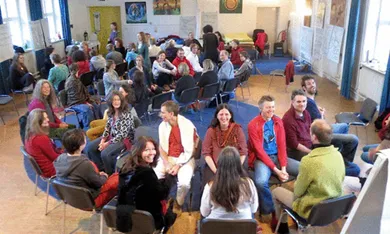
Clinton Callahan is the originator of Possibility Management and the Next Culture Research and Training Centre. Marion Callahan is one of the most experienced trainers in this method.
As the previous sections and resources have shown, facilitation, or better, participatory facilitation as presented in the IN.PACT course, is a large and wide area of principles, methods, tools and approaches. Some of them are introduced here, but there are endlessly many more. The method and tool that can and should be used for a particular purpose and group depend largely on the context and purpose of the work (or workshop), including age, target group, desired outcomes, environment and much more. There are no definitive recipes for planning and conducting group processes.
Design thinking for facilitating community regeneration
Design can most broadly be defined as intentionality expressed through interactions and relationships. Our worldview and value systems shape the way we relate to each other and to the rest of the community of life. Out of these relationships arise a series of needs, which shape our intentions: the way we aim to meet these needs. These intentions, and the worldview and value system that underlie them, define how, why and what we choose to design.
As Winston Churchill once said, “first we shape our buildings and then our buildings shape us”; the same holds true for the design of our communities, our patterns of resource use, our education systems, our monetary and economic systems, and our systems of governance. Design goes on designing! For example, some Japanese city environments are so devoid of trees and plants that the phobia of having leaves fall on one’s head is now a recognised psychological condition among Japanese teenagers.
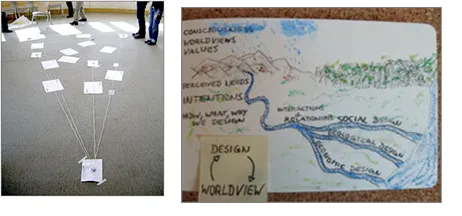
Design is fundamentally worldview-dependent, and the design decisions of previous generations, as well as of the present generation, have at least in part shaped our worldview and value systems. There is a cyclical relationship between worldview and design: we design solutions, objects and processes based on our dominant worldviews and value systems, and the world we create around us through our design decisions in turn shapes our worldview. Meta-design consciously creates design solutions or education processes that cause a deeper questioning and a possible shift in worldview or value systems (Wahl, 2006).
One example of effective meta-design is the Gaia Education Design for Sustainability (GEDS) curriculum. Why that curriculum is based on the four dimensions of social design, economic design, ecological design and worldview can be explained by analogy to the hydrological cycle, as Daniel Wahl does in the River of Design image above.
Imagine the River of Design! Way up in the mountains, where rain and snow have fed the ground with the water of life, lies the spring of the river of design. The level of consciousness from which we choose to engage with, and experience, the coming into being of the relationship between self and world begins to shape our worldview and value systems.
As the stream flows down the mountain, what we value shapes our perceived and real needs, and in turn our intentions, and therefore the how, what and why of our design. As the little stream turns into a big river, our designs express themselves in the ways we interact with each other and the relationships we form, as well as through the material objects and physical structures we create. The river of design could now be thought of as three separate but interconnected streams: social design, ecological design and economic design.
As these streams feed the sea of possibilities we live our daily lives in, the structures and processes we co-created or adopted (often without questioning) from previous generations in turn shape the way we see ourselves, our relationship to the world, and what we value. Water vapour rises from the sea of possibilities and forms clouds that shed their water as they hit the mountains, feeding the springs of the river of design with new ways of seeing and being. Consciousness, worldviews and intentionality manifest through design. The designs thus created in turn shape the way we see the world, what we value, our needs, and thus our intentions.
Donella Meadows famously suggested that “the most effective place to intervene in a system is at the paradigm level”. If we can change the way we see the world (the explanatory maps and models we use, and the value systems we base our intentions and decision-making processes on), we are affecting change at the upstream end of the river of design. Such subtle cultural changes are fundamentally unpredictable and uncontrollable, as they percolate through culture, giving rise to new and alternative structures and processes. Influencing the river of design upstream is design at the level of worldview and value systems.
Education, visioning and effective communication can be examples of such meta-design (Wahl, 2006). Appropriate meta-design is about providing a meaningful story that can guide appropriate participation and thus lead towards increased sustainability. “Culture is not about what is absolute, real or true. It is about what a group of people get together and agree to believe”, suggests Thom Hartmann. He adds: “Culture can be healthy or toxic, nurturing or murderous. Culture is made of stories, and these stories can be changed for the better” (Hartmann, 1999, p. 141).
Donella Meadows described a series of places to intervene in a system, which act like the points of a lever. From the least to the most effective, they are:
- Constants, parameters, numbers
- Buffer sizes
- Stock and flow structures
- Delays relative to change rates
- Balancing feedback loops
- Reinforcing feedback loops
- Information flow structures
- System rules
- System structure and self-organisation
- The system goal
- The paradigm used to design the system
- The power to shift paradigm to deal with new challenges
Based on a diagram of Donella Meadows’ leverage points, showing each place to intervene as an arrow pushing on a lever under the system.
The Donella Meadows Institute intends to remain a centre of critical thinking, informed by systems thinking and modelling.
Designing Regenerative Cultures (Wahl, 2016) explores how transformative innovation, systems and resilience thinking, a design-based approach, and learning from natural systems can all help to inform urgently needed, culturally creative conversations. These are conversations about how to co-create regenerative communities, regenerative economies, and a wide diversity of regenerative cultures elegantly adapted to the bio-cultural uniqueness of the places we inhabit, and globally interconnected by solidarity and collaboration in bringing about the transition to a regenerative human presence on Earth. Daniel Wahl is a co-author of all four dimensions of the GEDS curriculum. Many of the meta-design changes of scale-linking and salutogenic design for whole systems health, which he explored in depth in his PhD on Design for Human and Planetary Health (2006), are woven throughout that programme.
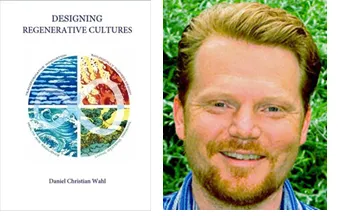
Daniel Christian Wahl has been a member of Gaia Education since 2007 and co-directed the Findhorn Foundation College between 2007 and 2010. His 2016 book Designing Regenerative Cultures is an example of applied meta-design for whole systems health. The book explores a wide range of key questions that may guide people in creating regenerative cultures everywhere.
Whole systems design approaches
To bring these ideas about design into practice (whatever different authors call it: regenerative design, whole systems design, systemic design and so on), it is useful to learn some relatively simple and practical approaches to such design.
Whole systems design can seem very complex and feel overwhelming, as it encompasses so many different working parts. There is a lot to consider when creating an effective, long-term and regenerative design.
To help simplify the process, you can break the design process down into simpler steps with design frameworks. Frameworks support us by offering step-by-step approaches to our design process.
There are many different whole systems frameworks to choose from, many of them similar to one another. Here is one framework to support you in your whole systems designs.
Observe, analyse, do, maintain
| Phase | Key questions and actions |
|---|---|
| Observe | What exists? What has existed? Who should be involved? |
| Analyse and design | What will you remove, move or add to solve challenges and address needs? |
| Do | Implement the design in small chunks. |
| Maintain | Take care of the system. Document change. Receive feedback. |
The whole systems design process is a cycle: after Maintain, you return to Observe.
When designing with nature or in social systems, it is important to start with observation.
Observe. The observation phase is about paying attention to, and documenting, what is happening in a system and when. This phase is not about trying to figure things out; it is more about witnessing what is. Use all six of your senses to engage and interact with your system. In whole systems design, observation never really ends, and it is recommended that you observe a system for an entire year before moving to the next phases of the design process. The observation phase includes:
- Observing and documenting existing elements, patterns, processes and relationships, weather, animals, insects, movement and resources.
- Researching historical patterns, including indigenous peoples and practices on the land, and past weather patterns.
- Observing and interviewing or consulting all stakeholders of the land, and identifying their goals and needs.
Analyse. After some time of observation, you can start to analyse what you have witnessed, seeking patterns and identifying the needs, challenges and opportunities at play. The analysis phase includes:
- Identifying patterns (for example: the area floods every season in the same spot; there is full sun in the backyard in spring, summer and autumn, but not in winter; there are heavy winds, typically coming from the north-west).
- Translating patterns into design needs, challenges, goals and opportunities.
- Identifying all possible elements.
This will help move you into the “do” phase, where you put the pieces of your design puzzle together, choosing and placing elements in a way that will achieve goals, take advantage of opportunities, overcome challenges and address needs.
Remember: even if you are designing your backyard or just a balcony, you are not isolated, and your analysis and actions need to consider the impacts and expectations of others.
Do. Then you can implement part or all of your design. The “do” phase includes:
- Choosing and placing design elements.
- Making an implementation plan.
- Implementing your design (usually in phases).
Maintain. Once the design is implemented, the maintenance phase starts. This will go on for as long as the design needs. The maintenance of a design is combined with starting the cycle again: it is important to keep observing your design, receiving feedback and redesigning as required. The maintenance phase includes all the maintenance required to keep the system healthy.
Systems mapping and sensemaking
Your progress is saved in this browser. Register to save it on every device.
Text © IN.PACT partnership, shared under CC BY-SA 4.0. Images, videos and quoted works belong to their authors and are not covered by this licence unless stated.