Lesson 1 · Module 1
Self-awareness and emotional intelligence
Explore the worldviews that shape how you act, recognise and manage your emotions, and build the personal support a facilitator needs.
“If you are a poet, you will see clearly that there is a cloud floating in this sheet of paper. Without a cloud, there will be no rain; without rain, the trees cannot grow: and without trees, we cannot make paper. The cloud is essential for the paper to exist. If the cloud is not here, the sheet of paper cannot be here either.
So we can say that the cloud and the paper inter-are. ‘Interbeing’ is a word that is not in the dictionary yet, but if we combine the prefix ‘inter’ with the verb ‘to be’, we have a new verb, inter-be. Without a cloud, we cannot have paper, so we can say that the cloud and the sheet of paper inter-are.
If we look into this sheet of paper even more deeply, we can see the sunshine in it. If the sunshine is not there, the forest cannot grow. In fact, nothing can grow. Even we cannot grow without sunshine. And so, we know that the sunshine is also in this sheet of paper.
The paper and the sunshine inter-are. And if we continue to look we can see the logger who cut the tree and brought it to the mill to be transformed into paper. And we see the wheat. We know that the logger cannot exist without his daily bread, and therefore the wheat that became his bread is also in this sheet of paper. And the logger’s father and mother are in it too.
When we look in this way we see that without all of these things, this sheet of paper cannot exist.” — Thích Nhất Hạnh
Thích Nhất Hạnh explains the universe in a sheet of paper: the idea of interbeing.
Welcome to the first module of the Participatory Community Facilitator Course, part of the IN.PACT project.
Becoming is one of the five modules of your journey towards gaining the knowledge, skills and capabilities of a participatory community facilitator. Each module contains four topics. The four topics of Module 1, Becoming: the art and attitude of facilitation, are:
- Self-awareness and emotional intelligence (this lesson)
- Ethics, boundaries and trust
- Power dynamics and compassionate communication
- Reflective and mindfulness practices
Self-awareness and emotional intelligence involves the ability to recognise and understand one’s own emotions, thoughts, values, strengths and weaknesses, and how these influence behaviour. Key skills include identifying emotions, understanding the connection between thoughts, feelings and actions, maintaining honest self-perception, demonstrating self-confidence and self-efficacy, and practising self-reflection and metacognition.
In turn, emotional resilience builds on self-awareness and includes skills such as emotional regulation, flexible thinking, self-efficacy, impulse control, optimism, empathy, connectedness and caring for others. It also relies on self-regulation, stress management, goal-setting, and the ability to learn from setbacks while maintaining focus and adaptability.
Together, these skills enable facilitators to navigate adversity, manage stress effectively, maintain healthy relationships and foster long-term well-being.
This and the other modules of the course provide foundational, carefully selected and curated content on the different aspects of a journey of becoming a participatory community facilitator. Many topics can only be covered at an introductory level. There is much more available on each topic and beyond, which you can explore through the links and resources provided, and through further opportunities elsewhere, using the concepts, ideas, tools and skills you learn here as a starting point.
Inner work and worldviews
While it is difficult to say which one of the five modules is the most important, we can argue that for human beings, if we don’t go about profound inner work and also transform our worldviews, our associated belief systems and our values, none of the changes and transformation we wish for in the outer world (be it social, economic or ecological) will happen significantly, or the changes will be superficial.
We humans behave based on a mixture of cultural and social values and dynamics that form our worldviews, belief systems, values and mindsets. Even if we think we are not, all our acts depend on our underlying beliefs about how the world works, who we are, and what our purpose in life is.
This is a fascinating module where the aim is not to learn but to unlearn: to understand the reasons why we perceive the world and believe what we believe, and also act how we act in the world, and to make intentional efforts to change them so we can co-create communities that support life (not only human life but all life).
We can live our lives controlled by the diverse and complex forces of culture, upbringing, propaganda and so on, or we can intentionally design lives and communities where life is at the centre of all our choices and where we acknowledge the interbeing of all that is.
Overall, this first module is about inner work in the journey of becoming a community facilitator: about worldviews, beliefs and the values we carry as facilitators in our work, our inner attitudes towards ourselves, others and the wider world, and hence about our ethics and relational presence in and for such work.
Self-awareness
“If the soul of our civilization is to be saved we shall have to find new and fuller expression, for the great saving unities – the unity of reality in all its range, the unity of life in all its form, the unity of ideas throughout human civilization, and the unity of the human’s spirit with the mysteries of the Cosmos … evolution is nothing but the gradual development and stratification of progressive series of wholes, stretching from the inorganic beginnings to the highest levels of spiritual creation … the old fixed concepts and contours of thought are breaking down … Holism is a process of creative synthesis; the resulting wholes are not static, but dynamic, evolutionary, and creative. … We are out of the bonds of the old crude mechanical ideas, and we enter an altogether new zone of ideas and categories.” — Jan Christian Smuts (in Thomson & Geddes, 1931, pp. 1114–1116)
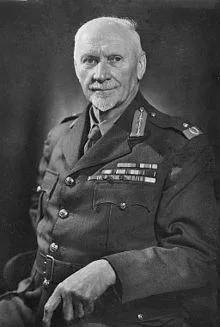
The term holism was coined in 1926 by the South African scientist, philosopher and statesman Jan Christian Smuts. He was among the first to point out “that the biosphere consists of nothing but wholes that are both partly autonomous and partly dependent upon or subsidiary to greater wholes” (Lemkow, 1995, p. 100). In his book Holism and Evolution, Smuts defined holism as “the tendency, as in nature, to form connected wholes” (in Brown et al., 2005, p. 135). The Scottish polymath Sir Patrick Geddes, a biologist, sociologist and town planner, called holism “a serious contribution towards the upbuilding of a new constructive worldview.” Smuts and Geddes understood the importance of our worldview in informing and guiding the survival of humanity. In Life: Outlines of General Biology, Geddes writes: “in the last resort a civilization depends on its general ideas” (Thomson & Geddes, 1931, p. 1114).
Arthur Koestler tried to provide a new terminology for holistic thinking that overcomes the dualistic, mutually exclusive definition of the words ‘whole’ and ‘part’. He focused on the fact that within the whole that contains everything, there are many wholes that are simultaneously parts of larger wholes. Koestler referred to this property of parts – being both wholes and parts – as the Janus Effect (after the ancient Roman deity Janus, often depicted with two faces looking in opposite directions). He regarded the Janus Effect as “a fundamental characteristic of all sub-wholes in all types of hierarchies.” Koestler argued that “there is no satisfactory word in our vocabulary to refer to these Janus-faced entities”, since sub-whole, sub-structure and sub-system did not properly indicate the relationship of simultaneous independence and interdependence. He therefore proposed the term holon, “from the Greek holos = whole, with the suffix on which, as in proton or neutron, suggests a particle or part” (Koestler, 1989, p. 48).
“Wholes and parts cannot exist by themselves either at a biological or social level. What we find are intermediary structures on a series of levels in ascending order of complexity, each of which has two faces looking in opposite directions; the face turned towards the lower levels is that of an autonomous whole, the one turned upward that of a dependent part.” — Arthur Koestler (in Goldsmith, 1996, p. 236)

This topic touches upon emerging worldviews which are essential for profound self-awareness and are the basis of many of the social movements and practical initiatives that are working for a more just and sustainable world. We are living through a fundamental shift in the guiding worldview of humanity. At the same time as we are rediscovering the wisdom encoded in the diverse worldviews of so many of the world’s traditional cultures and Indigenous peoples, we are also faced with the challenge of integrating these perspectives into a larger guidance system that can help to sustain human and all other life at a planetary scale. Reason and Goodwin explain: “The principle of holism argues that there are no privileged parts, no primary causes, no blueprints which define the emergent order” (1999, p. 287).
“The new biology of complexity and emergent properties shows just how limited and aberrant is a reductionist view of life, and how inappropriate is a relationship to nature based on control and manipulation.” — Prof. Brian Goodwin (1999a, p. 9)
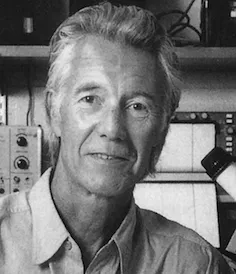
Brian Goodwin is one of the prominent scientists who suggested that a reductionist view of nature will fail to explain complex features. He was also instrumental in creating the Masters in Holistic Science at Schumacher College.
A tribute to Brian Goodwin and his contribution (about 10 minutes).
During the course of almost a century, we have been witnessing the emergence of a fundamentally participatory picture of reality that “turns out to be, in general, holistic, unpredictable and creative” (Goodwin, 2001, p. 42). The physicist Arthur Zajonc suggests that we have to expand our foundation of inquiry and develop a holistic epistemology “that is broad enough to include on the one hand a reinterpreted conventional science, but also open enough to include a science of qualities and beyond the science of qualities to a science of spirit – a science of the contemplative” (Zajonc, 2002). The ecological and spiritual activist Satish Kumar, co-founder of Schumacher College, has suggested that “unless we are able to heal the rift between science and spirituality, and develop a holistic perspective of life, peace will remain a distant dream” (Kumar, 2002).
A two-year project by the Royal Society for the encouragement of Arts, Manufactures and Commerce (RSA) on the role of spirituality in modern societies concluded with a report entitled Spiritualise: revitalising spirituality to address 21st century challenges. It suggested that a renewed public dialogue about the role of spirituality and meaning-making may help us to address the deeper underlying causes of many of today’s problems, and also give us a meaningful framework to contextualise our interconnectedness and interdependence with each other and with life as a whole.
Paying attention to what worldview informs our perspective of reality and influences our decisions and goals is a crucial process of self-reflection and increasing self-awareness. It opens up the potential for transformative and wise action in ourselves and in groups of collaborators.
This is the starting point and sets the scene for the first topic of the course. It already hints at the deep interconnectedness of all ecological, social and economic challenges and of our predicament, founded on problematic worldviews of separation from self, others and the natural world as root causes. And it shows that only deeply systemic ways of thinking, being and doing, encompassing all dimensions of sustainability and regeneration, will provide pathways towards an ecologically sustainable and socially just future for all.
Hence, exploring and diving deeper into the realms of worldviews, beliefs and belief systems, of values, mindsets and resulting attitudes, as well as the stories and narratives shaping our world and existence in real and tangible terms, is at the core of forging new pathways towards a different future for all. It also has a very practical orientation: to give an answer to questions such as:
- How can you integrate any practices that you may feel called to (meditation, yoga, prayer…) in your life?
- Can you create and cultivate the habit of a daily journal of your dreams, insights and observations?
- How can you develop a closer and deeper connection with nature?
- How can you design your own paths to personal health and well-being?
- How can you become an effective change agent, a contributor to the world you wish to live in?
IN.Sight implies holistic design processes that pay attention to the ‘world within us’ side of things (self-awareness), alongside and together with the practical work of the facilitator and changemaker. On the threshold between vision and reality, an integrative design can set the course for a healthy and sustainable reality.
Techniques for developing self-awareness
Briefly, on a more practical level, here are some techniques for developing self-awareness (some of them are covered in more detail in the following topics of the course).
Reflection practices:
- journaling about emotions and daily experiences;
- seeking feedback from colleagues and peers.
Mindfulness techniques:
- practising mindfulness to stay present;
- identifying triggers and patterns in emotional responses.
Managing to become a facilitator
“Will you consciously and bravely choose to reclaim leadership as a noble profession that creates possibility and humaneness in the midst of increasing fear and turmoil?” — Margaret J. Wheatley
The concept of leadership (and similarly of facilitation) may seem to be an isolating principle, one that separates those we see as ‘leaders’ or ‘facilitators’ from those we see as ‘regular people’. We may wonder, ‘How could I be a leader and facilitator of change and transformation? Do I have the skills and knowledge that leadership and facilitation might require?’
But in these times, when society seems to be collapsing and we have such a need for leaders and facilitators in all corners of the world, we need to expand the meaning of leadership. What if we considered leadership to be something that anyone may step into, as a service to the group? What cultural change would make that possible?
Asking ourselves what it would take for us personally to consider playing a leadership and facilitator role in our own group (such as facilitating a meeting, hosting a conflict dialogue, or sitting on a board of directors) often reveals our own internal barriers, such as fear, anxiety or a lack of resources. And if we are honest with ourselves we can see, perhaps a bit painfully, that such barriers can only be overcome by two crucial pursuits:
- self-improvement, such as raising self-awareness, healing from trauma, reducing reactivity, accepting not-knowing, relearning curiosity, gaining emotional literacy, and developing empathy for oneself and others; and
- seeking support from other group members, from non-human sources, and from others in our personal circles.
Let’s look at these pursuits one at a time.
Self-improvement
In his book The Gandhian Iceberg: A Nonviolence Manifesto for the Age of the Great Turning, Chris Moore-Backman imagines the nonviolent movement for social justice as an iceberg floating in the sea. And what is the vast underwater part of the movement made up of? What Moore-Backman calls ‘self-purification’.
Like Mahatma Gandhi, Martin Luther King Jr and Joanna Macy before him, Moore-Backman believes that the most important and urgent practice for anyone attempting to bring about peace and justice is self-purification.
In fact, it is this shifting of consciousness, ultimately an intensely personal and usually spiritual pursuit, that underlies and supports all of our actions to bring about a more just and healthy society. The two other parts of this work, constructing the alternative (the above-water part of the iceberg) and taking direct action to prevent harm (the tiny leading tip of the iceberg), need to be sourced from this deep personal work.
What do we mean by ‘self-purification’? Are we talking about meditation, pilgrimages and wearing hair shirts? Maybe, if that’s what works for you. Most of us know intuitively what we need in order to get grounded, centred and ready to see the world clearly and without judgement. For some it is daily prayer, writing or meditation. For others, a regular walk in the woods. For many, it means practices that connect us to our bodies and to nature, such as yoga, tai chi, qigong, creating visual art, singing or ecstatic dance. For some it’s a combination of these or something else entirely their own.
Such practices have immense power, recognised by wisdom traditions since ancient times. They have the power to support us to shed our fears, take risks, love deeply and see clearly. Even when we are in a place of not-knowing, we are able to walk with sure feet, good humour, empathy and a curious mind.
Brené Brown has much to teach us about the foibles of blame (first video below), about the nature of empathy (second video below) and about the power of vulnerability (a 20-minute TED talk).
Brené Brown on blame (animated short).
Brené Brown on empathy (animated short).
Without a regular practice such as this, most of us are too hampered or polluted by past wounds, trauma, self-judgement, blame and shame to be effective in our work for change or our attempts at leadership. Instead we are liable to poison the very movements we aim to sustain.
Beginning and maintaining a regular practice for self-purification can be very difficult. It’s important not to get bogged down in details like reading the right book, buying the highest-quality equipment, or finding the best place to put the meditation cushion. Just begin. Maybe find a friend to accompany you. And begin again. And again. And sooner or later you will find you are establishing a regular practice.
Thomas Hübl, founder of the Academy of Inner Science, offers training which helps the individual to place the practical application of alertness and transparency at the centre of their life. It is one example of inner work; of course, many others exist all around the world, in and for many different cultures and contexts.
Developing emotional intelligence
In addition to practical or spiritual practices, on the path of self-improvement it’s often useful to grow our emotional intelligence. Being emotionally intelligent means developing the ability to recognise our feelings and other people’s feelings, and to express them clearly. It wasn’t until the publication of Daniel Goleman’s bestseller Emotional Intelligence: Why It Can Matter More Than IQ that the term emotional intelligence became widely popularised.
Emotionally intelligent people:
- are aware of their feelings and other people’s feelings;
- control and regulate their emotional and behavioural impulses;
- empathise and understand other people’s points of view;
- develop motivating thoughts;
- establish goals and design plans to achieve them; and
- cultivate self-esteem and know how to be happy.
Factors contributing to emotional intelligence include empathy, motivation, self-esteem, decision-making, commitment and interpersonal awareness.
Emotional intelligence is made up of two different types of intelligence:
- interpersonal intelligence;
- intrapersonal intelligence.
Interpersonal intelligence is the ability to understand other people: what motivates them, how they work, how to work cooperatively with them. It requires empathy, the ability to feel and understand what another person is experiencing. Successful salespeople, politicians, teachers, clinicians and religious leaders are all likely to have high degrees of interpersonal intelligence.
Intrapersonal intelligence is a correlative ability, turned inward. It is a capacity to form an accurate and truthful image of oneself and to be able to use that healthy self-esteem to operate effectively in life.
Emotional intelligence and its role
Emotional intelligence is the capacity to recognise, understand and manage our emotions while also comprehending the emotions of others. It enables us to navigate our inner world and the world around us more effectively.
“The emotionally intelligent person is skilled in four areas: identifying emotions, using emotions, understanding emotions, and regulating emotions.” — Peter Salovey and John D. Mayer
Emotional intelligence is a learnable skill: nobody is born with mastery over their emotions. This is why improving emotional intelligence is so important. Developing this skill allows us to identify, label and manage our emotions with greater precision and control.
For the difference between IQ and EQ, read Differences between IQ and EQ on Simply Psychology.
Components of emotional intelligence
The five components of emotional intelligence (source: ThinkPsych):
- Self-awareness: the knowledge of one’s own thoughts, feelings and motivations.
- Self-regulation: the ability to regulate emotions and actions in a variety of environments.
- Empathy: the capacity to empathise with and appreciate another perspective.
- Decision-making: the ability to make responsible choices and accept their outcome.
- Social skills: being able to create and maintain healthy relationships.
Extra material: Daniel Goleman introduces emotional intelligence (Big Think).
Emotional intelligence features
The following lists can be used to test your emotional intelligence, both in regard to your intrapersonal and your interpersonal abilities.
1. Personal competence
Self-awareness
- Emotional awareness: recognising one’s emotions and their effects.
- Accurate self-assessment: knowing one’s strengths and limits.
- Self-confidence: sureness about one’s self-worth and capabilities.
Self-regulation
- Self-control: managing disruptive emotions and impulses.
- Trustworthiness: maintaining standards of honesty and integrity.
- Conscientiousness: taking responsibility for personal performance.
- Adaptability: flexibility in handling change.
- Innovativeness: being comfortable with and open to novel ideas and new information.
Self-motivation
- Achievement drive: striving to improve or meet a standard of excellence.
- Commitment: aligning with the goals of the group or organisation.
- Initiative: readiness to act on opportunities.
- Optimism: persistence in pursuing goals despite obstacles and setbacks.
2. Social competence
Social awareness
- Empathy: sensing others’ feelings and perspectives, and taking an active interest in their concerns.
- Service orientation: anticipating, recognising and meeting others’ needs.
- Developing others: sensing what others need in order to develop, and bolstering their abilities.
- Leveraging diversity: cultivating opportunities through diverse people.
- Political awareness: reading a group’s emotional currents and power relationships.
Social skills
- Influence: wielding effective tactics for persuasion.
- Communication: sending clear and convincing messages.
- Leadership: inspiring and guiding groups and people.
- Change catalyst: initiating or managing change.
- Conflict management: negotiating and resolving disagreements.
- Building bonds: nurturing instrumental relationships.
- Collaboration and cooperation: working with others towards shared goals.
- Team capabilities: creating group synergy in pursuing collective goals.
The same ideas are often summarised as four core competencies of emotional intelligence:
| Self | Others | |
|---|---|---|
| Awareness | Self-awareness | Social awareness |
| Actions | Self-management | Relationship management |
Source: Harvard Business School Online, “4 Core Competencies of Emotional Intelligence”.
| Self | Social | |
|---|---|---|
| Recognition | Self-awareness: emotional self-awareness, accurate self-assessment, self-confidence | Social awareness: empathy, organisational awareness, service orientation |
| Regulation | Self-management: self-control, transparency, adaptability, achievement drive, initiative | Relationship management: inspirational leadership, developing others, influence, change catalyst, conflict management, building bonds, teamwork and collaboration |
Source: Goleman’s Emotional Intelligence Model (2002).
Circle of influence and concern
Some things are in our control, and many are not. Noticing the difference helps us to put our time and energy where they can make a difference.
| In my control | Not in my control |
|---|---|
| My boundaries | The past |
| My thoughts and actions | The future |
| The goals I set | The actions of others |
| What I give my energy to | The opinions of others |
| How I speak to myself | What happens around me |
| How I handle challenges | What other people think of me |
| The outcome of my efforts | |
| How others take care of themselves |
| Circle of concern | Circle of control | |
|---|---|---|
| How people act | Reactive people have a large circle of concern and a small circle of control. A lot of time and energy is wasted reacting to issues they can’t control. | Proactive people have a small circle of concern and a large circle of control. A lot of time and energy is focused on issues that are within their control. |
| Examples | The economy, the news, the weather, natural disasters, political views of others, what other people think of you, wars, weapons and terrorist threats, the sex lives of celebrities and politicians | Your attitude and enthusiasm, where you live, where you work, what you read, what you buy, what skills you learn, businesses you start, places you travel to, leadership positions you hold, articles and books that you write |
Based on the graphics “In my control” and “Circle of Concern vs. Circle of Control”.
Why is emotional intelligence important?
In personal and professional growth, emotional intelligence:
- builds stronger relationships;
- encourages personal resilience and well-being.
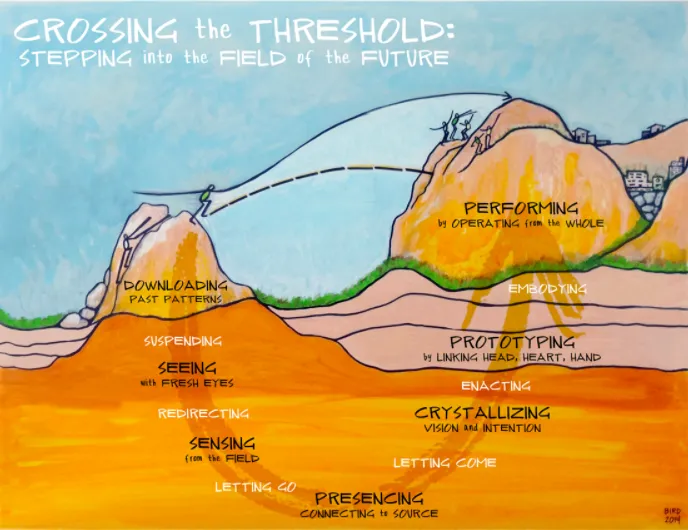
C. Otto Scharmer’s Theory U model of how to open your mind, emotions and will to moments of discovery and mutual understanding is profound. Read more about Theory U.
Tool: the emotion journal
This tool is taken or adapted from the Erasmus+ BurnOut project and from trainings developed by Mundus.
An emotion journal is one of the most powerful tools in emotional intelligence, designed to help increase awareness of what we feel and learn how to manage the messages these emotions convey. With an emotion journal, we can identify the physical signals our body sends us in response to different situations or thoughts.
An emotion journal is a notebook dedicated to recording and reflecting on the emotions experienced throughout the day, both positive and negative. It can also include other things, such as thoughts that may have been upsetting or reflections on how one reacted in certain situations.
Goals of using an emotion journal. Keeping a personal journal helps reduce levels of distress, anxiety and sadness, offering a sense of relief and catharsis. It serves to organise thoughts and feelings. Writing in a journal is an effective tool for stress relief when individuals write in detail about their thoughts and feelings related to stressful events, much like they would in a counselling session.
How to use it. Follow your train of thought without stopping or holding back out of fear of being observed or judged. The journal is a personal space to express all kinds of feelings, so they should not be repressed. The process should be fluid and truthful. It’s a free and safe space to document the emotions that have affected you or those you’re feeling at that moment. It can also be guided (as outlined below) to help you start expressing yourself and understanding the dynamics of this type of activity.
Building support for your empowerment
Often the moment we embark on a journey of self-purification or personal growth, we discover we lack what we need to continue. This lack can lead to the abrupt end of all our steps to grow and take greater leadership. We conclude that we don’t have what it takes, and we often give up, perhaps holding resentment towards others or feelings of shame about ourselves.
This tragic loss of our potential can be avoided by building support systems in all the groups we are part of. We need to recognise that the work we’re doing together, to make decisions collaboratively, to engage with conflict creatively, and to act in other ways outside of the competitive, punitive, oppressive status quo, is rewarding but very challenging work. To meet that challenge we will all require support from each other, and even from outside our group. With strong support systems, all members of our groups can have access to the resources they need to continue their path of growth and leadership.
What do we mean by support? Support in this context means whatever removes the blocks to action. Sometimes in order to take action we simply need the empathic attention of another human being. Sometimes we need inspiration, information, company, understanding, assistance or something else.
Support systems
There are two ways to make sure we all have the support we need. One is to build a support system for the group. This means looking at the collective resources and designing a way of making sure that everyone has access to them when needed.
As in designing your other group systems, like your decision-making system and your feedback system, when designing your group’s support system you’ll want to consider how to get input from everyone involved, what someone can do if they need support, what kinds of support are available and how to access them, and how to make sure everyone understands the system.
One example of a support system in an ecovillage is: a committee that maintains an updated list of people who can offer co-counselling (or RC, Re-evaluation Counseling), empathic listening, massage and other types of support; a website open to everyone in the community where they can look up this list and find people offering what they need; a way of organising ‘Care Teams’ for those in urgent need; an orientation for all incoming members, where a liaison explains how the system works; and an annual evaluation of how well the support system is working.
Re-evaluation Counseling is a process whereby people of all ages and backgrounds can learn how to support each other in order to release the effects of past trauma.
Support networks
In addition to a group support system, or in the absence of one, we can set up our own personal support network from among our circle of acquaintances. Especially when beginning a challenging new endeavour, it can be very useful to create or strengthen our support network.
A personal support network consists of people we know with whom we have agreements about getting or offering support. All that is required is to consider who among our acquaintances might be able to offer the inspiration, empathic listening, company or other kind of support that we need, and to contact them and set up an agreement.
It may be best to choose people for this role who are not work colleagues, family members or close friends. That way, when you have conflicts in those areas, you still have multiple options in your support network. Another thing to consider is what time zone your network members are in. Having people in time zones east and west of your own will mean there are people to call even early in the morning or late at night.
You might want to set up two kinds of support:
- regular meetings, in person, by phone or virtually, in order to offer each other empathy or company or whatever is needed; and
- an agreement about contacting them for support on an as-needed basis.
One example of a functional support network might be:
- four people, each from a different area of a person’s life,
- who agree to talk weekly at a designated time and listen empathically to each other for thirty minutes each; plus
- three other people, in different time zones, who agree to be called on an as-needed basis, and to listen empathically and non-judgementally for a set time,
- while not cancelling other commitments that cannot easily be rescheduled for this purpose, except in an actual emergency.
Who could play a role in your support network?

Self-awareness and emotional intelligence
Your progress is saved in this browser. Register to save it on every device.
Text © IN.PACT partnership, shared under CC BY-SA 4.0. Images, videos and quoted works belong to their authors and are not covered by this licence unless stated.