Lesson 2 · Module 1
Ethics, boundaries and trust
Understand the facilitator’s role and ethics, serve a group without steering it, avoid “facipulation”, and lay the foundations of trust and shared vision.
Ethics, boundaries and trust include a number of skills a community facilitator should have:
- Active listening is foundational, enabling facilitators to understand group dynamics, respect diverse perspectives, and build trust through genuine engagement.
- Impartiality and neutrality are essential for maintaining ethical standards, ensuring no personal bias influences outcomes and that all participants feel heard and respected.
- Boundary setting involves establishing clear group agreements, expectations and codes of conduct (often referred to as ‘guardrails’) to guide behaviour and keep discussions focused, respectful and inclusive.
- Trust-building is fostered through integrity, consistency, transparency and a commitment to confidentiality, allowing participants to feel safe in sharing ideas and emotions.
- Intervention skills, such as redirecting off-topic discussions, managing conflict and addressing disruptive behaviour, must be applied respectfully and thoughtfully to uphold ethical standards and maintain group cohesion.
“The next Buddha will not take the form of an individual. The next Buddha may take the form of a community; a community practicing understanding and loving kindness, a community practicing mindful living. This may be the most important thing we can do for the survival of the Earth.” — Thich Nhat Hanh
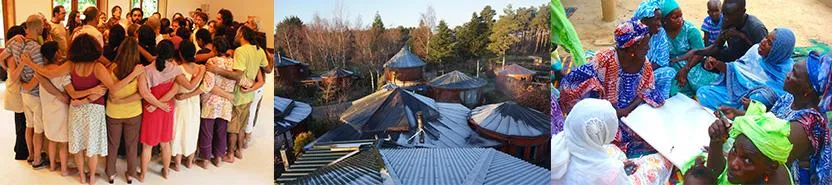
The archaeological evidence shows that the primordial social pattern for human beings is to gather together in relatively tightly knit, often egalitarian, clan-sized bands closely coupled with Nature. Today, we need to consciously reinvent cooperative and harmonious ways of living and working together. Therefore, seeding, growing and rebuilding meaningful groups, communities and networks are vital steps towards a thriving, sustainable future.
Building cooperative groups, organisations and communities is an endeavour involving immense challenges which should not be underestimated. Reconnecting with one another across barriers and borders of misunderstanding and miscommunication calls for clear, calm, firm intention. One of the most commonly cited reasons for the break-up of intentional group projects is conflict. So propagating successful communities will necessarily entail a healing process in which we step out of the cycles of pain and violence that have run through human history and take responsibility for initiating new patterns. This healing process is needed, and healthy, constructive social skills can be taught and learnt! Peaceful, productive relationships can be a conscious, deliberate choice rather than left to random chance.
Rediscovering the beauty, compassionate nature and innate power of human beings is part of our journey through this module and its topics. It also has a very practical orientation: to give an answer to questions such as these (covered in this and other modules):
- What will be the rallying call: the vision that will help our projects be coherent and inspiring?
- How will decisions be made and conflicts resolved?
- How will we walk that delicate line between being an individual and growing in a sense of personal empowerment, and synergising our wishes and desires with the collective body of which we are a part?
- Will we be able to celebrate our diversity, or will we find our differences too challenging and uncomfortable?
- What will we do to reconnect with the creative source in the Web of Life, and bring a sense of beauty to everything we do?
- Finally, will our group, organisation or community be a world unto itself (an insular, self-sustaining bubble on the face of the Earth) or will it reach out to the local and bioregional communities, building bridges, learning and teaching, giving and receiving?
The IN.PACT project implies holistic design processes that pay attention to the ‘people’ side of things, alongside the work on the change you and we want to bring into the world. On the threshold between vision and reality, an integrative design can set the course for a healthy and sustainable reality.
Recognising our interbeing
Diversity is a gift that we should cherish and celebrate, as it is the immense accumulation of the treasures created by life’s evolutionary journey. Diversity is the key to health, resilience and transformative innovation. All separation in the human community, whether due to class, race, political orientation, gender or age, is a socially created false separation. We need to shift from the ‘story of separation’ to the ‘story of interbeing’ (see Eisenstein, 2013) and heal the wounds of this false separation by recognising our profound interdependence and interconnectedness as wonderfully diverse expressions of the wider process of life’s evolution.
We have already started on this journey towards recognising our interbeing and are beginning to understand that a sustainable world will also have to be a more equitable and egalitarian world, since the current levels of inequity of money, power and education have no part in a healthier world for all.
“The Universe is a communion of subjects, not a collection of objects.” — Thomas Berry
This movement can be seen as a response to the need for everybody to be part of Thomas Berry’s ‘communion of subjects’. Berry’s vision of the ‘great work’ (Berry, 2000), participating consciously in the transition to a thriving and regenerative human presence on Earth, is primarily about our ability to re-inhabit the Earth and the Universe with a deeper understanding of our own being, emerging from the intimate interactions we have with all other beings. We are relational beings that only exist in relation to ‘other’: not as separate, isolated selves, but rather as facets of our larger self, the community of life. As the Vietnamese monk and teacher of socially engaged Buddhism Thich Nhat Hanh has put it, “to be is to inter-be”.
We can begin recognising this interbeing by acknowledging that all world citizens have the same ‘right’ to limited CO2 emissions and that the atmosphere is a common good, part of the global commons; or by finally acknowledging the equal rights of women (which have been denied historically in so many places, and are still being denied in many, but are gradually improving in most places); or by looking at the strong movement in all walks of life to find ways of organising institutions and workplaces so that the combined contributions of all involved are honoured and synergistic, and benefits are shared more equitably. There are many examples which show that we are beginning to recognise our unity in diversity, and to celebrate that diversity from a place of deep human solidarity. We are not all the same, and yet we all have the same rights and responsibilities as equal participants in the community of life.
The art, ethics and boundaries of facilitation
“Facilitation is the practice of supporting a group in conducting its meetings and reaching decisions. … The role is like a midwife, who works to assist the process of creation without themselves being the producer of the end result.” — Tree Bressen
Facilitation can be a fascinating way to support your group’s success and the empowerment of all group members. In fact, it can be so fulfilling and deep that it becomes a way of life.
To facilitate groups, the facilitator must learn a set of techniques that over time will become part of their ‘toolbox’. It can be seen in quite a utilitarian way: as a system of tools, techniques and skills to support a group of people to have smooth, productive meetings.
But most facilitators find, sooner or later, that simply applying tools is not enough to do the job well. To be truly effective, a facilitator must have an open and empathic attitude and be responsive to group needs, especially in times of tension or conflict.
This is what makes the job become almost spiritual: a path of leadership and service that requires and supports the development of lifelong merits like awareness, presence, empathy and insight.
If you choose to step into this crucial leadership role, it will be useful to examine carefully the sections on self-improvement and support in the first lesson of this module, and to strengthen those practices in your life. Meditation, mindfulness practice and a commitment to continued personal development are helpful to anyone who wants to become a better facilitator.
Seeds for Change has wonderful resources on cooperative governance and facilitation.
What a facilitator does
The word ‘facilitation’ comes from the Latin word for ‘easy’. To facilitate something is to make it easier. So a facilitator is neither the bicycle nor the rider, but the person who listens for the squeaks, investigates the source of the friction, and puts oil on the gears.
In order to do this, a facilitator pays attention to four things: process, content, energy and logistics.
Process refers to how things are done, the way things are accomplished, the format being used for discussion or for reaching an agreement. The key question here is: ‘What is the best way to achieve our goals for this meeting, or for this part of the meeting?’
Content refers to what a group is working on, what is being said, the matter under discussion. Key questions are: ‘What are we talking about? What, if anything, is being decided? What information do we need in order to make the best decision possible? How are we going to make sure that the needed tasks are accomplished?’
Energy is more subtle; it means the way the group feels as it works. Energy addresses the questions: ‘How is everyone doing? Are people laughing a lot, or do they look like they have a stomach ache? Is there tension in the room? If so, do we want to make any changes in order to care for each other’s well-being or our common goals and values?’
Logistics, in facilitation terms, refers to the layout of the room, materials, supplies, temperature, accessibility and other details. ‘Do we have the tools we need to hand? Is everyone comfortable?’
The facilitator is both observing and influencing the process, content and energy of the group by the choices they make. In order to make these choices, there is one overarching question it can be useful to hold in mind. Ask yourself, ‘What does the group need from me right now?’ Then do it.
What do facilitators do? A short video (4 minutes) by the International Institute for Facilitation and Change.
The agenda: combining process and content
Meetings go more smoothly when there is an agreed-upon agenda that is appropriate to the decision-making level of the group. An agenda is like a road map that keeps everyone focused and enables participants and the facilitator to keep track of where they are in the meeting. It helps people track both the process being followed and the content being discussed.
Ideally an individual or committee (for example, the Agenda Planning Committee) is responsible for vetting topics for the full group or plenary to discuss. These topics must meet agreed-upon criteria which identify them as areas of group-level concern.
Before the meeting, it’s useful for the facilitator to confer with the topic’s presenter, and perhaps with the agenda planner, to learn any important background information, including potential points of friction or tension, and to learn the purpose of the meeting: to present the background and collect input towards generating a workable proposal, to present a proposal and hear feedback, or to make a decision.
There are five basic steps that the facilitator takes with regard to each agenda item to help the group stay focused.
- State the name of the item, whether it is for introduction, discussion or decision, and how much time is allotted for it.
- Invite the sponsor or presenter to present the topic, and make space for them to answer clarifying questions.
- Facilitate the ensuing discussion (this may follow different formats depending on the group’s goals and culture).
- Identify any agreement (if applicable) and related tasks.
- Make sure any decisions and tasks are noted in the minutes.
A Manual for Group Facilitators, by the Center for Conflict Resolution, is a classic guide sold by the Foundation for Intentional Community (FIC). Group process consultant Laird Schaub says: “High quality meeting facilitation is neither a parlor trick, nor the result of mastering techniques. It comes instead from adopting a cooperative and agreement-hungry mind set, where you are open to surprises and ever eager for the creative possibilities of new information. It comes from trusting the process, without knowing ahead where it will lead. It comes from working with energy as well as with content. A Manual for Group Facilitators is the best introduction available for creating the kind of meeting culture where these attitudes can flourish.”
Serving the group
One of the most central and yet most challenging aspects of the facilitator’s job is to rein in their own ego, their own opinion about the topic, and their own preferences. We need to become nearly invisible, providing a clear channel for the dialogue to flow through and then stepping out of the way so that the group can do its work. It is crucial for the group to feel that the decision is its own, and that it was not pushed there by the facilitator.
Setting aside our own opinions doesn’t mean we cease to have a personality or a self. We learn to be ourselves while honouring our role as a leader who serves at the will of the group. To accomplish this balancing act, there are certain core concepts to hold in mind.
- Be curious: listen for the piece of the truth in each person. Cultivate not-knowing.
- Be omni-partial: respect everyone’s journey. Be on everyone’s side at the same time.
- Stay grounded: strengthen your core; be flexible, balanced, unattached.
- Exude confidence: have faith in the process. Don’t push the river.
- Serve the group: explain what you are doing and ask permission.
As you grow in your ability to embody these concepts, you will find you’re better able to observe and influence your own energy and the energy of the group.
During a meeting, a facilitator supports the group by making small interventions to help the group find the agreement that already lies somewhere in the room. Here are some of the most common types of actions that build cooperative agreement:
- Track and explain the process. Summarise frequently what you hear. Paraphrase to check understanding and weave different comments together.
- Support each person to be heard. Make space for slower thinkers or introverts. Consider inclusive formats or different pacing.
- Pay attention, make eye contact. Speak clearly and concisely.
- Be active and firm, and also gentle and supportive.
- Inhabit your whole self. Use your face, hands, body and voice to convey curiosity, respect and confidence.
- Seek common ground and agreements. Highlight and celebrate them whenever you hear them.
- Investigate apparently different viewpoints to find common ground.
- Track and name elements of a proposal as it emerges, so that the group can refine it for optimum success.
- Clarify agenda, decisions and tasks, and make sure notes or minutes include them.
- Work outside the meeting whenever possible.
- Stay connected to your own ethics and integrity.
- Remind the group regularly that the goal is to find a solution that meets everyone’s needs to their own satisfaction.
- Get support (before, during and after the meeting) to remember the humanity of everyone involved.
Note that although a facilitator’s job includes naming the potential elements of a proposal as they arise in a meeting, proposals are often compiled outside meetings by other members of the group. A proposal is simply a suggested path of action that a person or committee brings to the group, usually after gathering input from the group about what is important to them and needs to be addressed. It is often modified, and sometimes significantly overhauled, before being agreed upon by the group.
Whether your group uses consensus, sociocracy, the advice process or another method of decision-making, your process of reaching agreement must be clear to the facilitator. And in most cases, a facilitator who is entrusted to guide the group towards their shared goals will be following the principles and actions named above.
Formats
A facilitator who has been entrusted with the task of choosing a process for the group to follow has an infinite choice of formats. When considering the best process to suggest, a facilitator should consider the goals of that part of the meeting, the tone they want to set, the needs of the people who will be present, and the time available, among other factors.
A full-group discussion is the usual default, but this type of conversation can be tedious and inefficient. It also excludes those who are more comfortable in smaller groups or with different communication styles.
Several of the most common and useful formats are listed below. For more ideas, see Tree Bressen’s library of formats. Tree Bressen is an experienced facilitator and trainer who has compiled an extensive collection of formats and other resources.
- Pair work, dyads or ‘Think and Listen’: work in pairs. The facilitator gives a clear question or topic for each partner to answer. For half the time one person thinks and speaks, and the other is the listener. Then switch. Allow 2–5 minutes for each person.
- Go-round: go around the circle, giving everyone the same amount of time to address a topic or answer one to three questions.
- Brainstorm*: a fast, high-energy way to generate a lot of ideas or get people thinking outside the box. Start with a whiteboard with a clear title. Give everyone a minute to think. Then ask for ideas and start writing, maybe with two scribes to keep up with fast contributions. No discussion or criticism. Crazy ideas are fine. A brainstorm needs to be followed by a discussion of the results and then some method of winnowing, threshing or vetting the ideas generated, such as multi-voting or dot voting, explained below.
- Affinity grouping (also called clustering): like a brainstorm, except that people write each idea on a sticky note. Then all participants post their sticky notes on a wall and sort the ideas into thematic clusters. Each cluster is given a title. Then the clusters can be worked with one at a time by the full group or delegated to small groups.
- Multi-voting or dot voting: write the list of issues, problems or solutions to be prioritised on a flipchart or whiteboard. Collect ‘votes’ by one of the methods below, then tally and discuss the results as a group.
- Each person silently ranks the ideas and writes the rankings on the flipchart. The ideas with the highest totals are the ones to consider for implementation.
- Each person ranks only what they consider the four or five best ideas.
- Use dot labels, stickers or markers for voting. Each person has a certain number of dots (three to five) to ‘spend’ on ranking, and can spread them over several ideas or use them all on one great idea.
- Two colours of dots can be used. Everyone gets three to five dots of one colour and one ‘super dot’ of another colour, which is worth more points.
- Six thinking hats: this technique was created and developed by Edward de Bono in his book Six Thinking Hats (more information). Each colour ‘hat’ designates the type of input the person is invited to give: blue for the facilitator; white for facts; red for feelings; black for criticism; yellow for new ideas; and green for anything. The blue hat decides who wears which hats, and can have people switch hats or whatever seems useful to the group.
- World Café: in the World Café, the room becomes a café with a host at each table, who has a topic, a large sheet of paper and markers. Group members settle around different tables, discussing the topic each host is holding. Then they switch tables several times, concluding with a full-group discussion to collect and record key ideas or insights.
- The Art of Hosting is a highly effective way of harnessing the collective wisdom and self-organising capacity of groups of any size. Based on the assumption that people give their energy and lend their resources to what matters most to them, in work as in life, the Art of Hosting blends a suite of powerful conversational processes (see above and others) to invite people to step in and take charge of the challenges facing them.
*Note: some people with epilepsy find the term ‘brainstorm’ offensive. If there are such people in your group, find a different name for this process.

Using sticky notes to collect and cluster ideas can ensure broader participation in the discussion and also aid understanding and memory by generating a visual element.
Building cooperative culture through facilitation
One of the most important roles of a facilitator is that of holding, expressing and inspiring an orientation towards finding agreement.
Ideally everyone in a cooperative group comes with an intention to seek agreement, but often people arrive carrying baggage that gets in our way, including learned behaviours and attitudes that are competitive.
In order to stay focused on our intention to seek common ground, we often need a facilitator to hold a solid faith that we can find a way forward together that meets everyone’s needs. The facilitator does this on behalf of the whole group. It’s an important role, and since it bucks societal training, it can take a lot of energy and strength.
When facilitating, there are certain queries that can support us in actively seeking out the places in our groups where collaborative agreement resides. Here are a few. The next time you facilitate a meeting, try holding one or two of them in mind and see what happens.
- Where in the room is the agreement hidden?
- How can we link these ideas?
- What are the needs beneath these strategies and positions?
- How can we meet all these needs?
- How can we cherish these concerns, misgivings or dissenting ideas and use them to improve the proposal and build relationships and community?
Creative coaching
Coaching is a set of communication skills and processes designed to empower the recipient or client. Coaching can be seen as an important way to embody leadership in your group, by supporting the empowerment of group members.
This section is based on Hide Enomoto’s article ‘How Can We Support Each Other to Step into Our Power?’, included in the book Beyond You and Me*, p. 170.*
The philosophy of coaching takes the form of the four cornerstones:
- The coach holds the client as naturally creative, resourceful and whole.
- The coach addresses the client’s whole life.
- The coach holds the client’s agenda.
- The coach dances in the moment with the client.
The term ‘client’ is used in this context to mean anybody: your partner, child, colleague, group member, friend or neighbour.
The coach holds the client as naturally creative, resourceful and whole. In order to truly foster empowerment, the coach sees the client as a whole human being and not as a problem to be solved. Coaching stands firmly in the belief that there is nothing wrong with anybody: everyone fails and makes mistakes. A coach knows that the client has all the answers within and so asks questions instead of giving advice.
The coach addresses the client’s whole life. In coaching, attention is focused on the person, not on circumstances, because as long as outward circumstances are the focus, the client will not look within. There are three guiding principles.
- Fulfilment is about what makes you alive. The key word here is ‘values’, because you become alive when you honour your values.
- Balance is about making powerful choices. The key word here is ‘perspective’, because you can see that you have numerous choices when you expand your perspectives.
- Process is about being where you are and fully experiencing life in the moment. The key word here is ‘feeling’, because people feel the richness of their lives when they are in touch with their feelings.
The coach holds the client’s agenda. In coaching, the agenda, topic or theme of the session always comes from the client.
The coach dances in the moment with the client. In coaching, the client changes moment by moment. If the coach tries to predict, the prediction takes over as a new agenda and becomes more important than the client, and then the connection with the client is lost. To refrain from this, the coach must be present with the client at all times.
Coaching is about actively transforming our behaviours, habits and actions to get the results we want. Coaching is about looking at what hinders excellence and potential, and moving through and beyond it.
The five key components of coaching
There are five key components that are crucial to coaching effectively:
- curiosity;
- listening;
- intuition;
- self-management;
- action/learning.
Curiosity is the main source of open-ended questions. With an open-ended question, the answer is totally unpredictable. The coach’s curiosity is what allows the client to explore their inner world, which, in turn, leads to self-discovery.
Listening: the coach aims to listen carefully to the client’s verbal and non-verbal communication and to the environment within which the coaching is taking place.
Intuition is a powerful tool to move a coaching session forward, as long as there is no attachment to it. If a coach expresses intuition without any attachment, the client has more freedom to choose whether to accept the intuition or not.
Self-management: one of the challenges a coach faces is how to become ‘invisible’ or ‘get out of the way’ so the client can really focus and find the answers that lie within. This is called self-management.
Action/learning has two parts: forwarding the action and deepening the learning. The focus in coaching is on personal empowerment through self-discovery and decisive actions.
The dangers of facilitation: “facipulation”
Be careful of ‘facipulation’: when facilitation becomes manipulation.
Group facilitation aims to create conditions conducive to collective intelligence, the balanced expression of viewpoints, and the co-creation of solutions. However, there is a potential pitfall that can be called ‘facipulation’: a blend of facilitation and manipulation.
Definition. Facipulation is the use of facilitation tools and approaches to subtly steer the group towards a predetermined conclusion. The facilitator no longer simply supports the process; they intentionally influence the content and the outcome.
The risks and dangers of facipulation:
- loss of trust among participants when they perceive hidden bias;
- weakening of collective commitment;
- biased or unreliable decisions;
- a climate of mistrust and a reduction in authentic expression;
- breach of the facilitator’s professional ethics.
Warning signs: are you facipulating?
- You have already decided on the outcome before the session.
- You are reframing certain proposals by steering them.
- You are allocating more time to ideas that suit you.
- You are using participatory methods to legitimise a decision that has already been made.
- You are deliberately avoiding certain sensitive topics.
Tips for maintaining authentic facilitation:
- Clarify the group’s actual level of power from the outset.
- Clearly separate information sessions from co-creation sessions.
- Adopt a posture of active neutrality.
- Ask open-ended questions without hidden agendas.
- Request feedback on your approach at the end of the session.
- Be transparent if a constraint or decision has already been made.
| Facipulative behaviours | Facilitative behaviours |
|---|---|
| Asking close-ended or leading questions right from the start, geared to leading participants down your path | Start with open-ended questions to let the group determine the direction of the conversation. Use close-ended questions to confirm themes, trends and decisions, e.g. so my understanding is that you want to do XYZ, is that correct? |
| Providing your opinion or bias, negating or critiquing the group’s proposed ideas | Let the group share their opinions on ideas through a facilitated discussion. Essentially, bite your lip as others suggest ideas. Don’t hesitate in writing them down, and only paraphrase when ideas are unclear. |
| Providing more suggestions than the group, or giving yourself extra time to explain or embellish your own ideas | Provide suggestions after the group has contributed, and only if you believe your suggestions can stimulate further thought. Frame your ideas as a question instead of a statement, e.g. Have you thought about doing ABC? Don’t record or scribe your idea. Give the group time to discuss it, and if they like it, then record it. |
| Showing undue emotion for one idea over another | Remain neutral and promote all ideas during brainstorming processes. Use neutral language such as “OK” or “sounds interesting, any other thoughts on this?” instead of “great idea!” |
| Only capturing ideas you like, not writing everyone’s ideas down | Capture all ideas! Always start with a round-robin to ensure everyone has a chance to voice, or not voice, an opinion. |
| Asking a lot of clarifying questions about one person’s input, but not others’ | Only ask clarifying questions when necessary. Do not use clarifying questions to promote individuals. |
| Scribing an idea in your own words without checking whether you captured it correctly | Always try to capture an idea in the person’s own words. If you need to capture something in your own words, always ask “did I get that right?” or “is this what you meant?” before moving on. |
| Calling only on certain people who share your opinion | Call on all group members equally, regardless of their opinion. |
| Adding pre-session information that is biased | If necessary, add pre-session information that is unbiased and open-ended, or representative of multiple points of view. |
| Non-verbals: rolling your eyes, gasping, or hesitating to capture an idea just given | Monitor and limit your non-verbal reactions. Capture ideas instantly. |
Table of examples by First Facilitation.
The line between facilitation and manipulation is sometimes subtle. The difference lies essentially in intention, transparency, and respect for the group’s autonomy. True facilitation seeks to bring out collective intelligence, while facipulation seeks to direct it.
Foundations for starting and maintaining a community
Building community is not easy. The vast majority of forming groups do not survive past their first few years, as they are unable to get past the conflict stage into true community. To keep on thriving as a community group is not easy either, since every community is a dynamic and living reality that requires steady restructuring and a certain capacity to adapt to change.
Individual and collective transformation are linked. We cannot want ‘our’ community to change without being willing to look at the part we play in its dynamics, and to be open to personal development and transformation in the process of the group’s evolution.
If you are starting a new group project, the best thing you can do is to gather a small group of like-minded people with similar values and motivation to be your ‘core group’. For a big group, it is difficult to reach a consensus on the core principles, vision and goals.
Communities find a cohesive ‘glue’ in a common vision that is simple, clear and authentic. Articulating and recording this common vision is one of the first goals to be accomplished. Once the collective purpose and deepest values are articulated, this provides healthy soil for group growth.
Friendship, caring and mutual support are the qualities of human relationships that bind a community together. In an atmosphere of trust, communal processes flow with ease, laughter and lots of fun. But trust needs to be cultivated through honest communication. If we allow ourselves to be seen by others authentically, with our weaknesses and strengths, and if we speak our minds and our hearts with kindness and respect, trust naturally arises and a sense of group well-being is created. Trust grows when things work well because a pattern of organisation has been designed that truly serves the group and the individuals in it.
To do this, we need systems to guide all the activities that support our group’s functioning and thriving. And we need to create these systems intentionally. If we don’t design them ourselves, we risk accidentally inheriting the systems that others have already created for us, which may not serve us well.
Miki Kashtan, a self-described ‘practical visionary’ applying the tools of Nonviolent Communication to social transformation, recommends that all groups set up systems for the following functions: decision-making, information flow, resource flow, feedback, and conflict engagement.
Building community is a process involving different layers of action running in parallel. To create the structures, procedures and agreements which allow a group to work well and achieve its goals, some skills that engage members at personal, interpersonal and collective levels are needed. The foundation of Ken Wilber’s Integral Theory is a map known as the Four Quadrants (4Q):
| Interior | Exterior | |
|---|---|---|
| Individual | I (subjective): thoughts, emotions, memories, states of mind, perceptions and immediate sensations | IT (objective): material body (including brain) and anything that you can see or touch (or observe scientifically) in time and space |
| Collective | WE (intersubjective): shared values, meanings, language, relationships and cultural background | ITS (interobjective): systems, networks, technology, government and the natural environment |
The Four Quadrants of Integral Theory. See also the Integral Institute.
The table below, derived from Integral Theory, shows the structures and agreements needed by every group (lower right quadrant), and the personal skills (upper left quadrant), interpersonal skills (upper right quadrant) and collective aspects (lower left quadrant) that need to be considered and developed in order to build a sustainable community.
Starting community: the essential table
| Interior | Exterior | |
|---|---|---|
| Individual | Intention. Get to know yourself: inner skills. Self-esteem, trust in people and in life; emotional intelligence; ongoing learning and motivation; a creative attitude towards life. | Behaviour. Get to know others: outer skills. Efficient and compassionate communication; a cooperative attitude and flexibility to establish agreements; accountability; an attitude of celebrating in community. |
| Collective | Culture. Get to know yourself in a group: group processes. Pay attention to: elements of the group culture (values, beliefs, assumptions, expectations, fears and so on; look for a balance between coherence and flexibility); role games and dynamics (follow polarisations and work on edges and boundaries); leadership (acknowledge leaders’ contributions and work on integral leadership); power, rank and privileges (avoid power abuses and foster empowerment); eldership (promote openness and space for all voices). | Systems. Get to know your group: structures and agreements. Decision-making method; common vision and goals; criteria for membership; emotional management group method; conflict resolution procedure; expulsion procedure; economic agreements; lifestyle agreements; communication and behaviour agreements, etc. |
Finding and sharing the vision
Having a common vision is one of the most important elements in promoting group cohesion. Its absence is a cause of structural conflict and may end up with the dissolution of the group. Articulating and recording this vision is a first step every group should take in its process of building community.
The written version should be clear, simple and inspiring:
- clear, to avoid misunderstandings and make it accessible to those interested in joining the group;
- simple, to leave space for individual freedom by not having everything decided from the very beginning;
- inspiring, to become a source of permanent motivation and a guide that can orient the group to its destination.
It is crucial that all members of a group feel connected to the vision. Only then, when each person’s own individual sense of purpose can find expression in the larger collective sense of purpose that we call the vision, will that person want to work late, do the extra unseen chores and ‘go the extra mile’ for the benefit of the whole.
We should also keep in mind that vision is always an answer in the present: an expression of what we want to create, how we want to shape our reality, and how we take on responsibility for an emerging future now. In order to keep the vision sparkling and alive, we need to give space in groups for continual reconnection with the source behind the vision statement. Visioning is an ongoing process of focusing on intention that will never be completed.
As design is “the first signal of human intention” (William McDonough), how we co-design our vision, mission and goals is a crucial element of community design. Getting clear about what values guide us and what mission and goals give our daily activities meaning is essential to unite the diversity of a community in a shared purpose. Communicating this clearly will make it easier for potential new members to decide whether they might be interested in joining.
Vision, mission and goals
According to Diana Leafe Christian (Creating a Life Together: Practical Tools to Grow Ecovillages and Intentional Communities, New Society Publishers, 2003), a group’s common vision:
- describes the shared future you want to create;
- reveals and announces your group’s core values;
- expresses something each of you can identify with;
- helps unify your effort;
- gives you a reference point to return to during confusion or disagreement;
- keeps your group inspired;
- draws out the commitment of the people in your group.
It is also important to distinguish between vision, mission and goals.
- Vision is the shared future you want to create, your shared image of what’s possible. It is often expressed as the ‘who’, the ‘what’ and the ‘why’ of your endeavour. Ideally, it’s described in the present tense, as if it were happening now.
- Mission or purpose expresses the vision in concrete, physical terms. It’s what you will be physically doing, as well as experiencing, as you manifest your shared image of what’s possible.
- Goals and objectives are milestones you commit yourselves to accomplishing in the short or medium term. They are measurable; you know when you have accomplished them.
Examples of vision and mission statements
IFESH
- Mission: The mission of IFESH is to support African nations in their efforts to eradicate poverty, disease and inequity through self-help partnership programmes.
- Vision: Our vision is an Africa where everyone reaches their full potential through access to quality education, health and good governance.
From an image created by © Gaia Education.
- Vision: A world of resilient, deeply connected, and bioregionally responsible communities thriving through regenerative practices.
- Mission: We support the co-creation of regenerative cultures by providing transformative educational programmes and project-based learning for individuals and organisations leading systemic change.
Tamera, an intentional community and ecovillage in Relíquias, Portugal
- Vision: To birth Terra Nova – a world beyond war – by building Healing Biotopes: futuristic centers that research and model a new planetary culture.
- Mission: Tamera empowers people around the world to build a regenerative, nonviolent culture by:
- Research: researching the ethical, social, sexual, ecological, technological and economic foundations;
- Education: training and supporting those committed to the Healing Biotopes Plan;
- Outreach: building a planetary community and sharing our vision of Terra Nova.
The Work That Reconnects Network
- Vision: The Work That Reconnects Network provides support, guidance, and inspiration to people all over the world in their work for the Great Turning, in diverse communities, schools, universities, businesses, government agencies and NGOs. The Work That Reconnects Network functions as a vibrant living system, providing communication, education, mutual support and collaboration in creating curricula, practices, books and articles, music, poetry and art.
- Mission:
- To design and build a network of facilitators and community members in the Work That Reconnects for optimal communication, collaboration, inspiration, and mutual support, and to contribute to the Great Turning.
- To promote the Work That Reconnects in the world by building relationships in person and via social media, an interactive website, a periodic journal, and other means.
- To develop a support system with funding and staff to enable the Work That Reconnects Network to fulfill its vision.
A practical technique for creating a common vision
There are different techniques for creating a common vision. The Futures History method presented here is a simplified version of the method developed by Warren Ziegler. Participants need drawing materials and space to work in. The exercise may last from a few hours to several days, depending on the group.
- Imagine and draw something of your vision for your project 10 to 20 years from now.
- Join with others in a small group of three or four people, to listen to and look at each other’s thoughts for your future. Do this one at a time, with equal time for everybody, then share something you like about each other’s work and something that you have learnt.
- In your group, take time to develop a new vision using the fresh perspectives and insights you have gained. Create a poster to illustrate the essentials of your vision, with all common elements in the centre and the main discrepancies on the side.
- Post your collective vision on the wall for a gallery time in which you may ask each other questions. To each person you speak with, share something you like about their work. Notice which common elements you agree with, and which are your main discrepancies.
- Create a final poster that gathers all common elements in a new vision. Make a list of the main discrepancies that emerged during this process. Dedicate some time to discussing your discrepancies and looking for agreement or possible ways to address them.
- Spend time in pairs working on finding the next achievable step towards your vision. Create a future history by imagining yourself actually in the future vision now. From that position ask yourself, ‘How did this come about? How did it happen?’ Take time telling each other the story, take notes for each other, and prompt your partner towards a positive, personal action plan for initiatives to act on soon.
- Each person imagines being engaged in that action, by seeing the sights, hearing the sounds and feeling the feelings to ground it. Do this one at a time, taking equal time.
With this method, a move towards a consensus vision can be made. A small group takes the posters prepared in step 3 and works through them to spot the common ground. Ideally, this group will have whole-systems design skills and will be able to draw up a set of proposals for achieving many elements of the collective vision. The larger group will meet again later to review these proposals and split into working groups to act on them.
You can and should use this method as part of developing your project in Module 5 (Manifesting: design studio lab).
Once you have developed a vision, mission and goals for your group, organisation or project, you should review them to ensure their usefulness. You may want to test your vision documents and vision statement against the following criteria.
For you as an individual:
- Do you feel good when you read the written expression of your vision?
- Is it meaningful for you? If not, how would it need to be changed to make it meaningful?
- Does it resonate with your personal sense of identity? Do you feel as if you can ‘own’ it?
- Does it inspire you?
For your group:
- Is your vision document simple, clean and authentic?
- Does it reveal and announce your group’s core values?
- Does it focus on the ‘who’, ‘what’ and ‘why’ of your project?
- Is it fairly concrete and grounded (not vague or flowery)?
- After you read it, can you remember it? Do you ‘see’ it?
- Does it express your purpose?
- Does it inspire your group?
- Does it generate excitement?
- Does it show what your group or community will be like when your vision is achieved?
- Does it express passion, conviction and commitment?
Ethics, boundaries and trust
Your progress is saved in this browser. Register to save it on every device.
Text © IN.PACT partnership, shared under CC BY-SA 4.0. Images, videos and quoted works belong to their authors and are not covered by this licence unless stated.