Lesson 3 · Module 4
Distributed and regenerative leadership
Explore leadership that is shared across a group and aimed at regeneration, and use models such as Three Horizons to lead systemic change in your community.
Distributed leadership in facilitation emphasises shared responsibility and collective agency, where leadership actions are not confined to a single individual but emerge through collaboration and mutual influence across team members. This approach fosters a dynamic environment where decision-making, problem-solving and innovation are spread across the group. Key elements include facilitation of processes, horizontal sense-making, and emergent leadership roles, where individuals step forward based on expertise and situational needs rather than formal titles. Research highlights that facilitative leadership supports distributed practices by promoting dialogue, trust and shared understanding, especially in complex settings like healthcare quality improvement collaboratives or early childhood education.
Regenerative leadership builds on distributed leadership by focusing on long-term systemic transformation and sustainability. It emphasises eco-systemic collaboration, deep listening, and co-creation across diverse stakeholders. Regenerative leaders act as facilitators of collective intelligence, enabling organisations to adapt and thrive through creative tensions and “Both/And” thinking. Unlike traditional leadership models, regenerative leadership is not about control but about nurturing resilient, self-renewing systems. It aligns with facilitation by prioritising intentional relationship-building, vulnerability and shared visioning: core components of human-centred facilitation that foster innovation and organisational renewal.
Together, distributed and regenerative leadership in facilitation create a powerful framework for change: distributed leadership enables immediate, collaborative action, while regenerative leadership ensures that these actions contribute to enduring, adaptive and purpose-driven transformation.
From degeneration towards regeneration
“Who cannot see [Nature] everywhere, sees her nowhere rightly.” — Johann Wolfgang von Goethe, in T.H. Huxley (1869)
The term ‘regenerative’ has caught the global imagination and is often used as a substitute for the term sustainability. Bill Reed uses the term ‘regenerative’ as much to represent a moral relationship between human and nature as he does a design one.
James Lovelock’s Gaian theory explains that the world is a complex interacting set of related systems, as a single organism. He noticed that the planet was regulating itself to support life. This short video shows an interview between David Suzuki and James Lovelock discussing ‘Gaian theory’.
James Lovelock explains the Gaia hypothesis in conversation with David Suzuki.
Years later Janine Benyus affirmed this discovery in her study of biomimicry by saying “Life creates conditions conducive to life”. The term ‘regeneration’ carries with it a deep sense of reverence for the planet we inhabit that is much deeper than the term sustainability. When designing regenerative solutions, we access our deepest understanding of these systems and a reverence for our place within them, and we tread carefully as we make our presence known.
In this next video, five members of the Re-Alliance group talk about the meaning of ‘regeneration’ to them.
What is regeneration? Five members of Re-Alliance explain what it means to them.
By thinking ‘bioregionally’ in our cultures and places of living, we automatically begin to think in terms of systems. When thinking regeneratively, we simply extend our thinking to the elegant solutions that might feed, as opposed to degrade, those systems. As is mentioned in the video above, a thriving system is one that generates more energy than it consumes.
In 2018, Dr Daniel Wahl presented his talk ‘Human and Planetary Health: Ecosystem Regeneration’ to the Findhorn Foundation. He points out that we are at the dawn of a new planetary era, the Regeneration Rising; he says that we are at a crossroads to which we will not return. His talk is perceptive and radical and provides foundational insight for anyone journeying this road.
Dr Daniel Wahl, ‘Human and Planetary Health: Ecosystem Regeneration’, a talk given at the Findhorn Foundation in 2018.
As we think about the kinds of change we want to see, it is useful to look at a model developed by Bill Reed in 2007. Reed is an internationally recognised practitioner, lecturer, and leading authority in sustainability and regenerative planning, design and implementation, and co-founder of the Regenesis Group.
The model helps us to see how our solution designs might contribute, or not, to the long-term sustainability goal. It helps us to see our actions in terms of how they might impact the natural systems that support us; it suggests that by focusing on solutions that are health-sustaining, we can begin to create harmony and synergy in the place we live and for the planet around us. It shows us that we can broadly categorise our impact on a scale that takes us from ‘degenerative behaviour’ to ‘regenerative behaviour’.
| Approach | What it achieves | Side of the scale |
|---|---|---|
| Conventional practice | Achieving minimum standards | Degenerating |
| Green/high-performance buildings | Performance improvement, sustainability ratings | Degenerating |
| Sustainable design | Towards net-zero, carbon neutral | Degenerating |
| Restorative design | Reversal to pre-development environmental conditions | Regenerating |
| Regenerative design | Human and natural systems actively co-evolving as one | Regenerating |
Range of sustainability approaches, developed from Bill Reed (2007). The scale runs from degenerating, fragmented, technology-driven systems that require more energy, to regenerating systems based on living and whole-systems thinking that require less energy. Source.
Degenerative designs
- Conventional practice captures ‘business as usual’ activities.
- Green/high performance captures the intention that it is better for the environment if we use less energy. Businesses and consumers also recognise this as financially beneficial, since a critical metric of efficiency is reduced cost.
- Sustainable design is characterised by solutions that are environment-focused. The intention is to reduce carbon emissions to net zero. Sustainable design works towards the idea of neutralising environmental impact, with a focus on ‘doing no harm’. This falls under degenerative design since our impact on systems is already being felt. We have reached the point where our designs for the future need to interact positively with the natural environment.
Regenerative designs
- Designing restoratively allows us to return natural systems to their full strength, as they would have been untouched by human activity.
- Regenerative thinking allows us to find ways of building “elegant solutions carefully adapted to the biocultural uniqueness of place” (Wahl).
The following video shows Dr Daniel Wahl explaining a slightly modified version of this model that includes consideration of the SDGs.
Dr Daniel Wahl on how to distinguish between regenerative and sustainable design.
Perspective will also hold truth towards a new and thriving future through our work in ‘regeneration’. The term ‘regeneration’ holds within it a connection between all of the natural planetary systems and our relationship to them through our human cultures. A relationship like this requires reverence for the natural world. A paradigm-shifting thought recalled by Wahl comes in David Orr’s response to Wahl’s question about the transition to a more sustainable human presence on Earth. His response was that we first need to understand “why humanity is worth sustaining?”.
Truthful reflection on this question allows us to remain humble and to think about our presence in the context of the whole. This perspective is useful as we begin the precious work of creating elegant solutions that are carefully adapted to the biocultural uniqueness of place.
In this video, John Fullerton introduces the Regenerative Communities Network, a network of place-based, bioregional initiatives that are putting ideas of regenerative development into practice in the real world.
John Fullerton announces the Regenerative Communities Network.
In this next video, James Ehrlich talks about his ideas for ‘growing’ self-sustaining villages using regenerative concepts, integrating elegant technological solutions to complement biomimicry-inspired designs for thriving self-sustained communities.
James Ehrlich on growing living, self-sustaining villages (TEDxKlagenfurt).
Regenerative development concepts are spreading throughout the world, providing examples of how we might create thriving local communities and economies while being in deep relationship with nature. By working to implement these concepts in your own context with a regenerative and bioregional mindset, we establish a foundation which will feed and nurture our societies and the biodiversity of life for generations to come.
On change
As humans, we, our organisations and the world around us are changing all the time. Change is becoming increasingly complex and deeply systemic. We are becoming aware of where we need to go, but for many critical stakeholders the way forward represents too big a step from where we are today. Change agents must learn to manage change and their stakeholders carefully to realise progress.
H3Uni has created the Three Horizons of Change model. In this model, change agents map what to let go of and what to conserve, and determine the transformative innovation needed to reach a shared vision. The model accounts for the need to ‘keep the lights on’ by continuing to operate as we have done (the red line). Change agents plan and implement innovations that can be rolled out and experimented with. These innovations serve to offer new paths for ‘business as usual’; they educate the way forward, and they help to suspend mindsets attached to the existing paradigm. Finally, they plan and slowly implement solutions that will serve the viable vision for the future.
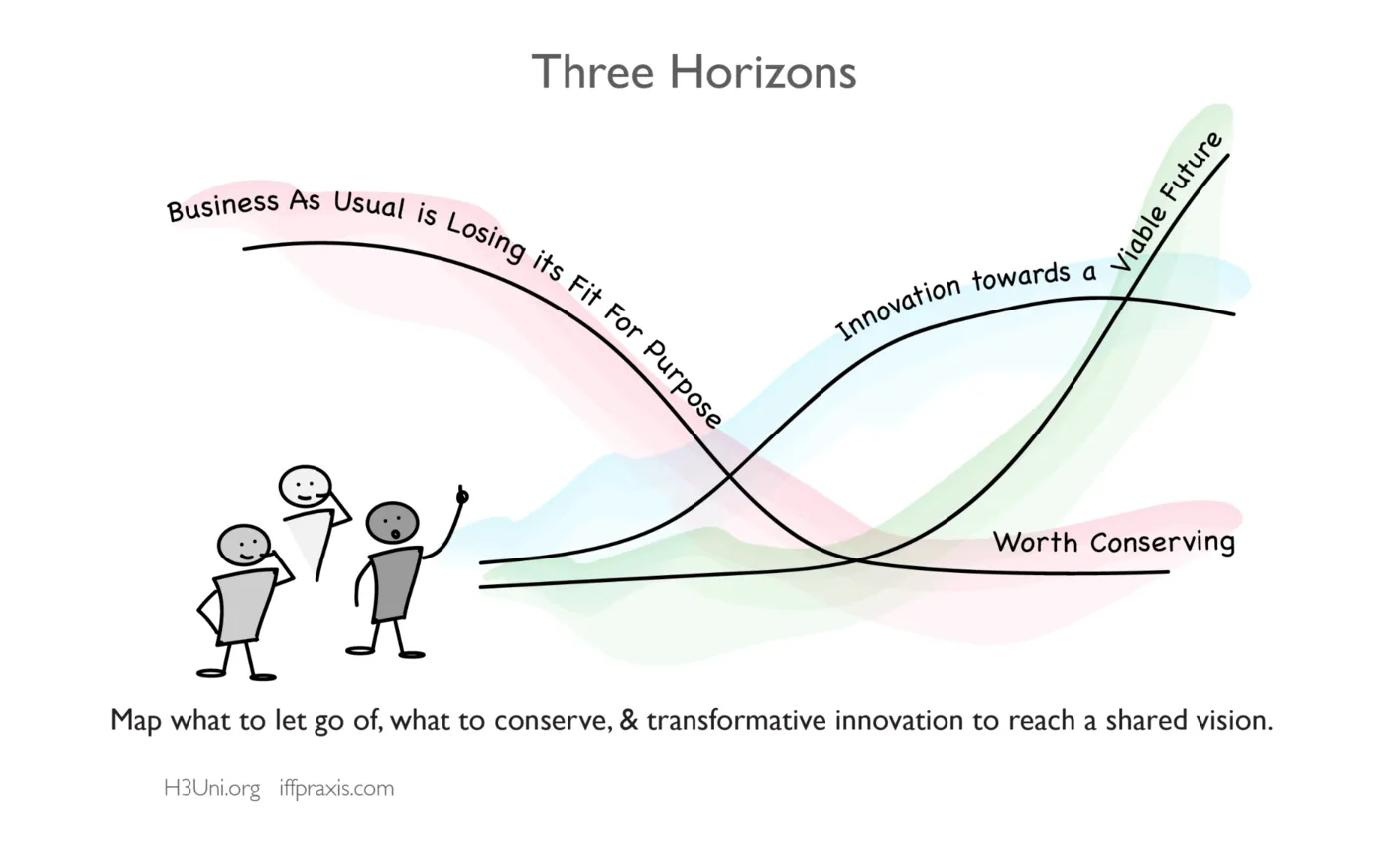
By following a model like this, change agents are able to generate more buy-in earlier in the process. A much more in-depth discussion of the model, with further resources, can be found in the H3Uni Three Horizons tutorial.
On leadership
Leaders of our era require different attributes than they have in the past. Authors, academics and thinkers such as Frederic Laloux (Reinventing Organisations), Giles Hutchins (Regenerative Leadership), Otto Scharmer (Theory U) and Dr Daniel Wahl (Designing Regenerative Cultures) join others in consensus that if we are to meet the challenges of the 21st century, leaders need to have an ‘awareness of self’. In support of this idea, the World Economic Forum released an article in 2015 describing the characteristics of leadership that are required to confront increasing complexity. Of particular relevance is the following quote:
“The point is that a greater degree of sophistication in a person’s understanding of and management of self and the world – what we might call “complexity of self” or simply “maturity” – directly influences how a person leads teams, negotiates, manages change, makes decisions, handles competing priorities and stakeholder interests, navigates relationships, and deals with emotional stress. Complexity of self is achieved by seeking growth and development, welcoming challenging experiences that stretch one’s understanding and equilibrium, exposing oneself to multiple perspectives, seeking and accepting feedback, listening and reflecting and, importantly, taking the risk of acting amidst uncertainty with the best of intentions for the good of the whole system, not just one’s own domain.” — Ted Bililies, Managing Director, AlixPartners, in How to be a Great Leader in a Complex World
Another relevant and inspiring work on emergent leadership for a regenerative world is Laura Storm and Giles Hutchins’ book Regenerative Leadership. They go deep into why a new leadership is needed and what Planet Earth is calling for.
“The old systems and structures of a post-industrial hyper-consumerist culture are slowly breaking down. The old ways cannot go on, and through this breakdown, we are witnessing pioneers all over the world birthing the conditions for a new way. These pioneers believe there is a better way – to live and do business. They are reconfiguring systems and structures and instilling new business practices that actually contribute to life on Earth rather than destroying it.
It may be easier to continue doing what you’ve always done, and it may seem sensible amid all this uncertainty and volatility to stick with what you are comfortable with. But in the long run it eats you up inside, weakens you and undermines your organization’s vitality and its stakeholder ecosystem.
The real question you have to ask yourself is: How can you help a new way to break through amid these challenging times? How can you act as if we indeed are in a time of crisis and help design new thriving ways?” — Excerpt from Regenerative Leadership, by Laura Storm and Giles Hutchins
A short video sharing an overall perspective of the book Regenerative Leadership.
When we are working to affect global change with the intention of producing health-generating outcomes, the way in which we approach this work is fundamental to the long-term impact of each action.
More recently, the so-called Inner Development Goals have been developed and are increasingly emerging. Meant to complement the SDGs, they provide a framework, concepts and a compilation of approaches, methods and skills to support and facilitate personal and collective transformation, reaching as far as our worldviews, beliefs, values, mindsets and attitudes, all of which underlie, or are at the core of, the multiple crises we face, and are in urgent need of an upgrade. They can be useful, as they provide valuable tools, methods and approaches for various aspects of working as a leader and facilitator, but they also have significant limitations and drawbacks that a regenerative leader has to be aware of.
Being a systems and regenerative leader for local change
Most of us have grown up in a world that addresses problem resolution using a very specific formula: breaking the issue down into its component parts and finding the weak link. This approach has proved quite successful, and in fact it was central to Frederick Taylor’s great time-and-motion calculations that brought us the substantial efficiencies that ushered in the great industrial age. However, this approach assumes a closed system: a finite world of inputs. With awareness of the interconnected nature of wicked problems, a new approach is required. The inputs are not only myriad and hard to quantify; they are constantly shifting and changing.
Leading transformation initiatives in this time requires awareness of the systems within which these issues sit. In her Forum for the Future article Systems Thinking: Unlocking the Sustainable Development Goals (2016), Stephanie Draper, CEO of Bond – The International Development Network, captured three useful levels of activity for using systems thinking in community-based projects.
| Level | Key element |
|---|---|
| The system | Complex systems insight |
| The community | Coalition-building and advocacy tactics |
| The individual | Collaborative leadership skills |
The key elements of systems leadership: systems leadership sits where the three overlap.
“For organisations rising to the challenge, that means operating on three levels – joining up with others’ efforts to achieve individual goals; looking at the inter-relationships between all the goals; and finally delivering the goals in a way that models the characteristics we need for a sustainable society.” — Stephanie Draper (2016)
The Australian Council for International Development has developed a free online toolkit for those looking to implement, for example, the SDGs, with a particular focus on applying systems thinking and collaborative approaches.
Being systemically aware requires humility, respect and curiosity. These attributes are critical because being a systems leader requires a constant and consistent immersion in learning.
This video created by UCLG (United Cities and Local Governments) encapsulates how the process of learning is central to the collaborative efforts that deliver success.
Gaia Education, alongside five other partners, coordinated the birth of a Youth Action for Nature and Well-being Toolkit, an example of a systems thinking approach to developing youth leaders ready to take action from a place of self-care, care for others, and care for the planet. Just like the concept of having multipliers around the world, the project focused on developing youth leadership to multiply the toolkit in their communities, creating ripple effects and, therefore, systemic changes.
Felicia Chavez is also a researcher and exponent of systems thinking, and has published several works such as Dear Marin, a case involving the SDGs and systems thinking. Felicia is also the creator of the course Systems Thinking for Real-World Change.
In any case, for practical work at a local level, pertinent living-systems-based questions to ask can include the following (source):
- What is the system in question, and how are we defining what belongs to the system and what does not?
- What is the wider context that the system in question operates in?
- What are the key agents whose interactions and relationships define the system structure and drive the system’s behaviour?
- How is our perspective of the system in question shaped by our worldview and value system?
- What are the key ‘emergent properties’ of the system that could not have been predicted by simply looking at the individual ‘parts’ of the system?
- How does our participation in the system, and our way of describing it, affect what we are observing?
A key skill in implementing transformation, in whatever context you operate in, is to develop the capacity for participatory group facilitation, as taught in this course and, of course, elsewhere. By bringing people together around questions that matter, we acknowledge that people have the capacity to work together, no matter who they are, and that each perspective has value to the whole.
When we think about the co-creation of new solutions that are intrinsically designed to create salutogenic conditions for all life around us, we are faced with yet another opportunity to challenge our traditional ways of thinking. We tend to find greater value in answers than in questions, and in solutions than in learning. We often experience the need for change as a threat to the status quo, and in doing so we rush to find solutions without truly understanding the opportunity we are confronted with.
In his book Designing Regenerative Cultures, Dr Daniel Wahl cites a 1903 quote which beautifully captures the more thoughtful and mindful approach that should accompany our work.
“[…] have patience with everything unresolved in your heart and do try to love the questions themselves as if they were locked rooms or books written in a very foreign language. Don’t search for the answers, which could not be given to you now, because you would not be able to live them. The point is to live everything. Live the questions now. Perhaps then, someday in the future, you will gradually, without even noticing it, live your way into the answer.” — Rainer Maria Rilke (1903)
To reinforce the concept of living the questions, Wahl poses the following:
“In a culture that demands definitive answers, questions seem to have only a transient significance; their purpose is to lead us to answers. But in the face of constant and rapid change and uncertainty, might not questions rather than answers offer a more appropriate compass?” — Daniel Wahl
Distributed and regenerative leadership
Your progress is saved in this browser. Register to save it on every device.
Text © IN.PACT partnership, shared under CC BY-SA 4.0. Images, videos and quoted works belong to their authors and are not covered by this licence unless stated.