
Lesson 4 · Module 4
Building communities of practice
Understand what communities of practice are and how to cultivate them over time, using seven design principles and the European Commission’s Playbook.
Building communities of practice (CoPs) in participatory facilitation fosters collective learning and shared ownership by bringing together individuals with a common domain to deepen knowledge through regular, peer-driven interaction. It emphasises tacit knowledge exchange, mutual support and co-creation, enabling participants to solve real-world problems, strengthen professional identity, and build trust across organisational or social boundaries. The essence lies in emergent, self-organised collaboration that bridges practice and learning, generating sustainable, context-rooted solutions.
This topic gives you some insights, and also practical tools, on why and how to create communities of practice as part of community-building processes.
Communities of practice: definition, origins and structure
Definition of communities of practice
Communities of practice (CoPs) are groups of people who share a common concern, field of activity, profession or passion, and who learn how to improve what they do through continuous interaction and shared experience. More than formal working groups or simple professional networks, communities of practice are spaces where learning emerges collectively through participation, dialogue, collaboration and practice.
The concept was developed mainly through the work of Etienne Wenger and Jean Lave in the early 1990s as part of their studies on social learning and apprenticeship. Their work challenged more traditional views of learning based only on formal education or individual knowledge acquisition. Instead, they proposed that learning is deeply social and takes place through participation in shared practices and communities. As the Wenger-Trayners later explained, communities of practice are:
“groups of people who share a concern or a passion for something they do and learn how to do it better as they interact regularly.” — Wenger-Trayner & Wenger-Trayner (2015)
This idea may appear simple, but it represented an important shift in how learning and knowledge began to be understood. Rather than seeing learning only as the transfer of information from an expert to a learner, communities of practice emphasise participation, relationships, shared experience and collective meaning-making. Knowledge is not simply transmitted; it is constructed and developed together through interaction and practice.
Origins and development of the concept
Although the term itself is relatively recent, the phenomenon is much older. Human societies have always learned collectively. Long before modern schools or universities existed, knowledge was shared through participation in communities: apprentices learned from artisans, hunters learned survival skills from elders, farmers exchanged techniques, and craftspeople developed practices together through guilds and workshops. Wenger and his colleagues note that communities of practice were among the earliest forms of social knowledge structures in human history.
The origins of the modern concept are closely linked to studies on apprenticeship and situated learning. Lave and Wenger observed that apprentices did not learn only through formal instruction from masters, but mainly through participation in a social environment where more experienced practitioners shared practices, stories, routines and tacit knowledge. Learning therefore happened through engagement in a community and through gradual participation in practice.
This represented an important shift in educational thinking. Traditional models often viewed learning as individual and classroom-based, centred on the transmission of knowledge from teacher to student. Wenger and Lave proposed a different perspective: learning is social, relational, and connected to participation in real practices and communities. In this sense, learning also becomes linked to identity, because people gradually become members of a professional or social community through participation.
The concept quickly expanded beyond apprenticeship studies and became influential in organisational learning and knowledge management. During the 1990s and early 2000s, many organisations began to realise that formal structures alone were insufficient for managing knowledge effectively. Valuable knowledge often remained informal, embedded in people’s experiences and daily practices. Communities of practice offered a way to connect practitioners, encourage collaboration, and facilitate the sharing of tacit knowledge.
The publication of Cultivating Communities of Practice by Wenger, McDermott and Snyder (2002) marked an important moment in the development of the concept. The authors argued that organisations should actively recognise and support communities of practice because they are central to learning, innovation and knowledge-sharing. Since then, communities of practice have been adopted in fields ranging from business and education to public governance, humanitarian work, digital collaboration and community development.
Where are communities of practice applied?
One of the reasons communities of practice became so influential is that they can exist in many different sectors and contexts. Wherever people learn through shared practice and experience, communities of practice can emerge.
In organisations and companies, CoPs are often used to connect employees working on similar challenges across departments or locations. Large organisations frequently struggle with fragmented knowledge and limited communication between teams. Communities of practice help create spaces where practitioners can exchange experiences, discuss challenges and collectively improve their work.
The literature provides several well-known examples. Companies such as DaimlerChrysler, Shell Oil, Hewlett-Packard, McKinsey & Company and the World Bank developed communities of practice to strengthen collaboration, preserve expertise and support innovation.
In education, communities of practice are widely used among teachers, educators, researchers and school leaders. They provide opportunities for peer learning, mentoring and collaborative reflection on teaching practices.
Communities of practice are also increasingly important in youth work and community development. In these fields, much knowledge is experiential and relational. Youth workers, facilitators and community practitioners often learn through experimentation, dialogue and reflection on practice. CoPs create spaces where these experiences can be shared collectively, helping practitioners develop more inclusive and participatory approaches.
International cooperation and humanitarian work also make increasing use of communities of practice. Wenger-Trayner presents the example of public-sector internal auditors from Eastern Europe and Central Asia who created a long-term learning community to strengthen their professional practices together (2015). Other examples include humanitarian negotiation networks, where practitioners working in conflict situations exchange experiences and support one another through peer learning.
Structure and characteristics of a community of practice
One of Wenger’s most important contributions was identifying the three core dimensions that define a community of practice:
- the domain,
- the community,
- and the practice.
| Dimension | What it is |
|---|---|
| Domain | Shared interest that gives us identity and purpose |
| Community | Relationships and interactions that enable learning and build trust |
| Practice | Shared repertoire of knowledge, tools, experiences and ways of doing |
The three dimensions of a community of practice overlap, and together they keep the community moving.
The domain is the shared field of interest that gives the group its identity and distinguishes it from a simple network or informal club. Belonging to the community means recognising the value of that domain and developing a shared competence around it, even when this knowledge is not formally acknowledged by outsiders.
The community refers to the relationships and interactions through which members learn together: they discuss common concerns, exchange information, support one another, and build trust over time. Sharing the same job title or accessing the same online space is not enough; a community of practice exists only when people actively interact and learn from one another, even if they do not work together every day.
Finally, the practice is the shared repertoire that members gradually create through sustained engagement, including stories, tools, experiences, routines, methods and ways of solving recurring problems. This practical knowledge may be deliberately documented, as in the case of engineers collecting lessons learned, or it may emerge informally through regular conversations, such as nurses exchanging patient-care experiences during lunch.
A community of practice therefore comes into being through the combination of these three elements: a meaningful domain that gives direction, a community that sustains learning relationships, and a practice that turns shared experience into usable knowledge.
What communities of practice are not
A useful way to introduce communities of practice is also to clarify what they are not. Because the concept has been used in many fields, it is sometimes surrounded by misleading assumptions.
A community of practice does not always appear spontaneously: although some groups organise themselves naturally, many need care, coordination, and conditions that help members see value in taking part. Nor is a community of practice necessarily leaderless or completely informal. In many cases, someone must support the group, connect people, organise activities, open strategic conversations, and help the community remain useful. This does not make the community less authentic; it simply recognises that shared learning often needs stewardship.
Another common misunderstanding is that communities of practice exist only to exchange knowledge that members already have. Sharing experience is important, but these communities can also generate new ideas, solve problems, create new ways of working, and give practitioners a stronger collective voice. Their value can also be assessed, even if not always with perfect precision: stories, examples, participation data, changes in practice and improvements in performance can all help show what the community is producing. At the same time, participation cannot be created by facilitation alone. A well-facilitated meeting helps, but people engage when the topic matters to them, when the organisation recognises the value of participation, and when members feel that their contribution leads to something useful.
It is also important not to romanticise communities of practice as always harmonious spaces. Disagreement can be productive when it is handled openly and respectfully, because differences often reveal new questions and lead to deeper learning. Similarly, technology does not create a community by itself. A platform, forum or online space becomes meaningful only when people use it to connect around shared practice.
Finally, communities of practice should not be treated as the answer to every learning or organisational challenge. They do not replace teams, networks, courses or formal structures; rather, they complement them. Their particular strength lies in creating social spaces where practitioners can learn from experience, test ideas, and improve their practice together.
Cultivating communities of practice: designing for aliveness
Once we understand what a community of practice is, the next question is not simply how to “create” one, but how to cultivate it over time.
This distinction is important. Communities of practice are living social spaces. They cannot be fully planned, imposed or controlled from the outside. They depend on people’s motivation, trust, shared interest and willingness to participate. For this reason, Wenger, McDermott and Snyder (2002) explain that the goal of community design is not to produce a fixed structure, but to create the conditions for the community’s own energy, direction and identity to emerge. They describe this as designing for “aliveness”.
A community of practice is alive when people feel that participation is meaningful. Members return because the community helps them think, solve problems, learn something useful, feel connected, test ideas or gain confidence in their work. This is especially important because participation in most communities of practice is voluntary. People will not continue to participate simply because a meeting exists; they participate when they experience value.
The chapter Seven Principles for Cultivating Communities of Practice, from the book Cultivating Communities of Practice by Wenger, McDermott and Snyder (2002), offers a useful framework for thinking about this process. These principles are not rigid rules or step-by-step instructions. Rather, they are orientations that can help facilitators and coordinators create the conditions for a community of practice to grow, evolve and remain meaningful over time.
The seven principles for cultivating a community of practice:
- Design for evolution
- Open a dialogue between inside and outside perspectives
- Invite different levels of participation
- Develop both public and private community spaces
- Focus on value
- Combine familiarity and excitement
- Create a rhythm for the community
Design orientations for facilitators and coordinators: these principles help communities grow, adapt and remain meaningful over time.
Principle 1: Design for evolution
Communities of practice are organic. They grow, change and adapt over time. For this reason, designing a community of practice is not the same as designing a formal organisation or a project plan. It is closer to supporting a living process.
A community of practice may begin with a small group of people who already know each other, or with an existing informal network. At the beginning, it is often better not to overdesign the community. A simple structure (for example, regular meetings around a shared challenge) can be enough to start building relationships and discovering what members really need.
As the community grows, new elements can be introduced gradually: an online space, shared resources, working groups, documentation, guest speakers, peer-learning activities or specific projects. The key is to allow the community to evolve according to the interests, needs and energy of its members.
A useful question for facilitators is: What small structure can help this community take its next step without limiting its natural development?
Principle 2: Open a dialogue between inside and outside perspectives
A strong community of practice needs both internal knowledge and external stimulation.
The “inside perspective” comes from the members themselves. They understand the real challenges, language, needs and practices of the community. They know what matters in their field and what kind of exchange would actually be useful.
At the same time, outside perspectives can help communities discover new possibilities and avoid becoming too closed within their own routines. External examples, new methodologies, practitioners from other fields or facilitators with different experiences can introduce fresh ideas and challenge existing assumptions.
Healthy communities of practice therefore create a dialogue between the knowledge already present inside the group and new perspectives coming from outside.
A useful question is: How can we honour the experience already present in the community while also bringing in new ideas that help it grow?
Principle 3: Invite different levels of participation
Not everyone participates in a community of practice in the same way. Some members become highly active, propose topics, lead activities and take responsibility for the community’s development. Others participate regularly but less intensely. Others may mostly observe, read, listen or join occasionally.
Wenger, McDermott and Snyder stress that this diversity of participation is normal and even necessary for healthy communities. The authors identify three main levels of participation:
- a small core group that actively drives the community,
- an active group that participates regularly,
- and a larger peripheral group that mainly observes and learns from the sidelines.
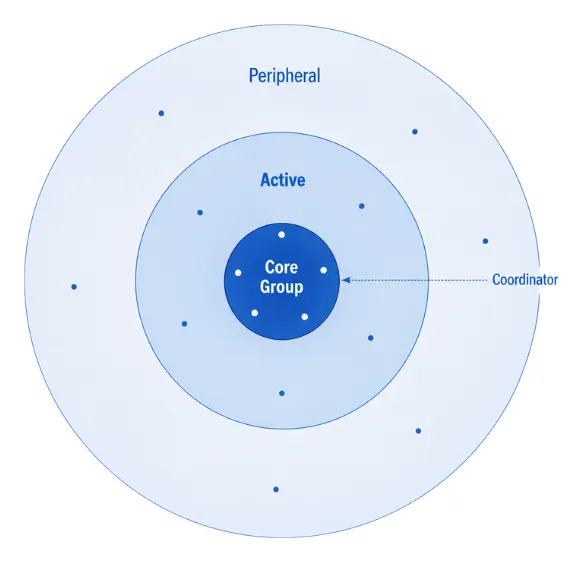
Peripheral participation should not automatically be interpreted as disengagement. Members who participate less visibly may still learn significantly from observing discussions, reading shared materials or following community activities.
A good community of practice creates “benches” for those on the sidelines, so that they can remain connected without feeling pressured. At the same time, it creates opportunities for members who want to take more active roles.
A useful question is: What different forms of participation can we offer so that people can engage in ways that feel meaningful and realistic for them?
Principle 4: Develop both public and private community spaces
Communities of practice live through both public and private interactions.
Public spaces are the visible moments of the community: meetings, webinars, workshops, online sessions, forums or shared events. These moments are important because they allow members to experience the community as a whole, exchange ideas, discuss topics and build a shared identity.
However, the life of a community of practice does not happen only in public meetings. Much of the real energy also comes from private or smaller interactions: one-to-one conversations, informal messages, follow-up exchanges, small working groups, peer support or spontaneous collaboration between members.
One common mistake is focusing too much on public events while neglecting the relationships that develop between them. A coordinator or facilitator often needs to “work” the private space by connecting people, following up after meetings, encouraging informal exchange and helping members find others who can support them.
The relationship between public and private spaces is mutually reinforcing. Strong personal relationships enrich public discussions, while public events often create opportunities for new private connections.
A useful question is: How can we strengthen both the shared moments of the community and the smaller connections that happen between them?
Principle 5: Focus on value
Communities of practice survive when members experience value.
This value can be practical, such as finding a solution to a problem, discovering a useful method, receiving feedback, accessing expertise or saving time. But it can also be relational or personal: feeling less alone, gaining confidence, meeting peers, being recognised, or developing a stronger professional identity.
Importantly, the value of a community of practice is not always visible immediately. Sometimes a conversation becomes useful weeks or months later, when a member applies an idea in their work. For this reason, communities should create moments where members can reflect on the value they are gaining.
Discussing value openly can also help members recognise the impact of the community and understand why participation matters.
A useful question is: What are members taking from this community into their real practice?
Principle 6: Combine familiarity and excitement
A successful community of practice needs both comfort and stimulation.
Familiarity creates trust. Regular formats, known faces, repeated rituals and predictable spaces help people feel safe enough to ask questions, share doubts and speak honestly. Over time, the community can become a place where people feel comfortable bringing unfinished ideas or difficult experiences.
At the same time, too much routine can make a community lose energy. Communities also need excitement: new topics, external guests, fresh examples, challenging questions, creative methods or opportunities to explore emerging issues.
Wenger, McDermott and Snyder describe vibrant communities as spaces that combine the comfort of familiarity with the energy of novelty.
“Routine activities provide the stability for relationship-building connections; exciting events provide a sense of common adventure.” — Wenger, McDermott and Snyder (2002)
A useful question is: How can we create enough continuity for trust, while also bringing enough freshness to keep people engaged?
Principle 7: Create a rhythm for the community
Finally, a community of practice needs rhythm.
Rhythm gives the community a sense of movement and continuity. It may include regular meetings, online discussions, informal check-ins, shared resources, peer groups, special events or moments of collective reflection.
If the rhythm is too slow, the community may lose energy. If it is too intense, members may feel overwhelmed. The right rhythm depends on the community’s purpose, members’ availability and stage of development.
Rhythm is described as one of the strongest indicators of a community’s aliveness. It is through rhythm that members know when and how to engage, and through rhythm that the community becomes part of people’s professional or organisational life.
In practice, rhythm could mean a monthly online session, a short reflection prompt between meetings, an active forum, or one special event every few months. What matters is that interaction does not depend only on occasional enthusiasm, but is supported by a structure that keeps the community present and active.
A useful question is: What rhythm is realistic enough to sustain participation, but alive enough to keep the community moving?
Final reflection
These seven principles show that cultivating a community of practice is not about controlling people or imposing a fixed structure. It is about creating the conditions for participation, learning and relationships to grow. A facilitator or community coordinator does not “make” a community alive. Instead, they help design spaces, rhythms, invitations and connections that allow the community’s own energy to emerge.
From theory to practice: the Communities of Practice Playbook
After exploring what communities of practice are and what helps them grow, we can now move to the practical question: how can we actually create, develop and sustain a community of practice over time?
To support this step, we can use the Communities of Practice Playbook, developed by the European Commission. This Playbook is a practical guide for people who want to start, run, support or strengthen a community.
It was created from research and direct experience with different communities inside the European Commission, and it brings together:
- practical guidance
- good practices
- reflection questions
- visual tools
- roadmaps for community development
Rather than giving a rigid formula, the Playbook helps us explore the key elements that make a community work:
- Vision
- Governance
- Leadership
- Convening
- Collaboration and cooperation
- Community management
- User experience
- Measurement
In this sense, the Playbook works like a practical companion: it helps transform the ideas explored in this module into concrete steps, questions and tools for building a living community of practice.
Explore the online version of the Playbook, or download the PDF version.
Further resources and inspiration
To continue exploring communities of practice, here are two video resources that bring the topic to life through real voices, examples and reflections.
Learning from Etienne and Beverly Wenger-Trayner
In this conversation, Anamaria Dorgo speaks with Etienne and Beverly Wenger-Trayner, internationally recognised researchers and practitioners in the field of communities of practice and social learning.
The conversation is a great way to hear directly from two of the people who have shaped this field. They discuss:
- the difference between communities of practice and broader social learning spaces
- how communities can be launched and supported inside organisations
- how participation and learning emerge through interaction
- how the value of communities can be understood through stories and shared experience
The conversation is practical, reflective and accessible, and offers a very useful complement to the ideas explored in this module.
A close-up look at communities of practice, with Etienne and Beverly Wenger-Trayner.
Why are communities of practice important?
In this second video, Emily Webber explains in a very practical and engaging way why communities of practice matter inside organisations and learning environments.
Emily Webber on building successful communities of practice.
Sources used for this topic
Building communities of practice
Your progress is saved in this browser. Register to save it on every device.
Text © IN.PACT partnership, shared under CC BY-SA 4.0. Images, videos and quoted works belong to their authors and are not covered by this licence unless stated.