Lesson 2 · Module 4
Collaborative governance and decision making
Learn how groups govern themselves, compare ways of deciding from voting to consensus, sociocracy and holacracy, and help groups work with uncertainty.
Collaborative governance is a strategic approach used in community development, or in any other group setting, to address complex issues and challenges by bringing together all parts and members of a group or community, reflecting its diversity. This approach fosters shared decision-making, equitable representation and joint accountability, enabling more resilient, inclusive and sustainable outcomes.
We will explore the foundations and practices of collaborative governance based on formalised structures and systems of coordination, inclusive engagement, and equity-centred principles like shared leadership, transparency, conflict resolution, and policy and systems change to address structural inequities and build trust. Practices like sociocracy or holacracy and other established collaborative governance and decision-making approaches will be explored, including case studies.
When implemented effectively, collaborative governance leads to improved resource allocation, enhanced creativity, stronger community trust and long-term resilience.
In summary, collaborative governance is not just a process. It is a transformative framework that restructures power dynamics, centres community voices, and enables sustainable, co-created solutions in group and community development, useful and adaptable in any context and setting.
How groups govern themselves
All human groups, including sustainable community initiatives and organisations, need to work out how to govern themselves. Since many intentional communities are explicitly exploring new ways of bringing people together that encourage creativity and natural leadership capacities, they require governance processes that support this intention. The same is true for cooperatives, social enterprises, transition town groups and any other intentional collective of positive change agents who want to work together.
This section focuses on the internal socio-political issues of sustainable communities and organisations, including some of the difficulties commonly encountered and the skills that promote smooth processing. Participatory techniques give people a voice in the decisions that affect their lives, but sometimes participation is challenging. Lack of knowledge or care about how to conduct a meeting has deep consequences that affect the quality of participation and may cause conflict.
What to observe in a group
All of us have spent a good part of our lives in groups of various sorts, but rarely have we taken time to stop and observe what is going on in the group, and ask why the members are behaving in a certain way. Here are some of the factors you may observe in any group.
1. Content and process
In any group meeting or discussion, we will find two main elements:
- Content: what is being said, the matter under discussion.
- Process: what is happening to the group itself, the way things are being accomplished.
2. Issues involved in any group
- Problems of identity and acceptance within the group. Who am I in this group? Where do I fit in? What kind of behaviour is acceptable here? Do I belong?
- Problems of group goals and personal needs. What do I want from the group? Are its goals consistent with mine? What have I to offer the group?
- Problems of power, control and influence. Who is in charge? Who will control what we do? How much influence will I have?
- Problems of intimacy. How close will we get to each other? How personal will things be? How much can we trust each other?
3. Roles or qualities to watch for in a group
- Leadership: seeking to bring out the best in the group and its members, in service to the group’s goals; can be seen as an authority figure.
- Followership: leaning on the leader or on anyone who seems to represent authority.
- Opposer: resisting anyone who seems to represent authority.
- Pairing: seeking one or more supporters.
- Fighting and controlling: asserting personal dominance, attempting to get one’s own way, to satisfy one’s own needs, regardless of others.
- Care: showing interest in people’s needs.
- Facilitation: drawing out ideas and processes to help the group move forward.
- Eldership: showing a capacity to accept and respect difference and conflict.
- Withdrawing: taking no part in the group to escape uncomfortable feelings.
4. Clues to help us observe
- Who talks? For how long? How often?
- Who do people look at when they talk? At the group? At one person? At the floor?
- How do people speak? What tone of voice?
- Who talks after whom? Any small asides between couples?
- Who interrupts? Do they interrupt the same person constantly?
- What gestures are used?
- How do people sit?
- Any yawns, twiddling of thumbs, gazing out of windows?
Ground rules for effective groups
Ground rules are a set of guidelines describing behaviours that may improve a group’s process. Sometimes the group develops these rules cooperatively, and sometimes the facilitator presents them as a proposal at the beginning of the group’s first meeting, or at the first meeting in which they are to be used.
Regardless, once ground rules have been accepted by the group, it is the job of the facilitator and all participants to see that the group respects these norms. Some sample ground rules (also called “group agreements”) appear below. Each group naturally chooses the norms that best meet its needs and values.
Many people tend to rebel against “rules”, since the very word reminds them of being in an authoritarian culture. So some groups reframe these as “norms”, recognising that they enable a smoother functioning of the group and more effective ways to meet their collective and individual needs.
Sample ground rules or norms
In her Introduction to Consensus handbook, Beatrice Briggs brings together a set of common rules found in all types of groups.
The bare minimum:
- Use a facilitator
- Everyone participates
- Speak only for yourself (make ‘I’ statements, rather than speaking for the group)
- No interrupting
- Seek a solution
Also useful:
- Begin and end on time
- Have an agenda and stick to it
- One speaker at a time
- Listen with respect
- No personal attacks or blaming
- Confidentiality (when appropriate)
- Silence = assent (if you do not say anything, it means you agree)
Other agreements used by some groups:
- Alternate male and female speakers
- No one may speak twice on a subject until everyone who wants to speak for the first time has had a turn
- Each speaker who is physically able must stand to speak (this is especially useful in large groups, or in groups where individuals tend to sit back in their seats and expound at length)
- Order of speakers is (1) people from other countries, (2) people of colour, (3) young people (under 20 years old), (4) women, (5) men
- Express yourself clearly and honestly
- All are treated equally and with respect
- We agree to disagree
- Seek common ground
- Listen to be changed
Behavioural ground rules for effective groups
Roger Schwarz’s “behavioural ground rules” differ from the more “procedural ground rules” that many groups and facilitators use. He says, “Procedural ground rules can be helpful, but they do not describe the specific behaviours that lead to effective group process.” His list of ground rules for effective groups includes:
- Test assumptions and inferences: when you assume something, you take for granted that it is true without verifying it.
- Share all relevant information: this ensures that members have a common base of information on which to make an informed choice and generate commitment.
- Use specific examples and agree on what important words mean: this enables the group to share relevant information that generates valid data.
- Explain your reasoning and intent: this means making your private reasoning public, so that others can see how you reached your conclusion and can ask you about parts of your reasoning which they may approach differently.
- Focus on interests, not positions: it is difficult to agree on positions, but easier to generate solutions that take into account all the interests identified.
- Combine advocacy and inquiry: this shifts a meeting from a series of monologues to a real dialogue, creating conditions for learning.
- Jointly design next steps and ways to test disagreements: this means deciding with others what topics to discuss, when to discuss them, how to discuss them, and when to switch topics, rather than making a decision privately and unilaterally.
- Discuss undiscussable issues: undiscussable issues are those that are relevant to the group’s tasks but that group members believe they cannot discuss openly in the group without some negative consequences.
- Use a decision-making rule that generates the degree of commitment needed: the more the group members are able to make an informed free choice, the more they are likely to be internally committed to the decision.
Collaborative decision making
“We meet and just keep talking until there's nothing left but the obvious truth.” — Oren Lyons, Faithkeeper of the Turtle Clan of the Onondaga Iroquois
Nowadays people are beginning to demand a voice in decisions that affect their lives, bringing their own creativity and insight to decision making. Wherever groups of people gather today to figure things out, make decisions or solve conflicts, there is the question of who gets to participate, whose wisdom will be heard and what process will be used.
Although hierarchy and top-down decision-making processes are still used, most groups (communities, organisations and nations) have learned the advantages of becoming more democratic and favouring greater participation, at least at some levels of government. In theory, democracy already includes the idea of participation: the etymological roots of democracy (Greek demos and kratos) imply that the people are in power, and thus all democracies are participatory. But reality tells a different story, and in its most common version, called representative democracy, it has many failures, including:
- Exclusion: people are sometimes excluded from elections and/or decision processes because of such things as age, race, class, gender, nationality, religion, homelessness, illiteracy, criminal convictions and mental illness.
- Majority rule: democracy offers little protection to marginalised and oppressed minorities (the tyranny of the 51%).
- Government abuses.
- Bureaucracy (including corruption, collusion, nepotism and more).
These weaknesses illustrate the famous statement of Winston Churchill: “Democracy is the worst form of government except for all those others that have been tried.”
In order to correct some of the defects of current democracy and work towards a sustainable future, (local) communities and organisations are fostering greater participation among their members.
“Participatory democracy is a process emphasizing the broad participation of constituents in the direction and operation of community and organizational systems. Participatory democracy tends to advocate more involved forms of citizen participation than traditional representative democracy. Participatory democracy strives to create opportunities for all members of any group to make meaningful contributions to decision making, and seeks to broaden the range of people who have access to such opportunities.” — Wikipedia, ‘Participatory democracy’
Different forms of participatory democracy include:
- Direct democracy: a form of government in which people collectively make decisions for themselves, rather than having their political affairs decided by representatives. Direct democracy is classically termed “pure democracy”.
- Deliberative democracy: a form of democracy in which public deliberation is central to legitimate lawmaking.
- Consensus democracy: the application of consensus decision making to the process of legislation. It is characterised by a decision-making structure which involves and takes into account as broad a range of opinions as possible, as opposed to systems where minority opinions can potentially be ignored by vote-winning majorities.
- Sociocracy: a system of governance using consent-based decision making among equal individuals and an organisational structure based on cybernetic principles (more on this a bit later).
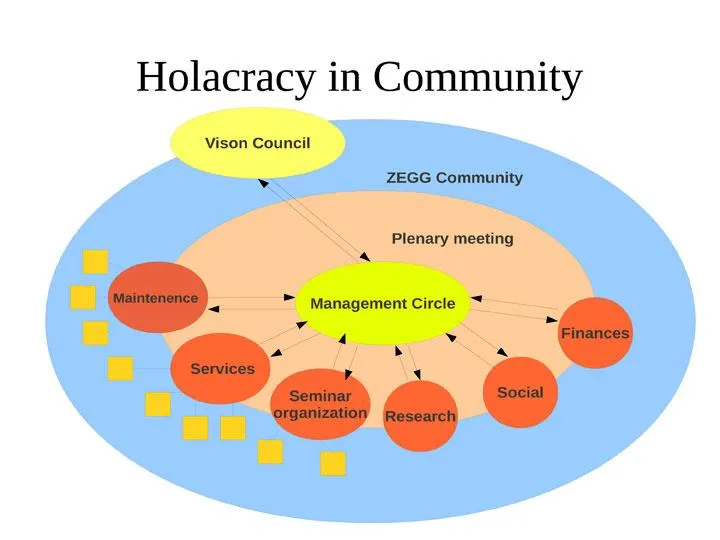
- Holacracy: a system of governance in which a group or organisation governs itself as a whole. It is a decentralised system that makes good use of the self-organising capabilities of complex and adaptive systems (more on this a bit later).
- Distributed decision making, such as the Advice Process: this was described by Frederic Laloux in his book Reinventing Organisations. It consists of a “decider” who has a stake in the issue seeking advice from those impacted by the issue, those with useful information about it, and others who might support or sabotage any changes. The decider then listens to the advice and makes a decision.
Government and governance
We need to distinguish between government and governance.
- Government is the governing body of a nation, organisation or community. In large groups the government is elected from among its members. In small groups it may be the whole group.
- Governance is the action or manner of governing. Governance involves the exercise of power to manage the affairs of a nation, organisation or group. Participatory governance is a relatively new phenomenon on the world stage, though practised by many indigenous cultures for centuries.
Within governance, not only who decides but also how decisions will be made needs to be considered. This implies answering the following questions:
- Are all decisions equal in importance, scope, etc.?
- Who has the power to make what types of decisions?
- Which decision-making method do we want to use for each type of decision?
- How often do we want to meet? How long do we want our meetings to be?
- What are our common agreements for meetings?
- How are we going to ensure a fair and participatory decision-making process?
- How do we handle conflicts and strong emotions arising in the decision-making process?
- How are decisions communicated to the whole group?
Democracy and deep democracy
Etymologically the word democracy means “people power”. One of the original goals of democratic forms of government was to balance and distribute power so that everyone had power, not just the ruling elite. What can be wrong with people power? As Arnold Mindell says, if people could be reasonable instead of emotional, democracy – and the good use of power – might work. But without awareness of our capacity to interact, social power alone will never solve our interactional problems.
According to Mindell (2002) there are two reasons why democracy does not work well:
1. Democracy mainly addresses social issues, not inner, personal ones. Within the privacy of our inner autonomy, without some form of awareness training, most of us behave like tyrants as we repress important parts of ourselves and then behave in a dictatorial way. We are not truly democratic inside. Democracy cannot work as long as it is recognised only as a blueprint for external structures. To make democracy an inner experience, we need to engage in some form of inner work, or inner dialogue, to create a deeper democracy.
2. Democracy is based on the concept of citizen power: more specifically, the power of the majority, instead of an awareness within each citizen. Perhaps in the best of all possible worlds, the majority is interested in the minority’s viewpoints; however, this is rarely the case. Awareness is a more comprehensive guiding principle than power. By using awareness, we can track what happens to those people and parts of ourselves that are not part of the majority when the majority rules.
“Inner work and awareness lead us to a deeper democracy. Deep democracy claims that all people, parts, and feelings are needed. Deep democracy appreciates present democratic forms but adds to them the need for awareness of feelings and atmosphere in moment-to-moment interactions and institutional practices. Deep democracy uses linear, organizational rituals, rights, and fair procedures after subtle, nonverbal experiences have been articulated and valued.” — Arnold Mindell (2002)
In order to deepen our collective practice of democracy, we also need to acknowledge that people-power comes with people-responsibility. Democracy (demos, the people, and kratos, the rule of) has to be paired with demosopheilo (opheilo, the responsibility or duty of the people) in order to be effective. It is not enough to say, “I want our society, organisation or community to run like this,” and vote for it. We have to acknowledge that we play an active part in creating the world we profess we want, and uphold the rules and regulations we voted for.
Furthermore, the outcome of truly participatory democratic decisions will also depend on the knowledge and wisdom of those who democratically made those decisions. We also need demosophy (the wisdom of the people). One could say a democracy is only as good as the quality of its education system and people’s open access to knowledge and information, based on a wide variety of perspectives and worldviews.
Foundations of good decision making
“What if we saw meetings – understood as gatherings to discuss issues of shared importance and to make collective decisions – as a basic human need, like food, sleep, or sex? What if meetings were treated not as a boring obligation, but as essential for survival? What if meetings connected us to our psychic depths, to our local community, and to the great mystery?” — Bea Briggs
To build a healthy group or community, the questions of governance (Who decides? How will we decide?) must be collectively answered. Making clear choices about the fundamental issues of power and process can transform a diverse group of people into a strong, stable, loving community. Not having a fair, participatory decision-making method early in a group will almost certainly generate conflict over power imbalances at some point.
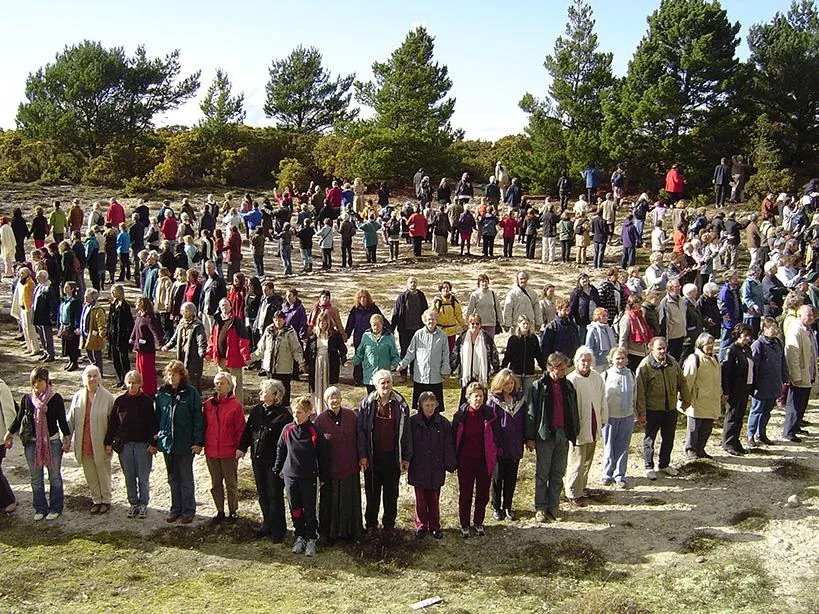
Greater participation doesn't imply that everybody must decide everything. Experience shows that this is too unwieldy, especially for big groups. People want to have input into the decisions that affect their lives, but they don't want to take part in meetings that are too long, boring or controlled by a few. We must learn to think and decide together in an integrated, synergistic way, rather than in fragmented and competitive ways. Present modes of collective decision making like the ballot box are simply too open to corruption and too slow for the swift, responsive self-guidance that we as societies need now.
In 2013 and 2014 many European countries felt a strong call for more participatory governance from their citizens (for example in Greece, Italy and Spain, but also in the UK). The same calls were heard earlier in the so-called Arab Spring, across Latin America, and in Asia (Thailand and India). We are on the cusp of an evolutionary leap to a more collaborative, participatory and co-responsible way of organising human society regionally, nationally and globally. This will require innovation in all fields, especially governance and education, and it will only succeed if most people get involved and stay involved.

So, what are the options? How can we as individuals promote a holonic shift and take part in it? The following guidelines, from the Work That Reconnects by Joanna Macy, are offered to invite further reflection on the way we make decisions and co-create healthy, thriving and regenerative cultures together.
- Attune to a common intention. Intention is not a goal or plan you can formulate with precision. It is an open-ended aim: may we meet common needs and collaborate in new ways.
- Welcome diversity. Self-organisation of the whole requires differentiation of the parts. Each one’s role in this unfolding journey is unique.
- Know that only the whole can repair itself. You cannot ‘fix’ the world, but you can take part in its self-healing. Healing wounded relationships within yourself and between you and others is integral to the healing of our world.
- You are only a small part of a much larger process, like a nerve cell in a neural net. So learn trust. Trust means taking part and taking risks, when you cannot control, or even see, the outcome.
- Open to flows of information from the larger system. Do not resist painful information about the condition of your world, but understand that the pain you feel for the world springs from interconnectedness, and your willingness to experience it unblocks feedback that is important for the wellbeing of the whole.
- Speak the truth of your experience of this world. If you have persistent responses to present conditions, assume that they are shared by others. Be willing to drop old answers and old roles; give voice to the questions that arise in you.
- Believe no one who claims to have the final answer. Such claims are a sign of ignorance and limited self-interest.
- Work increasingly in teams or joint projects serving common intentions. Build community through shared tasks and rituals.
- Be generous with your strengths and skills. They are not your private property. They grow from being shared. They include both your knowing and your unknowing, and the gifts you accept from the ancestors and all beings.
- Draw forth the strengths of others through your own acknowledgement of them. Never prejudge what a person can contribute, but be ready for surprise and fresh forms of synergy.
- You do not need to see the results of your work. Your actions have unanticipated and far-reaching effects that are not likely to be visible to you in your lifetime.
- Putting forth great effort, let there also be serenity in all your doing, for you are held within the web of life, within flows of energy and intelligence far exceeding your own.
Different systems to make decisions
The following list shows different methods of making decisions. Each one can be appropriate in different cases. Even the autocratic model, where the decision is made by a single person, can be very useful in extreme situations of crisis. Every group should consider what the best option is for a particular case, according to the group’s level of maturity and training. In many cases, groups use a combination of systems.
- Delegating decisions. An individual, subgroup or external party makes the decision for the group. Under a hierarchical scheme, the leader, president or a small group of people (oligarchy) makes the final decision with (consultative) or without (autocratic) input from the group members. Other forms of delegation include asking an expert to decide, or forming a committee made up of a few members to deal with the issue and reach a conclusion.
- Averaging decisions. Each group member makes their decision individually and these private recommendations are averaged out to yield a nominal group decision. For example, to choose among five possible candidates for a job opening, each member could rank the candidates from 1 to 5 and the group could then average these rankings.
- Plurality decisions. Members express their individual preferences by voting, either publicly or by secret ballot. In most cases, the group selects the alternative favoured by the majority of the members (simple majority scheme), but in some cases a more substantial plurality (such as a two-thirds majority scheme) is needed before a decision becomes final.
- A variant of plurality decision making is Systemic Consensus, which is a consensus-oriented group decision-making principle and method. The principle is that minimising participant resistance should be the highest concern when making decisions. The method asks participants to score all proposals, including the status quo, according to how much they oppose them, and selects the proposal with the lowest score.
- Deliberative decisions. The group members discuss the issue until they reach agreement without voting. Deliberation aims at a rationally motivated consensus: it aims to find a solution acceptable to all. In some cases, when consensus or something near enough is not possible, some kind of majoritarian decision method may be used (Forsyth, 2010).
Each decision-making system has its strengths and weaknesses. Delegation saves the group time and is appropriate for less important issues. Mandates from authorities can, however, leave members feeling disenfranchised and ignored. Averaging individual members’ inputs often cancels out errors or extreme opinions. But a group that just averages without discussion may make an arbitrary decision that fails to satisfy any of the group members, all of whom may end up feeling little responsibility for implementing the decision.
Some groups rely on some type of voting procedure to make final decisions. Voting is a way of making a clear-cut decision, even on issues that deeply divide the group, without involving a great amount of effort from individual group members. But it also has important limitations. When the vote is close, some members may feel alienated and defeated, and might be less likely to lend support to the decision. Voting can also lead to internal politics, as members get together before meetings to apply pressure, form coalitions and trade favours to ensure the passage of proposals that they favour.
Also, if the vote is taken publicly, individuals may conform to previously stated opinions rather than expressing their personal views. In the case of decisions where a high level of technical or background knowledge is required, but only some members of the group have this knowledge, the result of voting can often be biased by personal sympathies or simplistic arguments, and therefore may not serve the group in the long term. Education, and having all the necessary background information and knowledge, is critically important for good decision making. The issue of acknowledging the importance of ‘expert’ knowledge, without falling into delegating decisions to experts who might only see one aspect of the issue at hand, is difficult to resolve.
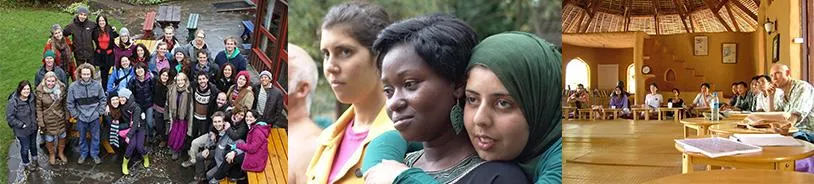
Decision making: consensus
Some groups avoid these drawbacks by resolving to make decisions by consensus. Consensus decision schemes create involvement and often lead to high levels of commitment to the decision and to the group. Unfortunately, groups may not be able to reach consensus on all issues. Consensus building takes a lot of time, and if rushed, it can fail.

Consensus was developed by Quakers in seventeenth-century England as an extension of their beliefs in equality, nonviolence and everyday accessibility to divine guidance.
A summary of consensus
“Consensus goes beyond majority rule. It replaces traditional styles of ‘top-down’ leadership with a model of shared power and responsibility. A group which uses consensus process effectively can become a healthy community and a powerful force for social change.” — Bea Briggs
Consensus is a decision-making process which strives for nonviolent resolution of conflicts and the cooperative development of decisions that everyone can support.
In order for a consensus process to work, five essential elements must be in place:
- A willingness to share power
- Informed commitment to the consensus process
- A common purpose
- Strong agendas
- Effective facilitation
1. Willingness to share power. Participants in a consensus group must be willing to give up hierarchical roles and privileges and to function as equals. The contributions of experts, professionals and elders are, of course, welcome, but they must not be allowed to silence the voices of other members of the group.
2. Informed commitment to the consensus process. Because consensus is radically different from the way most of us have been conditioned to function, the process needs to be carefully explained and the fundamental principles reviewed from time to time. The more people in the group who understand the process, the better it will work.
3. Common purpose. Without an overarching purpose to unify and focus its efforts, a group will spin its wheels endlessly, trapped in confusion, frustration and ego battles.
4. Strong agendas. The lack of an agenda, an agenda controlled exclusively by one or two people, and poorly prepared agendas all undermine the consensus process. They waste people’s time, erode their trust, and diminish a group’s effectiveness.
5. Effective facilitation. A facilitator is a guide, not a participant in the discussion. They must be neutral about the topics being discussed and fair in the treatment of all the members of the group, showing no favouritism. A facilitator does not give answers, but rather continuously asks questions intended to equalise participation (“Are we hearing from everyone?”), elicit wisdom (“Are there any other ideas?”), and clarify the group’s situation (“Are we ready to move on?”).
This section is based on Bea Briggs’s book Introduction to Consensus.
Three stages in the decision-making process
In the consensus process, no votes are taken. Ideas or proposals are introduced, discussed and revised as necessary, before reaching the point of decision. No significant issue may be introduced, discussed and decided in one meeting. If consensus is not reached, no action is taken. The intention is to nonviolently resolve all concerns and conflicts surrounding a proposal so that everyone can support the decision.
Further down this page you can find a consensus flowchart outlining the process, produced by Tree Bressen. The process follows a series of steps, starting with the presentation of the issue: background, clarifying questions, gathering relevant information.
- Discussion: I listen, ask, think about, feel, give my opinion, research, etc. (as much time as needed, perhaps over different meetings).
- Proposal: I propose… (to be done in a short time, weighing up the group’s interest and giving up if there is no interest).
- Refinement: listening to concerns, modification of the proposal or emergence of a new proposal.
- Decision: three options:
- To block: I oppose the decision, because:
- it is against my ethical principles
- it is against the group’s values and vision
- it endangers the existence of the group
- To stand aside: I don’t oppose, but don’t support either. I don’t take part in what follows.
- To give consent: there may be small details I don’t like. However, I support the decision and its implications.
- To block: I oppose the decision, because:
The final question: before taking a decision, the facilitator restates the proposal and asks, “Are there any concerns or objections to this proposal?” If there is no answer, there is consensus.
If full consensus turns out to be difficult to implement in your group, you have other options which keep the same spirit of inclusiveness and transparency:
- Super-majority voting: as in consensus, people try to build agreement for a proposal and modify the proposal as needed, but they vote for or against it. Depending on what the group has decided in advance, the required majority can be anywhere from 55% to, say, 95%. Typical numbers are a two-thirds or three-quarters majority.
- Voting fallback: the group attempts to come to consensus once, or twice, and if they don’t reach consensus, they fall back to a percentage of voting the group has previously decided on.
- Consensus minus one: in consensus-minus-one, a proposal still passes even if someone blocks it. It takes two to block the proposal for it not to pass.
- The sunset clause: in consensus, once a decision is made, it requires a consensus of the whole to change it. With a sunset clause, the group agrees on a proposal for a certain period of time, at which point the decision is automatically discontinued and the situation reverts to what it was before. The decision can be continued only by a consensus of the whole.
- Sociocracy: also called dynamic self-governance, it suggests an organisational structure as well as a decision-making process called consent.
These options are from Diana Leafe Christian (2003), Creating a Life Together*, New Society Publishers.*
Consensus process steps
This is the consensus flowchart, set out as steps:
- Presentation of issue: history of the item; why it matters; goal of today’s discussion. It may begin with a proposal for action or may focus on defining the issue.
- Clarifying questions and gathering input: ensure the issue is fully understood; gather feelings, ideas and possibilities; consider individual needs.
- Proposal: what we will do and how.
- Test for consensus: does this proposal work for the group? Have all concerns been resolved?
- Yes: consensus agreement (see step 8).
- Yes, with someone standing aside: “I don’t like this proposal because…, but I am willing to let the group proceed.” The person standing aside has no major implementation responsibilities, but is still bound by the decision.
- No: go to step 5.
- Concerns: problems with the proposal. The issue may be sent to a committee or laid over to a future meeting.
- Modification: address the concerns, and make changes to better serve the whole. Then return to the proposal (step 3) and test for consensus again.
- Block: “I have a firm conviction that this proposal does not serve the interests of the whole.” If the block is resolved, the proposal goes back to modification. If it is not resolved, the issue is laid down.
- Consensus agreement: a sense of unity; no remaining unresolved concerns; the decision is recorded in the minutes.
The cycle of proposal, test, concerns and modification is held by discussion, revisions, exploration, dialogue and listening. Adapted from the consensus process flowchart by Tree Bressen.
Decision making: sociocracy and holacracy
Both sociocracy and holacracy have become increasingly popular among non-profits, businesses and communities that are looking for alternatives to conventional top-down decision making. Learning about these options can yield insights into the ways we govern ourselves and help us organise our groups for effective functioning and successful results.
Sociocracy, also known as dynamic self-governance, is a form of governance using consent and an organisational structure emphasising equality, transparency and efficiency. Holacracy is a governance system that distributes authority for decision making throughout the hierarchy of a company or group, supporting self-organising teams and helping to foster innovation. Let’s look more closely at each one and identify each system’s advantages and disadvantages.
What is sociocracy?
Sociocracy literally means ruling by people who have a social relationship with each other. The concept was developed in Europe in the 1800s and first implemented in a Dutch school in the mid-20th century. Dutch educator and peace activist Kees Boeke based the school’s system on the values and consensus process of the Quakers, which he called one of the first sociocratic organisations. Boeke’s system required consensus to be reached before action could be taken, and included delegating detailed decisions to committees and making decisions by representatives if the group was large.
In the late 1960s a Dutch electrical engineer and former student of Boeke’s, Gerard Endenburg, further refined Boeke’s ideas for use in his own company. His system relies on the following principles:
- Policy decisions are made by consent. Action is taken only when all objections have been heard and the proposal has been modified to address them. Any objections must be “reasoned and paramount”. A process of rounds is typically used for discussion and checking for objections.
- The group is organised in circles. Each circle is semi-autonomous within its own realm of activity and responsibility. The circles are responsible for their own development and success in their sphere within the organisation.
- The circles are double-linked. Each circle appoints a representative to each higher circle, and each higher circle has a representative in each lower circle. The representatives are fully participating members of both circles and form a double feedback loop.
- People are elected to roles and responsibilities by consent. This basically means that the same process used to make policy decisions is used for filling jobs: people are nominated, reasons are given and the election of a certain individual is tested for consent.
Advantages of sociocracy. While at first glance sociocracy looks a lot like consensus, it differs from consensus in several important ways, which make it attractive to groups wanting to make decisions quickly and change them easily, or to large organisations looking to increase employee involvement.
Sharon Villines, co-author of We the People: Consenting to a Deeper Democracy, writes that sociocracy is a way to use consensus to govern large organisations, especially production-oriented ones, but also communities and not-for-profits. While consensus trainer Tree Bressen believes that sociocracy can be understood as one ‘flavour’ of consensus, community activist Paxus Calta emphasises that sociocracy engenders a culture that is oriented towards “yes, we're going to do this,” which can come as a relief to consensus groups that find themselves bogged down in concerns and blocks. Author Diana Leafe Christian advocates both sociocracy and holacracy as governance structures with decision-making methods that can free groups from the “tyranny of the minority” that can plague consensus-based groups. Finally, for organisations governed by top-down decisions within hierarchical power structures, sociocracy can be a manageable, transformative step towards inclusivity and power-sharing.
Disadvantages of sociocracy. In group process consultant Laird Schaub’s blog posts comparing sociocracy to consensus, he argues that sociocracy has many problems when compared with well-run consensus governance, especially for an intentional community. These problems include how to handle strong emotions, where to find all those double-linking circle volunteers, the difficulty of discerning whether objections are “paramount”, and the over-reliance on rounds at the expense of other discussion formats.
What is holacracy?
Holacracy means ruling by “holons”, or autonomous entities that are both self-reliant and dependent upon the larger organism of which they are a part. Holacracy was developed by Brian Robertson, a US software company founder, in 2007–2010. He was inspired by sociocracy’s circle structure and governance processes, as well as by agile software development principles. (He calls Holacracy an “operating system for organisations”.) In 2013–2015 Holacracy gained media attention and global interest after being adopted by several high-profile corporations. (Warning: the word Holacracy is a registered trademark, which means you can't market goods or services under that name without permission from HolacracyOne. The model itself, however, is open source.)
The central features of Holacracy include:
- Circles as the guiding organisational principle. Circles are linked, hierarchical and self-organising, but not self-directed. Circles receive their purpose and are assigned activities (accountabilities) by the broader or higher circle.
- Roles instead of job descriptions. One person can fill multiple roles; a role’s definition includes its purpose, domain and accountabilities. Roles are defined and updated by the circle responsible for filling them.
- Governance by integrative decision making. Holacratic organisations do not operate by consensus but by a method of integrating input into decisions only when it relates to a role’s needs or the organisation’s needs.
- Autonomous operational process. People have a high degree of authority in choosing how to implement their role, as long as they are aligned with the needs of their circle. Holacracy specifies certain meetings, and even the agenda of those meetings, so as to ensure feedback and quick decisions on high-priority issues.
Advantages of holacracy. Its promoters claim that, compared with conventional corporate culture, Holacracy supports innovation, allows employees to have their concerns addressed, and provides for an adaptable, nimble organisation. It may also decrease the burden on management and reduce gender bias and other abuses of privilege, due to the way roles and accountabilities are clarified. Its clear, formal, flexible structure and meeting format are “geared toward action” and purportedly allow a can-do entrepreneurial spirit to flourish. Compared with consensus or consent, its supporters hold that its emphasis on individual sovereignty and formal structure provides a framework that allows people to act more freely and decisively, and for their voices to be heard more meaningfully.
Disadvantages of holacracy. If you are looking for a consensus-based decision-making system, look elsewhere. Holacracy’s founder puts it this way: “In Holacracy, sovereign autocratic authority is distributed through an integrative governance process.” It seems that, like many people, he has experienced poorly run consensus meetings, found them lacking, and developed an autocratic model to fix the problems he saw. But compared with a well-run consensus-based community or non-profit, Holacracy may have little to offer. Holacracy’s structure and processes are laid out in a ‘Constitution’ that may overwhelm those who prefer a simpler model or less of a learning curve. Finally, some business people are sceptical that people have enough discipline to self-organise at all levels of a company.
What’s right for your group?
For a small, close-knit community or organisation with a high level of trust and a clear shared purpose, which values connection and a high level of support for decisions that affect everyone, consensus (with good training) may work best. If your group is larger, or needs to react quickly to changes in customers’ needs, but you still want policy and personnel decisions to be made by consent, sociocracy may be right for you. And if you feel comfortable with some major decisions (such as who does what) being made by leaders at different levels of your organisation, holacracy may work well.
In a world with so many different types of groups, it’s only right that there should be many different ways to run them.
Consent decision-making in practice
- Present proposal.
- Clarifying questions. “Do you understand the proposal?” “No questions.” Or, “Yes. What about…?” (In a round or popcorn-style.)
- Quick reaction round. “What do you think of it?” (Brief!)
- Consent round. “Do you have any reasoned objections to this proposal?” “No objection.” Or, “Objection.” “What is your objection?” Six reasons to object:
- One or more aspects of the proposal conflict with the circle’s aim.
- One or more obvious flaws, or important aspects left out, regarding the circle’s aim.
- There are no criteria or dates for later evaluating the implemented proposal.
- Potential unintended consequences of implementing the proposal, regarding the circle’s aim.
- One or more aspects are not well thought out, or are expressed in a confusing way.
- One or more aspects would not allow you to carry out your tasks, regarding its aim.
- Resolving objections. Nine ways to resolve an objection:
- Add the concern as a new criterion for evaluation, and/or make the first evaluation date sooner.
- The facilitator amends it.
- The proposal originator amends it.
- The person(s) objecting, one or more others, or everyone in the circle amends it.
- Round: “How would you resolve this?”
- “Fishbowl” of two or three people in the middle.
- Refer to the research team.
- Refer to the resolution team.
- Refer to a higher or lower circle.
- Announce decision and celebrate.
Source: “Consent Decision-Making” handout by Diana Leafe Christian, free to copy and distribute with this credit (DianaLeafeChristian.org, EcovillageNews.org).
Decisions in a complex world
A living system is self-organising: faced with changing external conditions, new structures and patterns emerge based on the system’s own internal dynamics. But this new order doesn’t come from above or outside; it emerges from the interactions of the elements of the system. Non-human living systems don’t consciously make decisions. Nobody is in control and nobody has the last word about the way forward. There is no council of wise people who deliberate until they reach a decision by consensus. In living systems, decisions are not made; they just emerge.
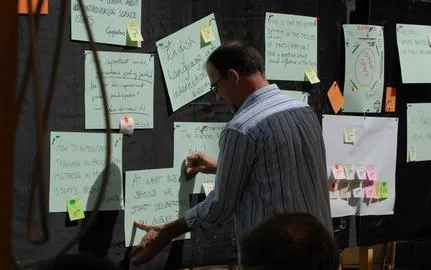
Self-organisation, however, does not happen in predictable stages. The interactions among agents in the system create unpredictable patterns that change over time. These patterns affect, in turn, how the agents interact with each other. This dual process brings the system into an uncertain future. Uncertainty in behaviour is an emerging feature of non-linear systems, due to the amplification of small differences in initial conditions that makes the future completely unpredictable.
In an increasingly complex world, human communities and organisations display many typical features of complex systems: open but permeable boundaries, non-linear interactions that amplify small differences and produce significant changes, and emerging structures that shape cultural habits and behaviours. In fact, human communities and organisations are complex, dynamic and non-linear systems.
But when making decisions, humans resist letting go of control and accepting uncertainty. Instead, when fearing uncertainty, the common response is more planning and control. This strategy presents many difficulties: too much planning and/or control makes people feel limited, conflicts increase, maintaining control is a huge waste of resources and energy, and more planning and control doesn't guarantee better decisions. The cost of reducing uncertainty is so high that it would be better to accept uncertainty and work with it.
Facilitators can help groups and organisations develop an appropriate response to the uncertainty of the system based on three possible strategies:
- Identify areas for self-organisation where creative responses are possible
- Identify areas for a rational approach and control
- Share the uncertainty and build confidence
When a group or organisation reaches a point of uncertainty, people begin to show their fear of the unexpected consequences that may occur, as well as the possible negative outcomes. In groups that value responsibility, the question of who will take responsibility if things go wrong is asked, but this question is not useful.
In a complex adaptive system, all agents are responsible for the information they share or hide and for their own actions, but they are not responsible for what happens next. Everyone has a great challenge and a great opportunity: to be honest and clear about their intentions, and to be open to constant feedback on what they do. There is no need to become paralysed or feel guilty about unfavourable outcomes over which nobody has control.
Collaborative governance and decision making
Your progress is saved in this browser. Register to save it on every device.
Text © IN.PACT partnership, shared under CC BY-SA 4.0. Images, videos and quoted works belong to their authors and are not covered by this licence unless stated.