Lesson 3 · Module 3
Art-based and somatic approaches
Explore music, dance, theatre, visual and land art, graphic facilitation and body-based exercises as ways to help groups connect and express what words cannot.
Art-based and somatic approaches in participatory facilitation serve to bridge power divides, access non-verbal knowledge, and foster authentic social change by moving beyond rational, position-based dialogue. These methods use creative processes, such as drawing, performance, music, and embodied movement, to help participants express "inexpressible" feelings, connect emotionally, and challenge traditional hierarchies where professional artists or researchers hold exclusive authority.
Art-based approaches transform facilitation by tapping into "right-brain" creativity to manage emotions, encourage authentic connections, and produce tangible artefacts that symbolise collective identity. By using materials like crayons, recycled items, or digital tools, facilitators create a "childlike" space of play that reduces anxiety and allows participants to contribute "pieces" of themselves, thereby enhancing engagement and comprehension of complex topics. These practices are particularly effective for marginalised groups, enabling them to co-create narratives, resist stereotypes, and act as co-researchers or co-authors who disseminate knowledge through powerful artistic outputs like murals, poetry, podcasts, videos or installations.
Somatic and embodied approaches focus on physical presence and sensory experience to deepen social connectedness and empower individuals to reclaim agency over their bodies and voices. By integrating performance, movement, and multi-sensory technologies, these methods allow participants to experience art and dialogue through the body, fostering a sense of co-presence and collective consciousness that verbal discussion alone may not achieve. This embodied participation is crucial for inclusive engagement, enabling people with visual impairments or those excluded from traditional discourse to interact meaningfully, co-design public spaces, and co-produce knowledge that drives development and social justice.
Art-based approaches
When people think of "art" they often imagine visual arts, such as drawing and painting. And indeed this is one of the primary ways that we embody the creative spirit, from prehistory and from our own early childhood. But there are infinite ways for humans to be artistic.
Many of these art forms can nurture the creative spirit, nourishing us and giving us energy to tackle the challenges of life. Many also lend themselves to lifting up our collective spirits and uniting us with each other so that we can accomplish our endeavours, including addressing social injustice and building resilient communities.
Let's explore a few of them, with examples for your inspiration and exploration.
Music and song
Singing is an ancient and almost universally accessible form of human expression. As a Zimbabwean proverb has it, "If you can walk you can dance, if you can talk you can sing." Singing alone can raise our spirits, and singing with others has a mysterious power to bond us. Community song circles, a part of many traditional cultures around the world, are re-igniting in communities across Europe and North America, where people take turns sharing songs (usually without additional accompaniment) that are easy to learn and fun to sing together. Larger community song gatherings, such as Village Fire in the US, are also becoming more common.
Watch a video from Village Fire 2018 made by participant Lyndsey Scott, who also hosts song circles online. The video shows song leader Annie Zylstra, who curates a collection of songs for community singing groups. It also includes, among others, vocal artist and activist Melanie DeMore, and Lisa Littlebird, who maintains an extensive song library.
Village Fire 2018, a community song gathering in the US, filmed by participant Lyndsey Scott.
Music is such a powerful art form for bringing people together and strengthening them that it has been at the heart of community building throughout history, and probably prehistory. Rhythmic music, like drumming, is common to all cultures on the planet, using a shared pulse or heartbeat for group entrainment. Many social change movements have relied on the power of music to align group members' hearts and minds. Just a few examples are African-American spirituals as a protest against slavery; nueva trova in Cuba; folk singer-songwriter Woody Guthrie; the songs of the Civil Rights era; a cappella group Sweet Honey in the Rock; the musician Milck, whose song I Can't Keep Quiet became an anthem of the 2017 women's march; protest songs like The Cutty Wren and The Diggers' Song; the bardic tradition as a form of resistance to political suppression; and anti-war songs from the 1960s through the present day.
I Can't Keep Quiet sung at the 2017 Women's March on Washington.
The Cutty Wren, one of the protest songs mentioned above.
The Diggers' Song, performed by Chumbawamba.
Dance
From our first steps, as little children, we humans dance. Dance can be highly choreographed and performed by trained experts, as a ballet, or it can be the most private, personal, spontaneous and direct expression of human emotions. We dance in sorrow and in celebration. We dance with partners, we dance alone, we dance at concerts, we dance with our communities in lines and in circles. In fact, circle dances, where there are no "partners" but instead dancers form a circle holding hands or with hands on each other's shoulders, are likely the oldest form of dance, and are still present in a modern form in communities around the globe.
Dance sometimes has a much deeper meaning than simply movement to music. It often plays an important role in rituals and special occasions, as well as being a way to disguise resistance. In Chile, women reclaimed the cueca, a wedding dance, as the cueca sola: they dance alone with photos of their disappeared husbands, sons, and fathers. The Paiute prophet Wovoka began the tradition of the Ghost Dance based on the belief that the community circle dance would bring the ancestors of indigenous people to help remove the white oppressors.
Cueca sola, canción de la esperanza (Cueca alone, dance of hope).
The Paiute prophet Wovoka and the Ghost Dance.
Capoeira is an Afro-Brazilian martial art that was developed by enslaved Africans in the 16th century as a way of practising fight techniques, disguised by music and dance. Watch the following video to have a sense of it:
Capoeira in Brazil.
Acting and theatre
Playing with masks, costumes, stories, and assumed characters is another art that may be as old as human culture. Watching people acting out a drama seems to fascinate us endlessly. While one form of this art has been commercialised via television and the film industry, acting on the stage is still popular. Moreover, theatre is a source of inexpensive community entertainment, with puppet shows, theatre improv, and amateur productions being favourite forms of "creating our own culture" in ecovillages and other intentional communities.
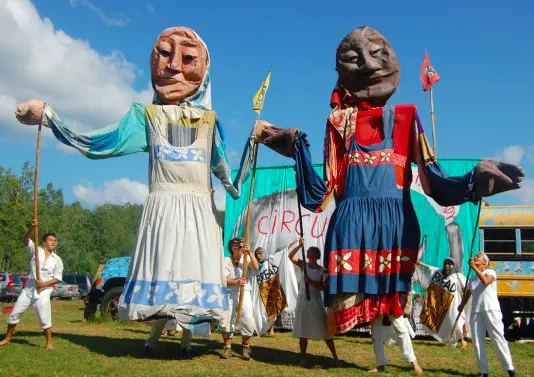
Theatre is often used by activist groups to give greater impact to their messages. Giant puppets and satirical outdoor "circus" performances to draw attention to political and social justice issues are the hallmark of Bread and Puppet and other similar troupes. Brazilian Augusto Boal's Theatre of the Oppressed aimed to expose systemic exploitation, restore dialogue, and involve spectators in rehearsing to take action in real life. Flash mobs, while popularly conceived as surprise choreographed dances (or musical pieces) designed to delight the unsuspecting public, can also be an organising tactic: dispersed, coordinated theatrical actions designed to disrupt or expose injustice.
Sculpture and architecture
The shapes that we make in space, to move among, to gaze at, to touch and to live within, shape us and our lives in return. Utilitarian objects such as chairs, tables and entire buildings can be made artistically, bringing us aesthetic pleasure and uplifting us as we interact with them. Anyone who has spent time in a strawbale house can attest to the way this natural wall material affects the feeling of being in the space.
Public sculpture projects such as the CowParade can bring greater visibility to local artists and raise funds for meeting local needs. On a greater scale, neighbourhoods or even whole towns can come together for Intersection Repair or City Repair, reclaiming public spaces through "placemaking": collaborative public street painting, natural building, mobile "teahouses" and ecological landscaping.
Watch City Repair founder Mark Lakeman on reclaiming the public commons:
City Repair founder Mark Lakeman on reclaiming the public commons (TEDxSantaCruz).
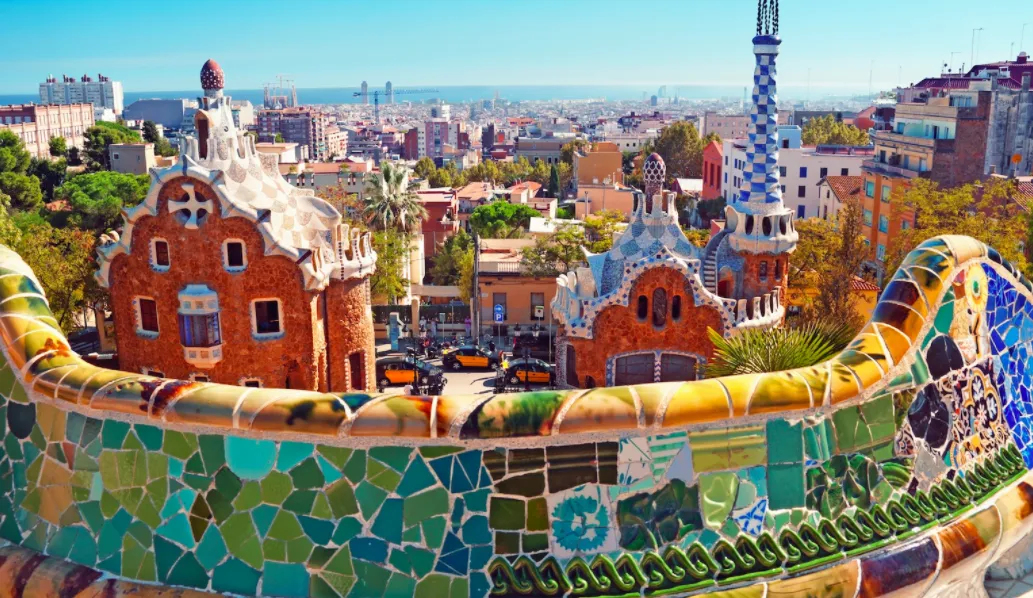
When we design the physical spaces that our families and communities will inhabit, we are making art as well as shelter. See the Shelter books by Lloyd Kahn, A Pattern Language by Christopher Alexander, the architecture of the ecovillage Auroville and the work of Antoni Gaudí in Barcelona, for just a few sources of inspiration.
Poetry
Poetry distils language into a sharp point, a feather, a gold nugget, a drop of water. The power of poetry to uplift us and connect us with the universal human experience is unmistakable. Although writing and reading poetry can be a solitary pursuit, writing workshops and regular neighbourhood writing groups can empower us to do more writing and to share our work with others, for mutual benefit.
Poetry can play a central role in bringing groups of people together. A poem can be displayed on the wall of the community centre, spoken at the beginning of shared meals and meetings, even included in our founding documents. It can also be a call to action; just a few poets whose poems have brought about a better world are Audre Lorde, Maya Angelou, Gary Snyder, Sappho, and Hanshan.
Essays, satire and fiction
Prose too, of course, can inspire change, illustrate new points of view, gather people around a cause, energise an issue with irony or humour and communicate a message to countless people at once. Some people whose mastery of these art forms has united a community or a movement include Thomas Paine, Jonathan Swift, Chinua Achebe, Wendell Berry, Alice Walker, Toni Morrison, Isabel Allende, Leon Trotsky and Mohandas Gandhi.
Broadcast and online media
We may not usually think of the mass media, such as television, radio, film, email, websites, mobile and social media, as art forms. Yet people are endlessly artistic, and these media have given artistically inclined people ever more ways to express themselves and communicate their ideas. From documentaries and biopics to viral TikTok dances that teens around the world record in their living rooms, the media is full of art.
Amy Goodman is the host and executive producer at Democracy Now! Watch how she uses the art of storytelling for social activism. Here she explains her vision for community-based journalism at the 2006 Bioneers Conference.
Amy Goodman on community-based journalism at the 2006 Bioneers Conference.
Some of this art is ephemeral, lasting only minutes, and some lasts for years and influences millions of people for better or worse, like the Nazi propaganda of Joseph Goebbels, the role of social media in the 2011 Arab Spring, the reporting and storytelling of Amy Goodman on Democracy Now! and the satirical comedy of Australian writer and performer Hannah Gadsby. (See Nanette and Douglas. Really, do.)
Trailer for Hannah Gadsby's Nanette (Netflix).
Trailer for Hannah Gadsby's Douglas (Netflix).
Nature as art
Environmental artists use materials directly from the earth to create their work. They paint, sculpt, and build in partnership with the systems, conditions, processes, and phenomena in the natural world, and often relate their art to social concerns. Leaves, branches, stones, ice, snow, growing plants, sand, and even moving water become pigment, clay and canvas.
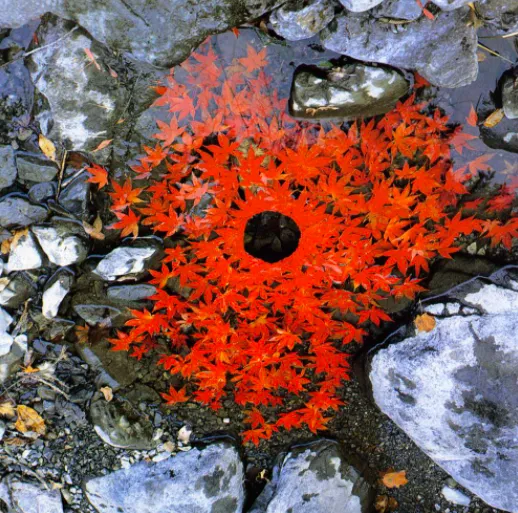
In creating land art, the artist avoids the world of galleries and commodification, since site-specific art resists exhibition and collection. In its urban form, environmental art can reintroduce natural elements or highlight pollution and decay. When it reflects an ethic of social justice or environmental sustainability, it is sometimes called ecological art or sustainable art, as in Beverly Naidus's Eden Reframed, in which a degraded site is remediated through permaculture design, mushrooms and plants, becoming an interactive exhibit that feeds visitors and shares their experiences in a "story hive".
Creative ideas
Designing for sustainability is largely a conceptual art form, as articulated by the American artist Solomon LeWitt. LeWitt believed the idea itself could be the work of art, and that an artist need not actually make the artwork; like an architect, they could conceive of the idea and then turn that idea over to others, who eventually produce it (source).
According to this theory, whether or not the designs that you and your groups create are implemented, creating the idea for a sustainable design is a work of art in itself. The design documents that are generated by a design team are in essence artefacts of the creative process. As artists conceiving of a world of thriving communities, we generate ideas that will have an effect on all of life. That said, we do need implementation of these ideas. Real-world examples, like successful projects and communities, have a powerful way of inspiring people to bring their own creative visions to life.
Damanhur: a community celebrating creative expression
Damanhur, a federation of communities in the alpine foothills north of Piedmont, Italy, is one example of a community design based on the arts and its intersection with spiritual, ecological, and regenerative values.
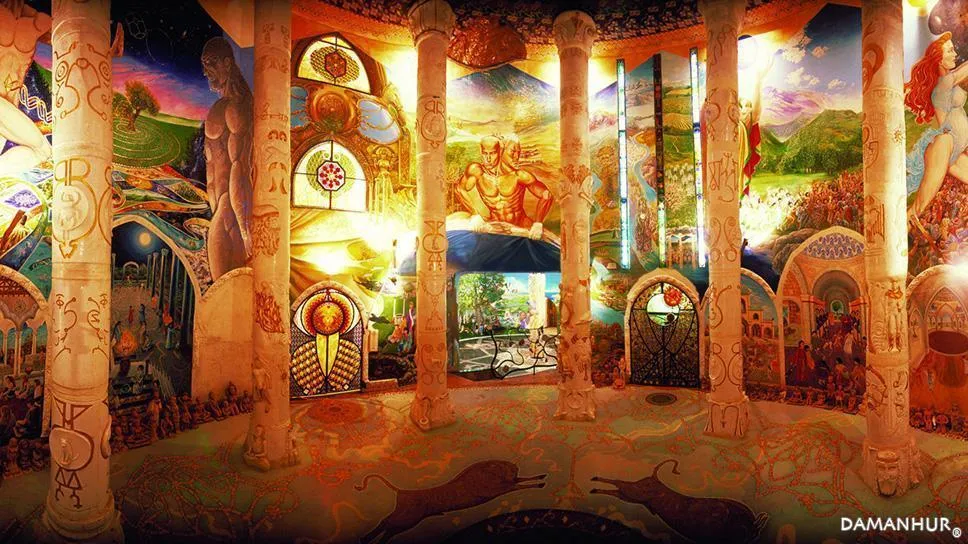
Damanhur, when looked at from a holistic perspective, may be considered a great work of art, a celebration of humanity.
Its citizens can be seen as living art in a spiritual community practice, each receiving the inspiration of others and, in turn, inspiring others. Each person is both the protagonist of the unfolding story, and the audience of the story they create together, depending on the context in which they are at a given moment. At Damanhur, the goal of creating art is to get in touch with one's dreams and images in order to tell a story of passion, commitment, joy and creativity, all played out on the edges of the relationship between the humans, the ecosystem they inhabit, and the other life forms and intelligent beings that surround them.
At Damanhur, everyone is encouraged to dream and express their creative side by making new works of art and experiences. This attitude has led to the creation of the unique Temples of Humankind.
The Temples are "exquisite works of art" that took years of creative energy and labour to create. It is an underground "complex of eight halls adorned with remarkable paintings, mosaics, sculptures and glass art – all created to celebrate universal spirituality".
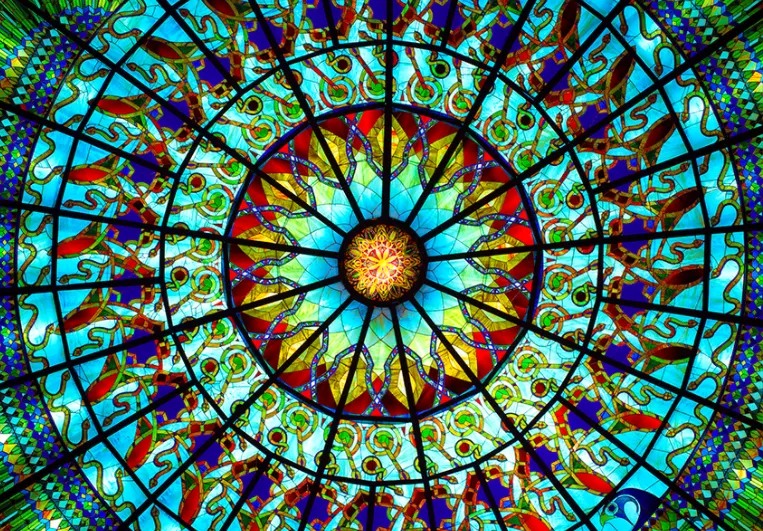
The Temples were constructed through the ingenuity and creativity of Damanhurians, who worked together to excavate the rock of a mountain entirely by hand. It is an "impossible" dream that awes and inspires thousands of visitors every year. The Temples are a stunning example of sacred and secular art coming together to resonate values that are important to the whole of humanity.
In the Temples, all community members have created original masterpieces. Individual talents and a collective vision converge and give rise to many works of art. In 2005, Damanhur received recognition from the United Nations Global Forum on Human Settlements as a model for a sustainable society.
Guests and visitors are welcome to participate with Damanhurians in the various art studios in creating collective works of art. This participation normally occurs during special events such as Midnight Action, as well as through the Damanhur Art School (see the Damanhur website).
Graphic facilitation: an artistic tool for more inclusive interactions
“A picture is worth a thousand words.” — Saying often attributed to Confucius
Graphic facilitation is a visual facilitation method that originated in the United States and translates ideas, discussions, and information into drawings, keywords, diagrams, pictograms, and structured layouts. It employs an artistic, pedagogical, and relational approach to foster collective understanding. Far from being reserved for people "who can draw", graphic facilitation is primarily based on the ability to make thought visible. Through simple shapes, symbols, colours, and clear visual organisation, it transforms sometimes abstract exchanges into concrete, accessible, and memorable materials.
A way to make interactions more inclusive
In groups, not everyone learns or retains information in the same way. Some people have a more auditory memory, while others need to manipulate, write, or see things to better understand. Graphic facilitation is particularly well suited to the needs of visual learners, for whom images facilitate comprehension and memorisation.
By making ideas visible in real time, it fosters greater participant inclusion, as everyone can follow the flow of the discussion thanks to clear visual cues: titles, arrows, drawings, keywords, mind maps, or timelines. This approach also helps reduce inequalities in access to information within a group. A complex explanation becomes more understandable when accompanied by a simple visual representation. This helps maintain attention, clarify proposals, and support everyone's participation.
Different practices
- Graphic recording: This practice takes place during events (conferences, round tables, etc.) where key messages and the speaker's remarks are translated live onto a large board.
- Group facilitation: A collective intelligence tool that uses visual elements to transcribe ideas generated during a group work session. It encourages reflection and interaction among participants.
- Sketchnoting: Taking notes for oneself, combining words and images.
- Visual mapping: Visually representing a summary of the information presented on a single sheet.
A particularly suitable support for young people
Graphic facilitation is also an excellent tool for supporting young people in their expression and concentration. Teenagers and young adults are often very receptive to visual and creative aids. Taking notes in the form of drawings, symbols, or diagrams makes the exercise more engaging and less academic. This allows them to:
- focus better during discussions;
- structure their ideas;
- retain important information more easily;
- express themselves in ways other than traditional writing;
- gain confidence in public speaking.
Drawing then becomes a tool for expression, even for young people who may struggle with traditional writing, verbal expression, or note-taking. This method also encourages active participation: instead of being mere spectators, participants become active contributors to the content creation.
More engaging and digestible summaries
One of the major advantages of graphic facilitation lies in the production of engaging, concise, and easily digestible visual summaries. A traditional report, often long and dense, can discourage reading. Conversely, a graphic summary allows you to get to the heart of the matter while preserving the richness of the discussions. The main ideas appear in a structured, hierarchical, and appealing way. This facilitates review, sharing, and internalisation of the content after a meeting, workshop, or training session. The final product becomes a dynamic, engaging, and easily shareable tool that values the group's contributions while encouraging further discussion.
Conclusion
Graphic facilitation is much more than a simple drawing tool: it is a lever for inclusion, participation, and retention. By harnessing visual intelligence, it makes communication more accessible, particularly for individuals and young people who learn best visually. It helps create more open, dynamic, and inclusive spaces for expression that better reflect the diversity of ways of thinking and learning.
More creative ideas to try
- Vision board: Create a collage using magazine clippings (images, words, colours) to represent your desires, your dreams, your identity or a group project. Materials: magazines, scissors, glue, paper or cardboard.
- Drawing to music. Principle: draw while listening to music. Instructions: "Draw what this music makes you feel." Objective: release emotions and bypass mental chatter.
- Collaborative mural. Principle: create large-scale artwork together on topics like "our vision of the future". Important rule: everyone contributes to a section. Benefits: cooperation, a sense of belonging, collective empowerment.
- Visual game: Use photos to explore a topic. Example: "Explain your biggest fear about adventure" and choose an image to help you in your paired discussion. Resource: the Dixit card game.
- Stop motion (mini creative film): Create a short video using objects, drawings, or characters. Materials: a smartphone and simple objects. Instructions: "Tell a story in 10–15 animated photos." Highly engaging group work that blends art and digital media.
- Life map or journey map: Represent your journey as a map or a path. Benefits: structuring your story, gaining perspective, valuing your experiences.
Somatic approaches
The somatic approach to facilitation involves integrating the body as a source of information, understanding, and expression in group processes. It allows us to go beyond "saying" to include "feeling" and "experiencing".
Examples of exercises
- Fluid debate: Positioning oneself in the space to answer questions. For example, to the question "How do I feel about this project?", participants position themselves in the room (near, far or in between).
- Mime: Using the body and postures to convey messages. One exercise is to create a weather report of how one feels by miming.
- Heart coherence: Practise synchronised breathing: 4 seconds inhale, 4 seconds hold, 4 seconds exhale. Use it before taking important decisions, for example.
- Quick body scan: Mentally scan the different parts of the body. You can put on some slow music. Observe the sensations. Objective: develop self-awareness.
Important notes
Art-based and somatic approaches
Your progress is saved in this browser. Register to save it on every device.
Text © IN.PACT partnership, shared under CC BY-SA 4.0. Images, videos and quoted works belong to their authors and are not covered by this licence unless stated.